
Polygala tenuifolia root extract,
does it really help with Improvement of memory, learning, and forgetfulness?
research showsBT-11 is a standardized root extract of Polygala tenuifolia. Two small double-blind RCTs were positive, but they came from the same research group, focused on the same proprietary ingredient, were short, and lack independent replication, placing the evidence at the bottom of C. It is not the unrelated drug also called BT-11 in inflammatory bowel disease research.
ads claimMarketing can connect traditional use for forgetfulness, acetylcholinesterase inhibition, and animal BDNF or neuroprotection findings to human memory improvement with generic Polygala capsules. Results from multi-herb formulas such as Guibi-tang or Ninjinyoeito are not evidence for Polygala alone.
Useful facts when choosing a product
- In Korea, crude root, powders, extracts, and individually recognized Polygala-root extract powder are distinct products with different extraction methods and marker profiles.
- The key human trials used the standardized proprietary ingredient BT-11 at about 300 mg/day, not ordinary Polygala tea.
- The supplier describes BT-11 as its proprietary ingredient, so the trial results cannot automatically be applied to other Polygala extracts.
- The cognitive-trial BT-11 is a standardized Polygala tenuifolia root extract and must not be confused with the unrelated BT-11 drug studied in inflammatory bowel disease.
- Polygala is often combined with other herbs in traditional formulas, so efficacy and adverse effects of formulas must be separated from Polygala alone.
Chamgap Semantic Classification Code
Candidate index · review held
S.polygala-tenuifolia-root-extract.UNK.memory-learning-and-forgetfulness.improve.placeboSupplements and nutraceuticals > Polygala tenuifolia root extract > Unknown > memory, learning, and forgetfulness > Improvement claim > Placebo
An automated migration candidate, not an issued permanent code; exact claim scope remains under review. This machine-generated migration candidate helps retrieval but is not a permanent assignment. The original verdict ID and URL remain authoritative.
What the research actually shows
Lee 2009 (PMID 19429065) identifies BT-11 as an extract of dried Polygala tenuifolia roots. The trial administered 300 mg/day for four weeks to healthy adults and reported placebo-adjusted improvement in K-CVLT immediate recall and SOPT errors. Most K-CVLT subtests improved in both groups, indicating a substantial practice effect. Shin 2009 (PMID 19699261) reported improved total CERAD and selected subtests in 28 BT-11 and 25 placebo participants, but follow-up was short. No adequately sized, long-term independent RCT was identified thereafter. An unrelated drug named BT-11 in inflammatory bowel disease must not be confused with this Polygala extract or misattributed to its evidence base.
Why this is classified as C (40)
Two direct RCTs rule out ? and D, but the same team, same proprietary ingredient, small samples, short duration, multiple tests, and absent independent replication place the evidence at the bottom of C with 40 points.
Counterpoint. An early positive signal remains for products matching BT-11 exactly, but it cannot be expanded to learning generally, dementia prevention, or daily functioning.
Rejudgment record. New verdict — Two small direct BT-11 RCTs recognized, but bottom-of-C because of the same team, one proprietary ingredient, and no independent replication
Cross-check — AI research and Codex final gate
Evidence Table
| Study | Design | Sample | Funding | Endpoint | Result | Weight |
|---|---|---|---|---|---|---|
| Lee et al. 2009 | Randomized double-blind placebo-controlled trial | Unknown; proprietary BT-11 ingredient | K-CVLT and SOPT | Immediate recall and SOPT errors improved versus placebo, but several K-CVLT scores improved in both groups. | Key | |
| Shin et al. 2009 | Randomized double-blind placebo-controlled trial | 53 | Unknown; proprietary BT-11 ingredient | CERAD and MMSE | Total CERAD and selected subtests improved more with BT-11, but follow-up was short. | Key |
| AHRQ review 2017 | Systematic review of cognitive-decline prevention | U.S. public agency | Long-term cognitive decline, MCI, and dementia | The elderly BT-11 trial was excluded for inadequate follow-up. | Boundary |
Receipt — 3 References
All 3 cited sources were verified for existence at the original page (as of 2026-07-17).
Final verification and publication gate: Codex · Evidence date: 2026-07-17 · Corrections: none
Cite this verdict
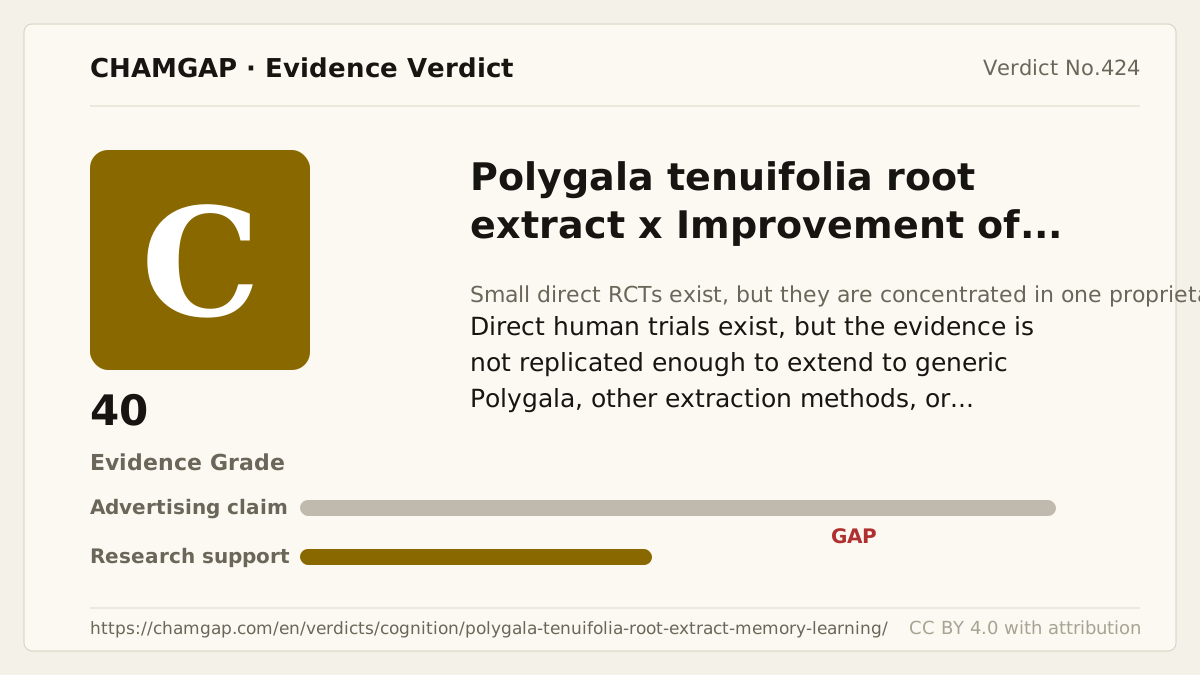
[Chamgap] Polygala tenuifolia root extract x memory, learning, and forgetfulness — Evidence Grade C·40. 3 cited sources checked. Source: https://chamgap.com/en/verdicts/cognition/polygala-tenuifolia-root-extract-memory-learning/ · CC BY 4.0CC BY 4.0 — free to use with attribution; do not distort grades, numbers, or verdict meaning.
What this document does and does not do
Chamgap is an information source. It reports what research has and has not confirmed; it does not tell readers what to take or buy. That decision belongs to readers and, when needed, medical or legal professionals. This verdict reflects literature available up to the search date and may change as new research appears. Nothing here is medical advice.