
Neumentix spearmint extract,
does it really help with Improvement of working memory and attention?
research showsNeumentix is a branded spearmint extract standardized for rosmarinic acid and total polyphenols. A 90-person trial found improvement in selected working-memory tasks with 900 mg/day, and a 142-person trial found improvement in selected sustained- and complex-attention tasks. Both positive trials tested the same Kemin ingredient, were company supported with several employee authors, and relied on selected scores from cognitive test batteries. With no independent replication or evidence for everyday function or cognitive disorders, the rating is C.
ads claimMarketing can expand the findings into immediate focus, removal of brain fog, or dementia prevention. The evidence concerns selected computerized cognitive-test scores after 90 days, not treatment of cognitive impairment or improvements in everyday function and long-term brain health.
Useful facts when choosing a product
- The study ingredient was Neumentix standardized to at least 24% total phenolics and at least 14.5% rosmarinic acid. It is not equivalent to ordinary spearmint tea or essential oil.
- The positive cognitive trials used 900 mg/day for 90 days. The 600-mg group in the working-memory trial did not show the same pivotal benefit.
- Formal Korean individually recognized health-functional-food status was not verified. Korean-language cross-border listings display combination products containing 900 mg Neumentix, which are not identical to the isolated study ingredient.
- No severe adverse events or meaningful laboratory differences appeared with 600 or 900 mg/day for 90 days, but the data are short term and manufacturer linked, and safety during pregnancy, lactation, or long-term high-dose use is not established.
Chamgap Semantic Classification Code
Candidate index · review held
S.high-polyphenol-spearmint-extract.UNK.working-memory-and-attention.improve.placeboSupplements and nutraceuticals > High-polyphenol spearmint extract > Unknown > working memory and attention > Improvement claim > Placebo
An automated migration candidate, not an issued permanent code; exact claim scope remains under review. This machine-generated migration candidate helps retrieval but is not a permanent assignment. The original verdict ID and URL remain authoritative.
What the research actually shows
The 2018 double-blind trial by Herrlinger randomized 90 adults aged 50 to 70 with age-associated memory impairment to 0, 600, or 900 mg/day. At day 90, the 900-mg group improved quality of working memory and spatial working-memory accuracy versus placebo, with borderline p values of 0.0469 and 0.0456; the 600-mg group did not show the same benefit. The 2019 Falcone trial gave 900 mg/day for 90 days to 142 healthy active adults and improved sustained attention and selected complex-attention tests, while mood, sleep, and quality of life did not differ. Both papers included multiple Kemin authors.
Why this is classified as C (48)
Placebo-controlled trials for working-memory and attention tasks justify the middle of C. All evidence is tied to a Kemin branded ingredient and company support, with borderline results, multiple cognitive tasks, no independent replication, and no everyday functional outcomes, supporting C with 48 points under the branded-ingredient ceiling.
Counterpoint. A small signal remains for selected working-memory and attention tests in healthy adults. This verdict does not extend to ordinary spearmint, immediate effects, or treatment of mild cognitive impairment or dementia.
Rejudgment record. New verdict — Placebo-controlled working-memory and attention trials are acknowledged, but all tested a Kemin branded ingredient with company involvement, selected positive outcomes among multiple cognitive tasks, no independent replication, and no everyday functional results, triggering the branded-ingredient ceiling
Sub-claim grades by effect
This ingredient is marketed for several effects. A single overall grade blends strong and weak claims together, so each effect is graded separately here. The overall grade reflects the strongest disconfirming or core claim.
| Effect (sub-claim) | Grade | Basis |
|---|---|---|
| Working-memory and attention tasks after 90 days in healthy adults | C | Selected tasks were positive in two trials, but both used the same manufacturer-specific ingredient and lack independent replication. |
| Treatment of mild cognitive impairment or dementia, or improvement in everyday cognitive function | ? | No human efficacy literature was found that permits judgment of patient-centered clinical outcomes or everyday functioning. |
Cross-check — AI research and Codex final gate
Evidence Table
| Study | Design | Sample | Funding | Endpoint | Result | Weight |
|---|---|---|---|---|---|---|
| Herrlinger KA et al. 2018 | Randomized double-blind placebo-controlled three-arm trial | 30 | Supported by Kemin Foods with multiple employee authors | CDR working memory, spatial working memory, other cognition, sleep, and mood | At 900 mg/day, quality of working memory improved 15% and spatial working-memory accuracy 9%, with p values of 0.0469 and 0.0456; 600 mg did not show the same benefit. | Key; manufacturer-linked |
| Falcone PH et al. 2019 | Randomized double-blind placebo-controlled parallel trial | n=142 | Kemin ingredient with multiple employee authors | Ten cognitive domains, sleep, mood, and quality of life | After 90 days at 900 mg/day, sustained attention and selected complex-attention tests improved, while sleep, mood, and quality of life did not differ. | Key; manufacturer-linked |
| Lasrado JA et al. 2017 | Safety and tolerability analysis from the same 90-day randomized trial | n=90 | Kemin Foods; multiple Kemin-affiliated authors | Adverse events, vital signs, hematology, chemistry, and hormones | No severe adverse events or significant between-group safety differences appeared with 600 or 900 mg/day. | Safety |
Receipt — 4 References
All 4 cited sources were verified for existence at the original page (as of 2026-07-18).
Final verification and publication gate: Codex · Evidence date: 2026-07-18 · Corrections: none
Cite this verdict
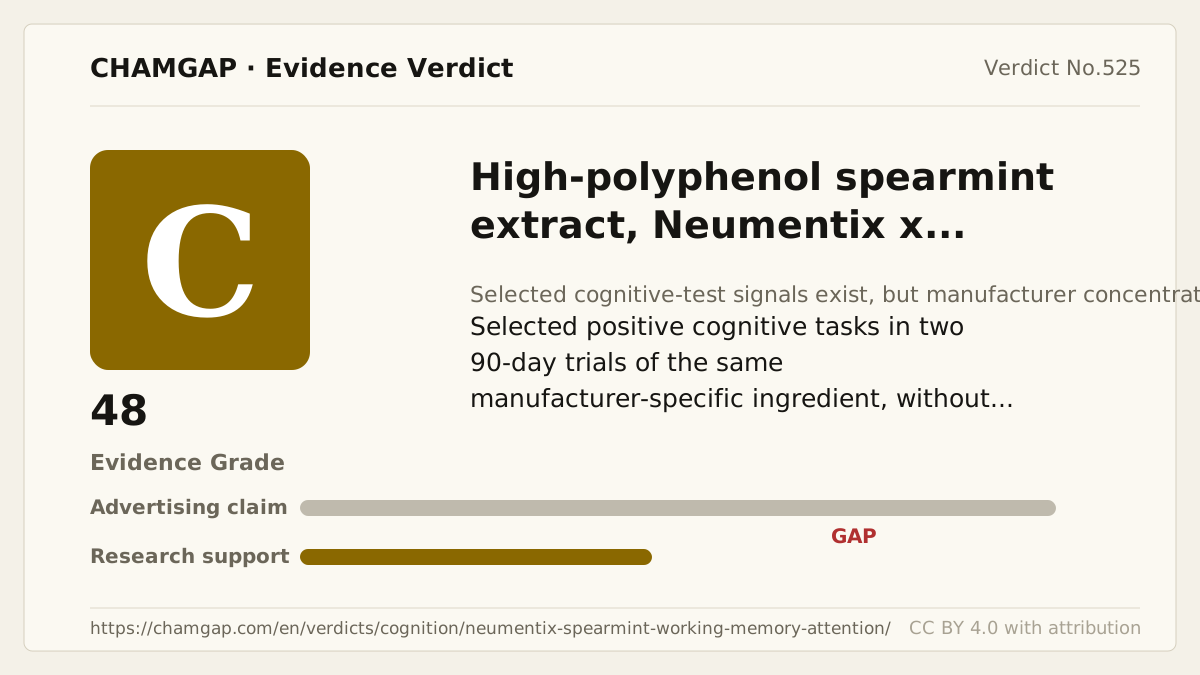
[Chamgap] Neumentix spearmint extract x working memory and attention — Evidence Grade C·48. 4 cited sources checked. Source: https://chamgap.com/en/verdicts/cognition/neumentix-spearmint-working-memory-attention/ · CC BY 4.0CC BY 4.0 — free to use with attribution; do not distort grades, numbers, or verdict meaning.
What this document does and does not do
Chamgap is an information source. It reports what research has and has not confirmed; it does not tell readers what to take or buy. That decision belongs to readers and, when needed, medical or legal professionals. This verdict reflects literature available up to the search date and may change as new research appears. Nothing here is medical advice.