
Marine-derived plasmalogens,
does it really help with Improved memory and global cognition in older adults with mild cognitive impairment?
research showsScallop- or ascidian-derived plasmalogen products are rated D for improving memory and global cognition in older adults with mild cognitive impairment. The pivotal 24-week trial randomized 328 participants and had 276 completers, but its overall intention-to-treat analysis found no significant between-group difference in the primary MMSE-J endpoint or in secondary outcomes including memory. Signals in women and participants younger than 77 years with mild Alzheimer disease were subgroup findings, not positive results in the full MCI population. A product-related society funded the trial and a donor company supplied material, while a separate 49-person ascidian-product trial used computerized tests in healthy middle-aged adults and cannot establish the target claim.
ads claimMarketing can expand subgroup and selected-memory-test signals into improved memory and global cognition for all older adults with MCI. The pivotal overall primary endpoint was null, and results from one scallop preparation cannot automatically be transferred to an ascidian ingredient or another branded finished product.
Useful facts when choosing a product
- Plasmalogens are ether-linked phospholipids, and scallop and ascidian sources can differ in species, extraction, and lipid composition and should not be treated as identical products.
- The pivotal trial used 1 mg per day of purified scallop-derived plasmalogen for 24 weeks, so its findings cannot be transferred automatically to another dose or multi-ingredient finished product.
- MCI has multiple causes, and progressive memory loss or changing daily function warrants cognitive assessment and evaluation of reversible causes rather than delayed care through supplement use.
- No severe adverse-event imbalance appeared in the trial, but sample size and duration are insufficient for long-term safety, and seafood allergy, contamination, and product-specific quality require separate review.
Chamgap Semantic Classification Code
Candidate index · review held
UNK.scallop-or-ascidian-derived-plasmalogens-in-finished-memory-products.UNK.memory-and-global-cognition-with-mild-cognitive-impairment.improve.placeboUnknown > Scallop- or ascidian-derived plasmalogens in finished memory products > Unknown > memory and global cognition with mild cognitive impairment > Improvement claim > Placebo
An automated migration candidate, not an issued permanent code; exact claim scope remains under review. This machine-generated migration candidate helps retrieval but is not a permanent assignment. The original verdict ID and URL remain authoritative.
What the research actually shows
Fujino 2017 randomized 328 adults aged 60 to 85 years with MMSE-J scores of 20 to 27 to scallop-derived plasmalogen 1 mg per day or placebo. Among 276 completers, the overall intention-to-treat analysis found no significant difference in MMSE-J, WMS-R, depression score, or other primary and secondary clinical outcomes. WMS-R differences appeared in subgroups of women and participants younger than 77 years with mild Alzheimer disease, not in the overall MCI group. Watanabe 2020 reported a Cognitrax composite-memory signal with an ascidian product in 49 healthy adults with a mean age near 46 years, but company-affiliated authors, small size, and a different population make it indirect.
Why this is classified as D (26)
The pivotal trial enrolled 328 participants and had 276 completers, with no significant overall MCI-group difference in the primary MMSE-J endpoint or the secondary WMS-R endpoint. Positive findings were concentrated in a mild-Alzheimer subgroup rather than the stated overall MCI effect. Product-related funding, patents, source-specific attribution limits, and a failed primary endpoint make C inappropriate and support D with 26 points; mild adverse events and limited long-term safety remain separate from efficacy.
Counterpoint. Subgroup signals can motivate an independent large MCI trial but cannot be treated as established benefit. Replication should use the same prespecified primary endpoint and analysis plan.
Rejudgment record. New verdict — Applied D because the multicenter trial enrolled 328 participants and had 276 completers but found no overall MCI-group difference in the primary MMSE-J or secondary WMS-R outcomes, while positive findings depended on mild-Alzheimer subgroups and selected domains without independent replication and with product-linked funding and patents
Sub-claim grades by effect
This ingredient is marketed for several effects. A single overall grade blends strong and weak claims together, so each effect is graded separately here. The overall grade reflects the strongest disconfirming or core claim.
| Effect (sub-claim) | Grade | Basis |
|---|---|---|
| Improved memory and global cognition in older adults with MCI | D | The pivotal overall primary MMSE-J and secondary memory endpoints showed no significant between-group difference. |
| Improvement in subgroups or selected memory domains | ? | Exploratory signals exist, but no evidence establishes a consistent prespecified human benefit. |
| Equivalent efficacy across scallop, ascidian, and all branded finished products | ? | No human evidence tests equivalence across sources, extraction methods, doses, and multi-ingredient products. |
Cross-check — AI research and Codex final gate
Evidence Table
| Study | Design | Sample | Funding | Endpoint | Result | Weight |
|---|---|---|---|---|---|---|
| Fujino T et al. 2017 | Twenty-four-week multicenter randomized double-blind placebo-controlled trial | 328 randomized; 276 completed treatment, with 140 active and 136 placebo participants | Japanese Plasmalogen Society; donor company B&S supplied active material and placebo; two authors had manufacturing-method patent applications | Primary MMSE-J; secondary WMS-R, GDS-S-J, and blood plasmalogens | The overall intention-to-treat analysis found no significant between-group difference in primary or secondary outcomes; positive findings were limited to mild-Alzheimer subgroups. | Pivotal direct randomized trial with a failed primary endpoint |
| Watanabe H et al. 2020 | Twelve-week randomized double-blind placebo-controlled trial | 49 healthy adults, with 25 active and 24 placebo participants | Reported no specific grant; principal authors were affiliated with ingredient, pharmaceutical, and clinical-research companies | Composite memory and other Cognitrax computerized cognitive measures | Composite-memory signals appeared at weeks 8 and 12, but this was a small ascidian-product trial in healthy adults averaging about 46 years of age. | Exploratory evidence indirect by product and population |
Receipt — 2 References
All 2 cited sources were verified for existence at the original page (as of 2026-07-19).
Final verification and publication gate: Codex · Evidence date: 2026-07-19 · Corrections: none
Cite this verdict
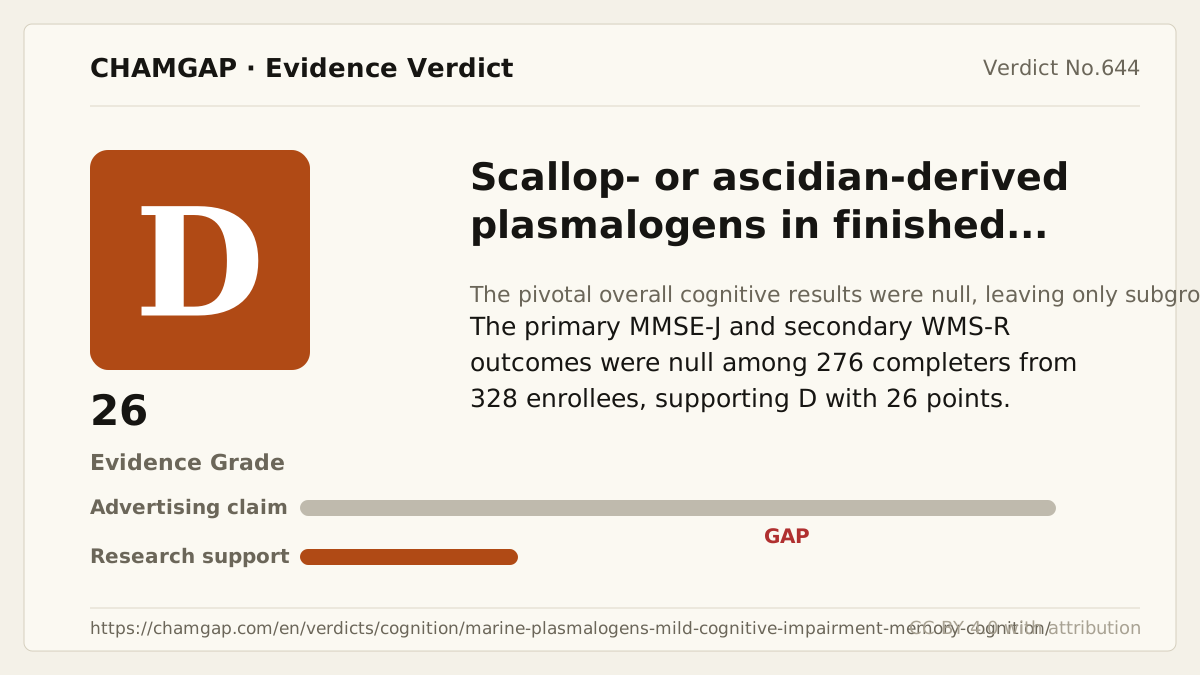
[Chamgap] Marine-derived plasmalogens x memory and global cognition in mild cognitive impairment — Evidence Grade D·26. 2 cited sources checked. Source: https://chamgap.com/en/verdicts/cognition/marine-plasmalogens-mild-cognitive-impairment-memory-cognition/ · CC BY 4.0CC BY 4.0 — free to use with attribution; do not distort grades, numbers, or verdict meaning.
What this document does and does not do
Chamgap is an information source. It reports what research has and has not confirmed; it does not tell readers what to take or buy. That decision belongs to readers and, when needed, medical or legal professionals. This verdict reflects literature available up to the search date and may change as new research appears. Nothing here is medical advice.