
Magnesium L-threonate,
does it really help with Memory, executive function, and increased brain magnesium?
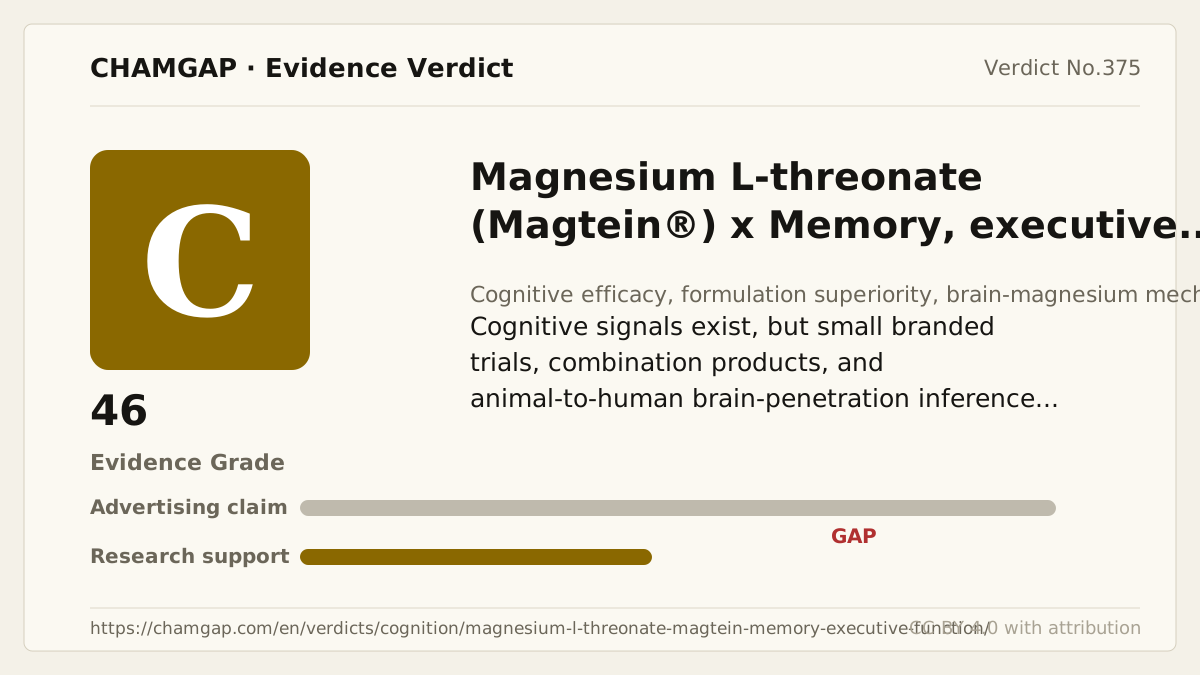
research showsA few Magtein®-related RCTs show memory and executive-function signals. Trials in 44 middle-aged or older adults with cognitive impairment and 100 adults with sleep dissatisfaction were positive, but both were funded by product developers or distributors and some outcomes were null. A 109-person trial used a combination with phosphatidylserine and vitamins C and D. Direct evidence that it raises human brain magnesium or outperforms other magnesium forms is not established, so the grade is C.
ads claimClaims that it crosses the blood-brain barrier or is better for the brain than other forms connect rodent brain or cerebrospinal-fluid measurements with human cognition trials. Direct human brain-magnesium elevation and comparative superiority were not demonstrated.
Useful facts when choosing a product
- Imported Magtein® products sold in Korea commonly list 2,000 mg/day of the compound, providing about 144-147 mg elemental magnesium.
- The 2,000 mg amount is not 2,000 mg of elemental magnesium; compound mass and elemental magnesium must be distinguished.
- Human cognition trials used 1-2 g/day for 30 days to 12 weeks.
- Kidney impairment and concurrent magnesium antacids or laxatives, certain antibiotics, and osteoporosis drugs require professional review.
Chamgap Semantic Classification Code
Candidate index · review held
UNK.magnesium-l-threonate.UNK.memory-executive-function-and-increased-brain-magnesium.increase.placeboUnknown > Magnesium L-threonate > Unknown > Memory, executive function, and increased brain magnesium > Increase claim > Placebo
An automated migration candidate, not an issued permanent code; exact claim scope remains under review. This machine-generated migration candidate helps retrieval but is not a permanent assignment. The original verdict ID and URL remain authoritative.
What the research actually shows
The Liu 2016 trial reported composite-cognition and TMT-B signals in 44 completers, but Neurocentria was involved in funding, analysis, and writing. The Threotech-funded Lopresti 2026 trial in 100 adults reported p=0.043 for the primary NIH Total Cognition outcome using prespecified one-tailed tests; Raven was p=0.953 and objective Oura sleep outcomes were null. The Zhang 2022 trial in 109 adults combined Magtein® with phospholipids and vitamins C and D, preventing standalone attribution. No human trial directly measured increased brain or cerebrospinal-fluid magnesium or compared superiority against another form matched for elemental magnesium. Animal brain-penetration findings do not establish human formulation superiority.
Why this is classified as C (46)
The cognition subclaim is C because standalone signals exist in the 44- and 100-person RCTs, but branded funding, one-tailed testing, null objective outcomes, and the 109-person combination trial are major limits. Brain superiority over other magnesium forms is unknown because human brain or cerebrospinal-fluid measurement and direct formulation comparison are absent. The overall verdict is C with 46 points.
Counterpoint. Animal brain penetration does not show that human brain or cerebrospinal-fluid magnesium rises or that this form outperforms other magnesium formulations. An independent three-arm trial comparing Magtein®, another form matched for elemental magnesium, and placebo with direct human brain or cerebrospinal-fluid measurement is needed.
Rejudgment record. Reassessment (cross-check reflected) — Applied C to signals in the 44- and 100-person cognition trials, unknown to unmeasured human brain or cerebrospinal-fluid elevation and formulation superiority, and excluded standalone attribution from the 109-person combination
Sub-claim grades by effect
This ingredient is marketed for several effects. A single overall grade blends strong and weak claims together, so each effect is graded separately here. The overall grade reflects the strongest disconfirming or core claim.
| Effect (sub-claim) | Grade | Basis |
|---|---|---|
| Cognition (memory and executive function) | C | Standalone signals in 44 and 100 participants, limited by branded funding, one-tailed testing, and selected null objective outcomes |
| Brain superiority over other magnesium forms | ? | No human brain or cerebrospinal-fluid increase measured and no direct comparison with another form matched for elemental magnesium |
Cross-check — AI research and Codex final gate
Evidence Table
| Study | Design | Sample | Funding | Endpoint | Result | Weight |
|---|---|---|---|---|---|---|
| Liu et al. (2016) | Twelve-week randomized double-blind placebo-controlled trial | 44 | Neurocentria involvement in funding, analysis, and writing | Composite cognition, TMT-B, memory, and sleep | Improved composite cognition and executive function; sleep and anxiety were indeterminate because of placebo effects | Key |
| Zhang et al. (2022) | Thirty-day double-blind placebo-controlled trial | 109 | Magtein®PS branded combination product | Clinical Memory Test | Improved all memory subscales; combined phosphatidylserine and vitamins C and D | Supportive |
| Lopresti and Smith (2026) | Six-week randomized double-blind placebo-controlled trial | 100 | Threotech funded the study, supplied the product, and contributed to study-design conceptualization | Primary NIH Total Cognition, Raven reasoning, reaction time, and objective Oura sleep | NIH Total Cognition p=0.043 with prespecified one-tailed testing; Raven p=0.953 and objective Oura sleep outcomes were null | Key |
Receipt — 3 References
All 3 cited sources were verified for existence at the original page (as of 2026-07-16).
Final verification and publication gate: Codex · Evidence date: 2026-07-16 · Corrections: none
Cite this verdict
[Chamgap] Magnesium L-threonate (Magtein®) x memory, executive function, and brain magnesium — Evidence Grade C·46. 3 cited sources checked. Source: https://chamgap.com/en/verdicts/cognition/magnesium-l-threonate-magtein-memory-executive-function/ · CC BY 4.0CC BY 4.0 — free to use with attribution; do not distort grades, numbers, or verdict meaning.
What this document does and does not do
Chamgap is an information source. It reports what research has and has not confirmed; it does not tell readers what to take or buy. That decision belongs to readers and, when needed, medical or legal professionals. This verdict reflects literature available up to the search date and may change as new research appears. Nothing here is medical advice.