
Donepezil,
does it really help with Prevention of progression from mild cognitive impairment to Alzheimer disease?
research showsOnly one long-term 769-participant trial directly assessed progression from mild cognitive impairment to Alzheimer disease; the three-year HR was 0.80 (95% CI 0.57 to 1.13). It allows a 43% risk reduction, and the first year showed a positive signal, HR 0.42 (0.24 to 0.76). Because clinically meaningful benefit is not excluded, the grade is D with 30 points, not F.
ads claimPromotion or informal advice can merge early use of a memory medicine with prevention of dementia. Possible temporary symptomatic benefit in established Alzheimer dementia does not mean prevention of disease onset at the MCI stage, and a first-year signal does not erase failure at three years.
Useful facts when choosing a product
- Donepezil is a prescription acetylcholinesterase inhibitor officially indicated for treatment of dementia of the Alzheimer type. Prevention of progression from MCI to Alzheimer disease is not an authorized indication.
- For Alzheimer dementia, treatment commonly starts at 5 mg once daily with later titration according to tolerability. Dose and titration should follow the product label and prescription, and the medicine should not be self-used for prevention.
- Common adverse effects include nausea, diarrhea, vomiting, reduced appetite, insomnia, fatigue, and muscle cramps. Weight loss can occur and deserves monitoring in older or low-weight patients.
- Vagotonic effects can cause bradycardia, heart block, and syncope, and gastrointestinal bleeding risk also warrants consideration. A history of falls or syncope, conduction disease, or concurrent heart-rate-lowering medicines should be reviewed before prescribing.
Chamgap Semantic Classification Code
Candidate index · review held
M.donepezil.UNK.progression-from-mild-cognitive-impairment-to-alzheimer-disease.prevent.placeboMedicinal interventions > Donepezil > Unknown > progression from mild cognitive impairment to Alzheimer disease > Occurrence-prevention claim > Placebo
An automated migration candidate, not an issued permanent code; exact claim scope remains under review. This machine-generated migration candidate helps retrieval but is not a permanent assignment. The original verdict ID and URL remain authoritative.
What the research actually shows
The ADCS trial randomized 769 adults with amnestic MCI to vitamin E, donepezil 10 mg, or placebo and followed possible or probable Alzheimer disease diagnoses for three years. The overall donepezil hazard ratio of 0.80 was not significant, although progression was lower during the first 12 months. A donepezil-specific Cochrane review assessed the key randomized trials and found small short-term cognitive signals and more adverse effects but no evidence of delayed progression to Alzheimer disease. The AAN MCI guideline summarized no cognitive or dementia-progression benefit from cholinesterase inhibitors. The FDA label identifies donepezil as treatment for dementia of the Alzheimer type but does not authorize MCI prevention, and this is a different axis from disease-progression therapies for biomarker-confirmed early Alzheimer disease such as lecanemab.
Why this is classified as D (30)
Only one long-term 769-participant trial directly assessed progression from mild cognitive impairment to Alzheimer disease; the three-year HR was 0.80 (95% CI 0.57 to 1.13). It allows a 43% risk reduction, and the first year showed a positive signal, HR 0.42 (0.24 to 0.76). Because clinically meaningful benefit is not excluded, the grade is D with 30 points, not F.
Counterpoint. MCI has heterogeneous causes, so depression, sleep apnea, hearing, thyroid status, vitamin B12, anticholinergic medicine burden, and vascular risk deserve assessment before treatment. Exercise, cognitive and social activity, and hearing correction can be discussed on their separate evidence and individual context. Grade-independent note: AAN guidance notes the unapproved use and insufficient evidence. This recommendation is not used to determine the efficacy grade.
Rejudgment record. New verdict — Only one long-term 769-participant trial directly assessed progression from mild cognitive impairment to Alzheimer disease; the three-year HR was 0.80 (95% CI 0.57 to 1.13). It allows a 43% risk reduction, and the first year showed a positive signal, HR 0.42 (0.24 to 0.76). Because clinically meaningful benefit is not excluded, the grade is D with 30 points, not F.
Sub-claim grades by effect
This ingredient is marketed for several effects. A single overall grade blends strong and weak claims together, so each effect is graded separately here. The overall grade reflects the strongest disconfirming or core claim.
| Effect (sub-claim) | Grade | Basis |
|---|---|---|
| Prevention of progression from MCI to Alzheimer disease | D | The direct three-year conversion trial was negative, and Cochrane and AAN do not support preventive efficacy. |
| Symptomatic treatment of established dementia of the Alzheimer type | D | Evidence supports small short-term symptomatic cognitive and functional benefit, but this is separate from disease modification or MCI prevention. |
| Transient delay of MCI progression during the first 12 months | D | This was a time-window signal in one large trial and did not persist through the full three-year result, so it is capped at C. |
Cross-check — AI research and Codex final gate
Evidence Table
| Study | Design | Sample | Funding | Endpoint | Result | Weight |
|---|---|---|---|---|---|---|
| Petersen RC et al. ADCS MCI trial, 2005 | Three-year multicenter randomized double-blind placebo-controlled trial | 769 adults with amnestic MCI at 69 sites | Fifty percent from NIA and fifty percent from Pfizer and Eisai | Progression to possible or probable Alzheimer disease | The three-year donepezil-versus-placebo HR was 0.80 (95% CI 0.57 to 1.13; P=0.42), with only a transient first-year difference. | Pivotal large direct long-term refutation |
| Birks J and Flicker L. Cochrane review, 2006 | Systematic review of randomized donepezil trials in MCI | Two pivotal double-blind randomized trials | Academic Cochrane review | Cognition, global status, progression to Alzheimer disease, and adverse events | Beyond minor short-lived cognitive signals, there was no evidence of delayed progression and adverse effects were more frequent. | Independent synthesized refutation |
| Petersen RC et al. AAN MCI guideline, 2018 | Evidence-based clinical practice guideline | Synthesis of pharmacologic and nonpharmacologic MCI evidence | American Academy of Neurology | Cognition and progression from MCI to dementia | It found no high-quality drug evidence and required disclosure that cholinesterase inhibitors are off-label and unsupported. | Guideline opposition and scope confirmation |
Receipt — 4 References
All 4 cited sources were verified for existence at the original page (as of 2026-07-19).
Final verification and publication gate: Codex · Evidence date: 2026-07-19 · Corrections: none
Cite this verdict
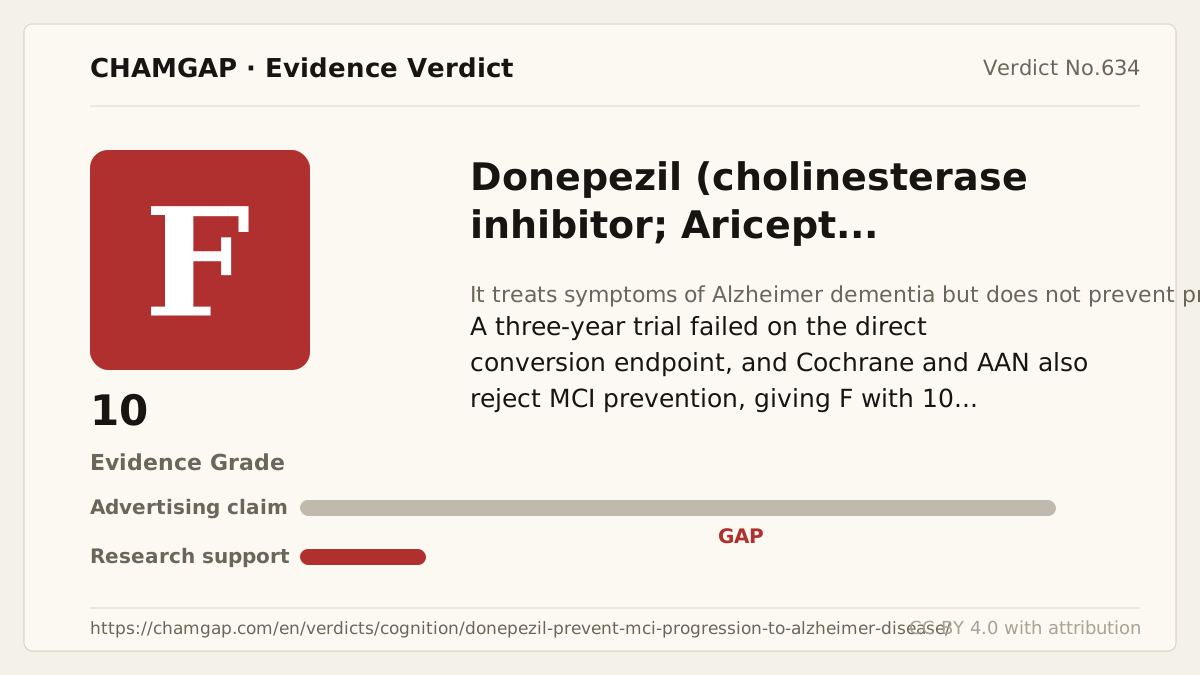
[Chamgap] Donepezil x prevention of progression from mild cognitive impairment to Alzheimer disease — Evidence Grade D·30. 4 cited sources checked. Source: https://chamgap.com/en/verdicts/cognition/donepezil-prevent-mci-progression-to-alzheimer-disease/ · CC BY 4.0CC BY 4.0 — free to use with attribution; do not distort grades, numbers, or verdict meaning.
What this document does and does not do
Chamgap is an information source. It reports what research has and has not confirmed; it does not tell readers what to take or buy. That decision belongs to readers and, when needed, medical or legal professionals. This verdict reflects literature available up to the search date and may change as new research appears. Nothing here is medical advice.