
Dihydroberberine,
does it really help with Improved postprandial glucose, insulin, and HbA1c?
research showsNo completed, published human efficacy trial was identified that tested dihydroberberine itself for postprandial glucose, insulin sensitivity, or HbA1c in patients or people with prediabetes, so the grade is ?. The only published direct human evidence is an absorption crossover study in five healthy men. It reported greater plasma berberine exposure after 100 or 200 mg DHB, but glucose and insulin did not differ among conditions. Greater absorption and the efficacy literature for ordinary berberine cannot substitute for target efficacy evidence on DHB.
ads claimMarketing converts better absorption into claims that a lower dose improves glucose and HbA1c more effectively. Pharmacokinetic exposure does not automatically prove efficacy or safety, and the five-man study was not a diabetes-treatment trial.
Useful facts when choosing a product
- GlucoVantage is a proprietary DHB ingredient made with a patented process. Korean consumers mainly encounter it in imported or direct-import single-ingredient or combination capsules; no DHB product approved in Korea as a diabetes medicine was identified.
- The only published human study tested 100 mg and 200 mg DHB as separate single-capsule conditions and administered four total doses from the day before through the study morning.
- Commercial products may provide 100 to 200 mg per dose or combine DHB with other glucose-oriented ingredients, but no research dose has been validated for HbA1c improvement.
- Long-term safety and coadministration data with diabetes drugs are lacking. Hypoglycemia cannot be excluded when combined with glucose-lowering medication, and use should be avoided or discussed with a clinician during pregnancy or lactation and in liver or kidney disease.
Chamgap Semantic Classification Code
Candidate index · review held
UNK.dihydroberberine.UNK.postprandial-glucose-insulin-and-hba1c.improve.placeboUnknown > Dihydroberberine > Unknown > postprandial glucose, insulin, and HbA1c > Improvement claim > Placebo
An automated migration candidate, not an issued permanent code; exact claim scope remains under review. This machine-generated migration candidate helps retrieval but is not a permanent assignment. The original verdict ID and URL remain authoritative.
What the research actually shows
Kazmierczak and colleagues crossed five healthy young men among four conditions, administered four doses, and measured plasma berberine concentrations, capillary glucose, and insulin for two hours after the final dose. DHB 100 and 200 mg produced greater plasma berberine exposure than berberine 500 mg, but glucose and insulin did not differ significantly, and the authors called for efficacy studies in overweight and glucose-intolerant populations. NCT07322679 was registered to evaluate 12 weeks of GlucoVantage on mixed-meal glucose and insulin and HbA1c in healthy adults, but no completed published results were identified by the verification date. Cell and animal mechanisms and randomized trials of ordinary berberine are not direct clinical efficacy data for DHB.
Why this is classified as ?
A human absorption study exists, but it was not a target efficacy trial and glucose and insulin were null. A registered study has no published results, and ordinary berberine evidence cannot be transferred to a distinct compound. The absence-of-target-human-efficacy rule therefore gives ? with a null score. Product variation and uncertain long-term safety are recorded separately.
Counterpoint. A completed independent trial directly improving postprandial glucose, HbA1c, or insulin sensitivity could support reassessment. Greater bioavailability alone cannot establish benefit now.
Rejudgment record. New verdict — Only a manufacturer-funded absorption study in five healthy men exists, with no completed published DHB human efficacy trial of postprandial glucose, HbA1c, or insulin sensitivity, and ordinary berberine evidence was not transferred
Sub-claim grades by effect
This ingredient is marketed for several effects. A single overall grade blends strong and weak claims together, so each effect is graded separately here. The overall grade reflects the strongest disconfirming or core claim.
| Effect (sub-claim) | Grade | Basis |
|---|---|---|
| Improved postprandial glucose | ? | No completed published DHB human trial has evaluated efficacy with meal testing or continuous glucose monitoring in patients or people with prediabetes. |
| Improved HbA1c | ? | No completed published human efficacy trial has reported HbA1c after months of DHB administration. |
| Improved insulin or insulin sensitivity | ? | Insulin did not differ in the five-man absorption study, and no efficacy trial using HOMA-IR, a clamp, or a comparable measure exists. |
Cross-check — AI research and Codex final gate
Evidence Table
| Study | Design | Sample | Funding | Endpoint | Result | Weight |
|---|---|---|---|---|---|---|
| Kazmierczak KL et al. 2022 | Randomized double-blind placebo-controlled four-condition crossover pharmacokinetic pilot | Five healthy men | Funded by NNB Nutrition, which supplied GlucoVantage | Plasma berberine concentration, capillary glucose, and insulin | DHB 100 and 200 mg increased plasma berberine exposure, but glucose (p=0.97) and insulin (p=0.24) did not differ among conditions. | Not efficacy evidence and not a validated efficacy surrogate |
| ClinicalTrials.gov NCT07322679 | Registered randomized double-blind placebo-controlled 12-week trial | Target enrollment of 120 healthy adults; results unpublished | Registered as industry-funded and using GlucoVantage | Mixed-meal glucose and insulin, HbA1c, and body composition | No completed peer-reviewed published results were identified by the verification date. | Ongoing and not efficacy evidence |
| Zhang C et al. 2026 | Cell and animal mechanistic study | No human participants | Reported academic and regional research support | Islet-cell insulin secretion and glucokinase mechanisms | Proposed DHB mechanisms but did not test human postprandial glucose or HbA1c efficacy. | Preclinical context |
Receipt — 3 References
All 3 cited sources were verified for existence at the original page (as of 2026-07-18).
Final verification and publication gate: Codex · Evidence date: 2026-07-18 · Corrections: none
Cite this verdict
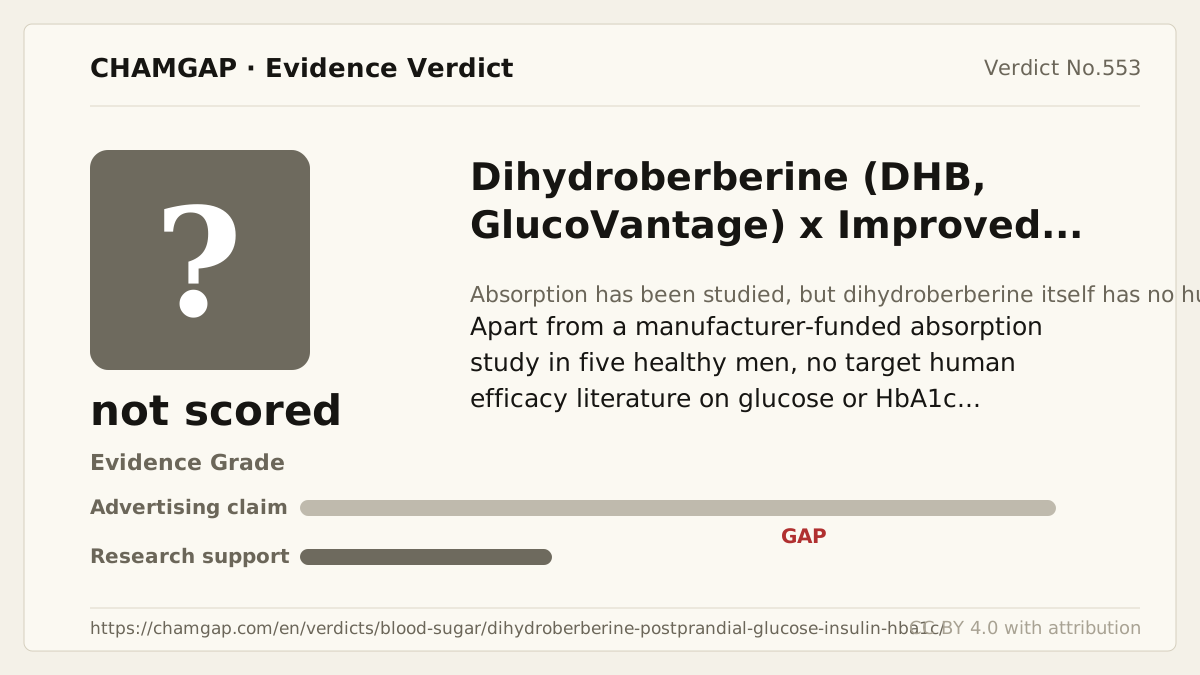
[Chamgap] Dihydroberberine x improved postprandial glucose, insulin, and HbA1c — Evidence Grade ?. 3 cited sources checked. Source: https://chamgap.com/en/verdicts/blood-sugar/dihydroberberine-postprandial-glucose-insulin-hba1c/ · CC BY 4.0CC BY 4.0 — free to use with attribution; do not distort grades, numbers, or verdict meaning.
What this document does and does not do
Chamgap is an information source. It reports what research has and has not confirmed; it does not tell readers what to take or buy. That decision belongs to readers and, when needed, medical or legal professionals. This verdict reflects literature available up to the search date and may change as new research appears. Nothing here is medical advice.