
Sea buckthorn berry oil,
does it really help with Relief of postmenopausal vaginal dryness and mucosal atrophy symptoms?
research showsTwo controlled trials that assessed symptoms repeatedly found no between-group benefit for vaginal dryness. In an RCT of 116 postmenopausal women, vaginal dryness, burning, and itching were all null; the vaginal health index had p=.08, vaginal pH p=1.00, and moisture p=.62, while the only positive finding was epithelial integrity, a partial surrogate. A subsequent RCT in 40 women also found no between-group difference in any vaginal symptom, including p=.484 for dryness. Both trials used manufacturer-linked blends of fruit and seed oils, so direct symptom efficacy receives grade D.
ads claimClaims that omega-7 regenerates vaginal mucosa or resolves menopausal vaginal dryness convert one epithelial-integrity surrogate into direct symptom efficacy. Ocular and skin-moisturizing studies, as well as the skin and blood findings from the same trial, cannot be repurposed as evidence for vaginal dryness.
Useful facts when choosing a product
- Online and cross-border products in South Korea are commonly sold as sea buckthorn berry oil or omega-7 softgels.
- Both direct RCTs used manufacturer-linked fruit-plus-seed oil blends rather than isolated berry oil.
- The key 116-person trial used 3 g/day, while the 40-person follow-up used an Omegia blend capsule for 12 weeks, so composition and dose may differ from ordinary products.
- Vaginal bleeding, pain, or recurrent infection should prompt clinical evaluation rather than self-treatment with a supplement.
Chamgap Semantic Classification Code
Candidate index · review held
UNK.sea-buckthorn-berry-oil.vaginal.postmenopausal-vaginal-dryness-and-mucosal-atrophy-symptoms.relieve.placeboUnknown > Sea buckthorn berry oil > Vaginal > postmenopausal vaginal dryness and mucosal atrophy symptoms > Symptom-relief claim > Placebo
An automated migration candidate, not an issued permanent code; exact claim scope remains under review. This machine-generated migration candidate helps retrieval but is not a permanent assignment. The original verdict ID and URL remain authoritative.
What the research actually shows
The 2014 Larmo trial randomized 116 postmenopausal women with vaginal dryness, itching, or burning to 3 g/day of a standardized fruit-plus-seed oil blend or placebo for three months, and 98 completed the study. Improvement rates for dryness, burning, and itching did not differ significantly between groups; the vaginal health index had p=.08, pH p=1.00, and moisture p=.62. Epithelial integrity was positive in the full assigned analysis with an odds ratio of 3.1, but the 95% confidence interval in the compliant-only analysis was 0.99-8.35. The 2024 Chan trial was a manufacturer-supported multi-endpoint study that randomized 40 women over age 45 to a fruit-plus-seed oil blend or placebo. Vaginal dryness had a between-group p=.484, and itching, redness, discharge, odor, infection, pain, and dysuria were also all null between groups.
Why this is classified as D (30)
Dryness, burning, and itching were null in the 116-person RCT, and the subsequent 40-person RCT was null for all vaginal symptoms, including p=.484 for dryness. Although a partial surrogate signal for epithelial integrity exists, both studies used manufacturer-linked oil blends and lack large independent replication. Repeated null direct-symptom findings therefore result in D with 30 points, while the absence of repeated large independent disproof precludes F.
Counterpoint. The partial epithelial-integrity signal requires a large manufacturer-independent trial with vaginal dryness prespecified as the primary endpoint.
Rejudgment record. Reassessment (cross-check reflected) — Dryness, burning, and itching were null in the 116-person RCT and every vaginal symptom was null between groups in the 40-person RCT; the only positive was a partial epithelial-integrity surrogate, and both trials used manufacturer-linked oil blends
Sub-claim grades by effect
This ingredient is marketed for several effects. A single overall grade blends strong and weak claims together, so each effect is graded separately here. The overall grade reflects the strongest disconfirming or core claim.
| Effect (sub-claim) | Grade | Basis |
|---|---|---|
| Relief of postmenopausal vaginal dryness and vaginal symptoms | D | Dryness, burning, and itching were null in the 116-person RCT, and all vaginal symptoms were null between groups in the 40-person RCT |
| Clinical improvement of vaginal mucosal atrophy | D | Epithelial integrity showed a partial surrogate signal, but the vaginal health index, pH, moisture, and direct symptoms were null |
Cross-check — AI research and Codex final gate
Evidence Table
| Study | Design | Sample | Funding | Endpoint | Result | Weight |
|---|---|---|---|---|---|---|
| Larmo PS et al. 2014 | Randomized double-blind placebo-controlled trial | 98 | Supported by Aromtech and Tekes, with a manufacturer-employee author | Vaginal dryness, burning, itching, vaginal health index, pH, moisture, and epithelial integrity | All direct symptoms were null between groups; the vaginal health index had p=.08, pH p=1.00, and moisture p=.62. Only epithelial integrity was positive in the full assigned analysis, with a compliant-only 95% confidence interval of 0.99-8.35. | Key |
| Chan LP et al. 2024 | Randomized double-blind placebo-controlled multi-endpoint trial | 40 | Funded by Puredia, which also provided the ingredient | Skin, blood, ocular outcomes, and questionnaire-based vaginal symptoms | The between-group p-value for vaginal dryness was .484; itching, redness, discharge, odor, infection, pain, and dysuria were also all null between groups. | Key |
Receipt — 2 References
All 2 cited sources were verified for existence at the original page (as of 2026-07-17).
Final verification and publication gate: Codex · Evidence date: 2026-07-17 · Corrections: none
Cite this verdict
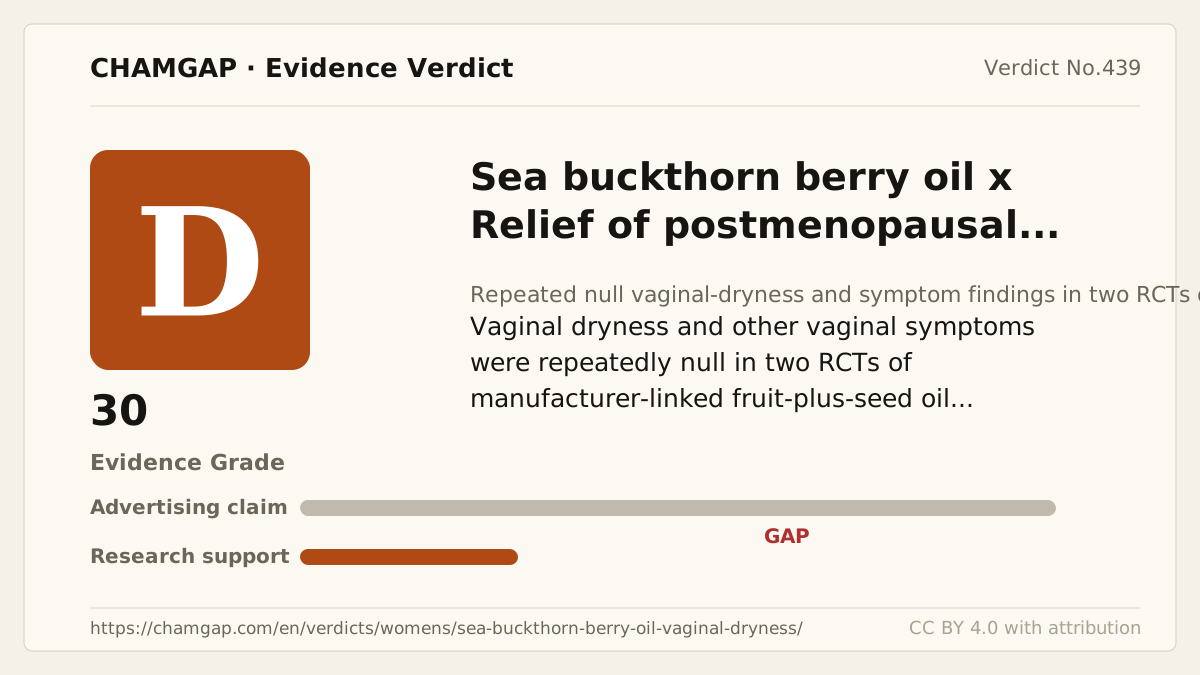
[Chamgap] Sea buckthorn berry oil x postmenopausal vaginal dryness and mucosal atrophy symptoms — Evidence Grade D·30. 2 cited sources checked. Source: https://chamgap.com/en/verdicts/womens/sea-buckthorn-berry-oil-vaginal-dryness/ · CC BY 4.0CC BY 4.0 — free to use with attribution; do not distort grades, numbers, or verdict meaning.
What this document does and does not do
Chamgap is an information source. It reports what research has and has not confirmed; it does not tell readers what to take or buy. That decision belongs to readers and, when needed, medical or legal professionals. This verdict reflects literature available up to the search date and may change as new research appears. Nothing here is medical advice.