
S-equol,
does it really help with Relief of menopausal hot flashes, sleep disturbance, and muscle pain?
research showsA placebo-controlled trial of a finished S-equol product at 10 mg/day improved hot-flash frequency and neck or shoulder stiffness. However, only 126 participants completed the trial, the population was limited to Japanese postmenopausal equol nonproducers, and the evidence is concentrated around the SE5-OH product and Otsuka-related research. Sleep improvement comes mainly from an open-label consumer-use survey rather than a confirmatory trial. The claim is therefore graded C and should not be presented as personalized hormone replacement.
ads claimPhrases such as replacing a hormone metabolite the body cannot make, personalized hormone balance, or solving hot flashes, insomnia, and pain together overstate the evidence. Equol-producer status is a gut-microbial trait, not proof that supplementation is equivalent to hormone therapy or corrects a personal hormone deficiency.
Useful facts when choosing a product
- Finished S-equol products, including Equelle marketed by Korea Otsuka Pharmaceutical, are sold in Korea, with products providing 10 mg/day identified.
- The key trial used 10 mg/day of the natural S-equol finished product SE5-OH for 12 weeks.
- General soy isoflavones, endogenous equol-producer status, and direct finished S-equol products are distinct exposures.
- Professional review is appropriate for soy allergy, a history of estrogen-sensitive disease, pregnancy or lactation, or concurrent hormone treatment.
Chamgap Semantic Classification Code
Candidate index · review held
UNK.s-equol.UNK.menopausal-hot-flashes-sleep-disturbance-and-muscle-pain.relieve.placeboUnknown > S-equol > Unknown > menopausal hot flashes, sleep disturbance, and muscle pain > Symptom-relief claim > Placebo
An automated migration candidate, not an issued permanent code; exact claim scope remains under review. This machine-generated migration candidate helps retrieval but is not a permanent assignment. The original verdict ID and URL remain authoritative.
What the research actually shows
The Aso 2012 multicenter double-blind trial randomized 160 Japanese postmenopausal equol nonproducers with hot flashes to S-equol 10 mg/day or placebo; 126 completed. At week 12, hot-flash frequency fell by 1.9 versus 1.0 episodes per day, and hot-flash severity and neck or shoulder stiffness also improved. A 2019 systematic review and meta-analysis pooled trials involving equol or equol-producer status, but it combined general soy-isoflavone and finished S-equol evidence, reducing product specificity. A Pharmavite-funded open-label survey reported perceived sleep improvement, but only 247 of 1,164 baseline respondents completed the 12-week survey and there was no placebo control.
Why this is classified as C (54)
Hot flashes and neck or shoulder stiffness are supported by a positive finished-product trial, but subjective outcomes, a selected Japanese nonproducer population, and concentration around a branded product limit them to C. Sleep is D because evidence is mainly open-label. The composite verdict is C with 54 points.
Counterpoint. A positive S-equol-specific signal remains. Confidence would increase with independent trials across ethnic groups and equol-producer states, and with objective sleep measures such as actigraphy or polysomnography.
Rejudgment record. New verdict — Accepted positive hot-flash and stiffness findings from a finished S-equol trial while separating subjective, branded, selected-population evidence from uncontrolled sleep evidence
Sub-claim grades by effect
This ingredient is marketed for several effects. A single overall grade blends strong and weak claims together, so each effect is graded separately here. The overall grade reflects the strongest disconfirming or core claim.
| Effect (sub-claim) | Grade | Basis |
|---|---|---|
| Menopausal hot flashes | C | Positive SE5-OH 10 mg/day trial, limited by selected Japanese nonproducers, subjective outcomes, and a concentrated product program |
| Sleep improvement | D | Finished-product placebo-controlled sleep efficacy is not established; evidence centers on an open-label consumer-use survey |
| Neck or shoulder muscle stiffness and pain | C | Improved on a subjective symptom scale in the same 12-week trial |
Cross-check — AI research and Codex final gate
Evidence Table
| Study | Design | Sample | Funding | Endpoint | Result | Weight |
|---|---|---|---|---|---|---|
| Aso et al. (2012) | Twelve-week multicenter randomized double-blind placebo-controlled trial | 126 | SE5-OH and Otsuka-related research program | Hot-flash frequency and severity, neck or shoulder stiffness, and menopausal symptom scales | Hot-flash frequency and severity and neck or shoulder stiffness improved versus placebo | Key |
| Daily et al. (2019) | Systematic review and meta-analysis | Mixed | Hot flashes | Signal for reduced hot flashes, but general isoflavone and direct S-equol evidence were mixed | Supportive | |
| P06-111-19 sampling trial (2019) | Twelve-week open-label online survey | 247 | Pharmavite LLC | Self-reported hot flashes, night sweats, and sleep disturbance | Perceived improvement signal without placebo control or complete follow-up | Limited |
Receipt — 3 References
All 3 cited sources were verified for existence at the original page (as of 2026-07-17).
Final verification and publication gate: Codex · Evidence date: 2026-07-17 · Corrections: none
Cite this verdict
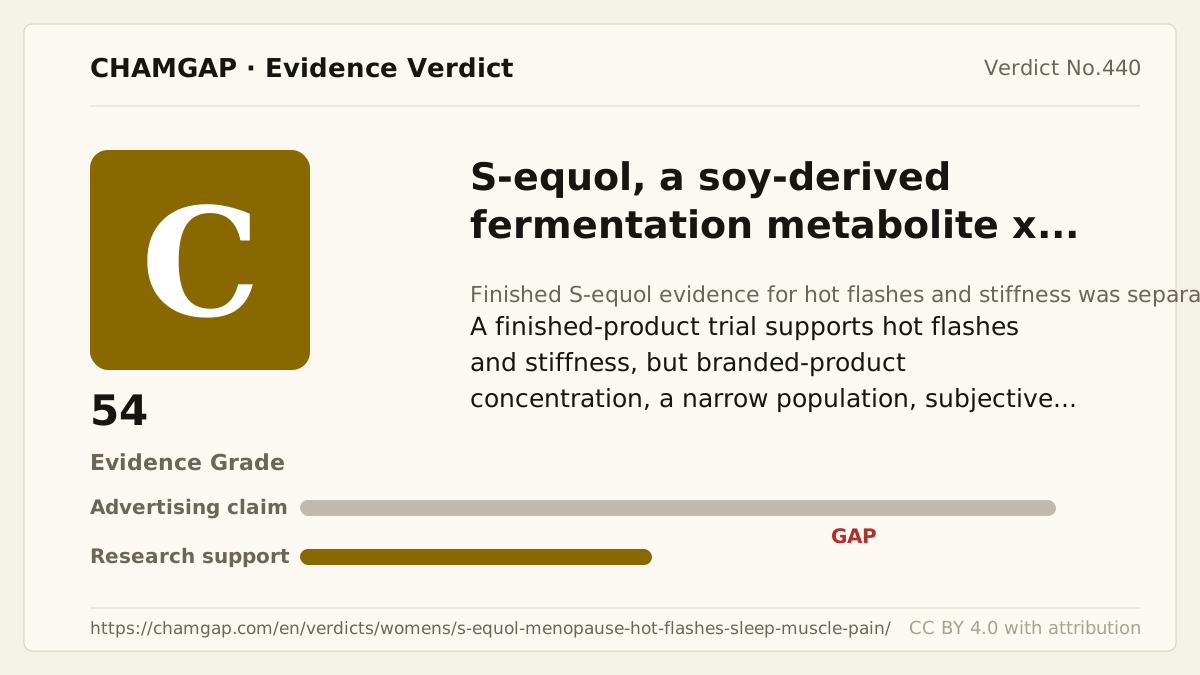
[Chamgap] S-equol x menopausal hot flashes, sleep disturbance, and muscle pain — Evidence Grade C·54. 3 cited sources checked. Source: https://chamgap.com/en/verdicts/womens/s-equol-menopause-hot-flashes-sleep-muscle-pain/ · CC BY 4.0CC BY 4.0 — free to use with attribution; do not distort grades, numbers, or verdict meaning.
What this document does and does not do
Chamgap is an information source. It reports what research has and has not confirmed; it does not tell readers what to take or buy. That decision belongs to readers and, when needed, medical or legal professionals. This verdict reflects literature available up to the search date and may change as new research appears. Nothing here is medical advice.