
Red raspberry leaf,
does it really help with Shorter labor, uterine health, and menstrual-pain relief?
research showsA 192-person RCT giving 2.4 g/day of raspberry-leaf tablets from 32 weeks of pregnancy did not shorten the first stage of labor and found no significant association with birth outcomes. The second stage was 9.59 minutes shorter on average and forceps delivery was less frequent, but these trends were not statistically conclusive. A 2021 integrative review likewise concluded that human studies had shown neither benefit nor harm. Shorter labor is grade D, while direct trials for menstrual pain and broad uterine health are absent.
ads claimClaims that the herb tones the uterus, provides an easier birth, shortens labor, or relieves menstrual pain present traditional descriptions and smooth-muscle experiments as clinical efficacy. Labor and menstrual pain are different clinical settings.
Useful facts when choosing a product
- In Korea, the leaf is available as tea bags or leaf tea and through imported capsules and tablets; it differs from raspberry-fruit products.
- The core RCT used 1.2 g twice daily, totaling 2.4 g/day, from 32 weeks of pregnancy.
- The extracted dose from a cup of tea cannot be directly equated to the tablet dose.
- Safety evidence in pregnancy is insufficient, so it should not be used to induce labor without obstetric advice.
- Traditional use and a natural image do not establish fetal or maternal safety.
Chamgap Semantic Classification Code
Candidate index · review held
UNK.red-raspberry-leaf.UNK.shorter-labor-uterine-health-and-menstrual-pain-relief.relieve.placeboUnknown > Red raspberry leaf > Unknown > Shorter labor, uterine health, and menstrual-pain relief > Symptom-relief claim > Placebo
An automated migration candidate, not an issued permanent code; exact claim scope remains under review. This machine-generated migration candidate helps retrieval but is not a permanent assignment. The original verdict ID and URL remain authoritative.
What the research actually shows
The 2001 Simpson trial randomized 192 low-risk nulliparous women to raspberry-leaf tablets at 1.2 g twice daily or placebo from 32 weeks until labor. It did not shorten the first stage and found no significant birth-outcome difference. The 2021 Bowman integrative review included 13 studies, comprising five laboratory, two animal, and six human studies, and concluded that human studies had shown neither benefit nor harm and that the evidence was weak. A 2024 prospective observational study of 91 women found an association with less medical augmentation, but the authors stated that its small nonrandomized findings could not be relied on or generalized.
Why this is classified as D (30)
The direct randomized trial was null for the central shorter-labor claim, and an integrative review found no human benefit. Because evidence is concentrated in one trial and a nonsignificant second-stage trend remains, this is D with 30 points rather than repeated-disproof grade F. Menstrual pain and uterine health are separate unknown subclaims.
Counterpoint. A sufficiently powered independent RCT of a standardized formulation with a prespecified labor-duration primary endpoint is needed.
Rejudgment record. Reassessment (cross-check reflected) — Reflected the null first-stage and overall birth outcomes in the direct labor RCT and no demonstrated benefit in the 2021 review, while separating absent menstrual-pain and uterine-health trials
Sub-claim grades by effect
This ingredient is marketed for several effects. A single overall grade blends strong and weak claims together, so each effect is graded separately here. The overall grade reflects the strongest disconfirming or core claim.
| Effect (sub-claim) | Grade | Basis |
|---|---|---|
| Shorter labor | D | The 192-person RCT was null for the first stage of labor and overall birth outcomes. |
| Uterine health and menstrual-pain relief | ? | No direct human trial |
Cross-check — AI research and Codex final gate
Evidence Table
| Study | Design | Sample | Funding | Endpoint | Result | Weight |
|---|---|---|---|---|---|---|
| Simpson M et al. 2001 | Double-blind randomized placebo-controlled trial | 192 | Non-U.S. research support; details unclear | Duration of labor stages, mode of delivery, and maternal and neonatal outcomes | No shortening of the first stage or significant birth-outcome difference; a nonsignificant 9.59-minute second-stage and forceps-delivery trend. | Key |
| Bowman R et al. 2021 | Systematic integrative review | 13 | University of Canberra and ACT Health research | Efficacy and safety in pregnancy and labor | Human studies demonstrated neither benefit nor harm, and the evidence base was weak. | Key |
| Bowman R et al. 2024 | Prospective observational study | 47 | Australian university and health institutions | Labor augmentation and birth outcomes | An association with less augmentation was observed, but the authors stated that it could not be relied on or generalized. | Low |
Receipt — 3 References
All 3 cited sources were verified for existence at the original page (as of 2026-07-16).
Final verification and publication gate: Codex · Evidence date: 2026-07-16 · Corrections: none
Cite this verdict
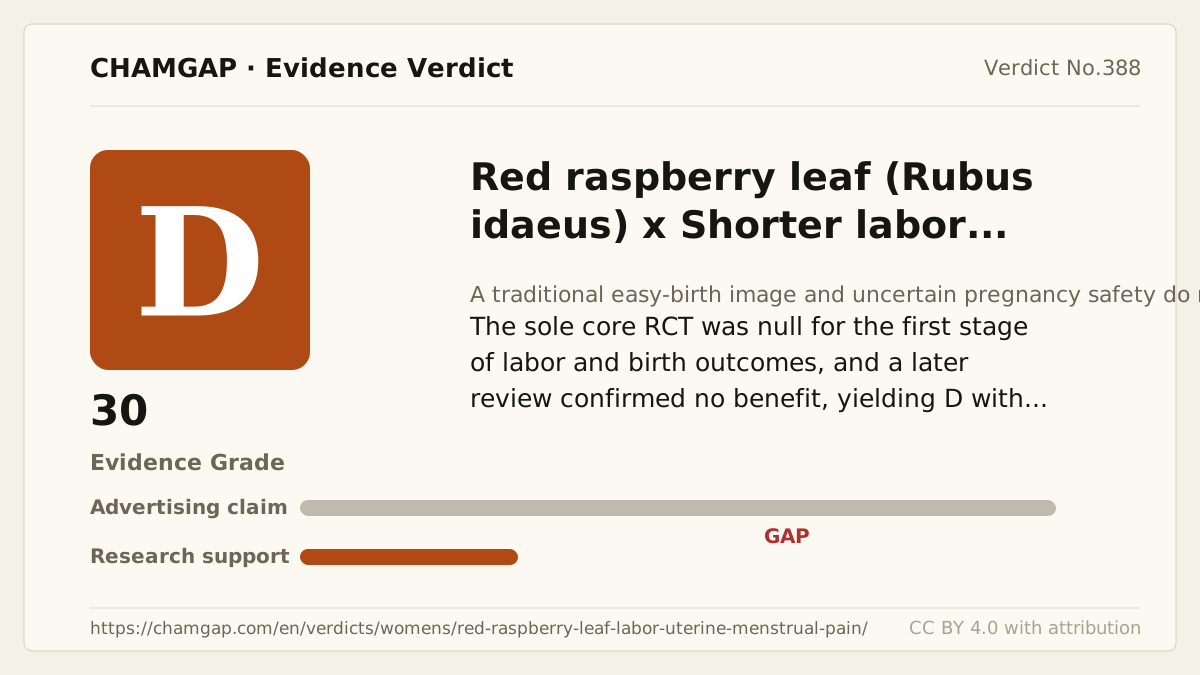
[Chamgap] Red raspberry leaf × Shorter labor, uterine health, and menstrual-pain relief — Evidence Grade D·30. 3 cited sources checked. Source: https://chamgap.com/en/verdicts/womens/red-raspberry-leaf-labor-uterine-menstrual-pain/ · CC BY 4.0CC BY 4.0 — free to use with attribution; do not distort grades, numbers, or verdict meaning.
What this document does and does not do
Chamgap is an information source. It reports what research has and has not confirmed; it does not tell readers what to take or buy. That decision belongs to readers and, when needed, medical or legal professionals. This verdict reflects literature available up to the search date and may change as new research appears. Nothing here is medical advice.