
Pueraria mirifica,
does it really help with Breast enlargement, estrogen balance, and relief of menopausal symptoms?
research showsPueraria mirifica is a different species from Pueraria lobata, or kudzu, covered in verdict 182. Small Thai clinical studies provide signals for menopausal symptoms, but a 2018 systematic review judged efficacy inconclusive because eight studies involving 309 women had methodological deficiencies, high risk of bias, placebo susceptibility, and nonstandardized materials. Credible human efficacy trials of breast-size enlargement are essentially absent. Breast enlargement is therefore graded ?, menopausal symptoms C, and the overall grade is C with 43 points.
ads claimAdvertising bundles natural estrogen, hormone balance, bust enhancement, and feminization. Clinical evidence instead centers on self-reported menopausal symptoms and vaginal surrogate markers and does not objectively establish breast enlargement.
Useful facts when choosing a product
- In Korea, products are mainly available through cross-border e-commerce or purchasing agents, with labels ranging from 100-300 mg per capsule to extract-equivalent claims of 1,000 mg.
- Menopause trials generally used 20-100 mg/day, which is not directly equivalent to high-potency commercial label claims.
- P. mirifica is distinct from P. lobata, or kudzu, and evidence from the two species is not interchangeable.
- Because miroestrol, deoxymiroestrol, and related constituents are estrogenic, pregnancy, lactation, hormone-sensitive conditions, unexplained vaginal bleeding, and concurrent hormone therapy require professional review.
Chamgap Semantic Classification Code
Candidate index · review held
UNK.pueraria-mirifica.UNK.breast-enlargement-estrogen-balance-and-relief-of-menopausal-symptoms.relieve.placeboUnknown > Pueraria mirifica > Unknown > Breast enlargement, estrogen balance, and relief of menopausal symptoms > Symptom-relief claim > Placebo
An automated migration candidate, not an issued permanent code; exact claim scope remains under review. This machine-generated migration candidate helps retrieval but is not a permanent assignment. The original verdict ID and URL remain authoritative.
What the research actually shows
The 2004 phase II study by Chandeying and Sangthawan used 50 or 100 mg/day for six months but was not a randomized placebo-controlled trial. The 2007 trial by Manonai and colleagues analyzed 71 postmenopausal women receiving 20, 30, or 50 mg/day or placebo for 24 weeks and reported signals in vaginal dryness and atrophy markers. The 2011 trial by Virojchaiwong and colleagues gave 25 or 50 mg/day to 52 hysterectomized women but compared two doses without placebo. The 2018 systematic review by Kongkaew and colleagues evaluated eight studies involving 309 women and found symptom-score signals, but concluded that menopausal efficacy remained inconclusive because of design and reporting deficiencies, high risk of bias, placebo effects in self-assessment, and undefined active constituents and sources. This clinical literature did not validate increased breast size.
Why this is classified as C (43)
Menopausal symptoms receive C because small human studies exist, but the systematic review judged efficacy inconclusive and material and design limitations are substantial. Breast enlargement receives ? because direct human efficacy literature is essentially absent. Estrogenic safety is separately rated caution.
Counterpoint. Signals in vaginal symptoms and climacteric scores remain hypothesis-generating. No independent trial has prospectively specified objective breast volume and used standardized material, placebo, and adequate follow-up.
Rejudgment record. Reassessment (cross-check reflected) — Applied C to small, low-quality human signals for menopause and ? to absent direct human efficacy literature for breast enlargement, while separating estrogenic safety
Sub-claim grades by effect
This ingredient is marketed for several effects. A single overall grade blends strong and weak claims together, so each effect is graded separately here. The overall grade reflects the strongest disconfirming or core claim.
| Effect (sub-claim) | Grade | Basis |
|---|---|---|
| Relief of menopausal symptoms | C | Eight studies with small samples and high risk of bias |
| Breast enlargement | ? | No objective breast-volume trial; the 27-person study assessed skin firmness and angle |
Cross-check — AI research and Codex final gate
Evidence Table
| Study | Design | Sample | Funding | Endpoint | Result | Weight |
|---|---|---|---|---|---|---|
| Chandeying & Sangthawan 2004 | Six-month phase II open dose-comparison clinical study | 37 | Insufficient disclosure of product source and commercial involvement | Vasomotor and climacteric symptom scores, hormones, and lipids | Symptoms decreased from baseline with both 50 and 100 mg/day, but absence of placebo limits attribution. | Supportive |
| Manonai et al. 2007 | Twenty-four-week randomized double-blind placebo-controlled trial | 71 | Unknown; limited material-standardization reporting | Vaginal dryness, dyspareunia, vaginal health index, pH, and cytologic maturation | Signals in selected vaginal symptoms and atrophy surrogates; not a breast-size trial. | Key |
| Virojchaiwong et al. 2011 | Six-month double-blind comparison of 25 mg and 50 mg | 52 | Listed as non-U.S. government support; no placebo | Modified Greene climacteric score and laboratory measures | Scores fell in both dose groups, but the study only compared doses without placebo. | Supportive |
| Kongkaew et al. 2018 | Systematic review of clinical trials | 309 | Academic authors; incomplete funding and material-source disclosure in included trials | Self-reported menopause, hormones, urogenital outcomes, bone surrogates, and safety | Signals existed, but methodological deficiencies and high risk of bias led to an inconclusive efficacy judgment. | Key |
Receipt — 4 References
All 4 cited sources were verified for existence at the original page (as of 2026-07-17).
Final verification and publication gate: Codex · Evidence date: 2026-07-17 · Corrections: none
Cite this verdict
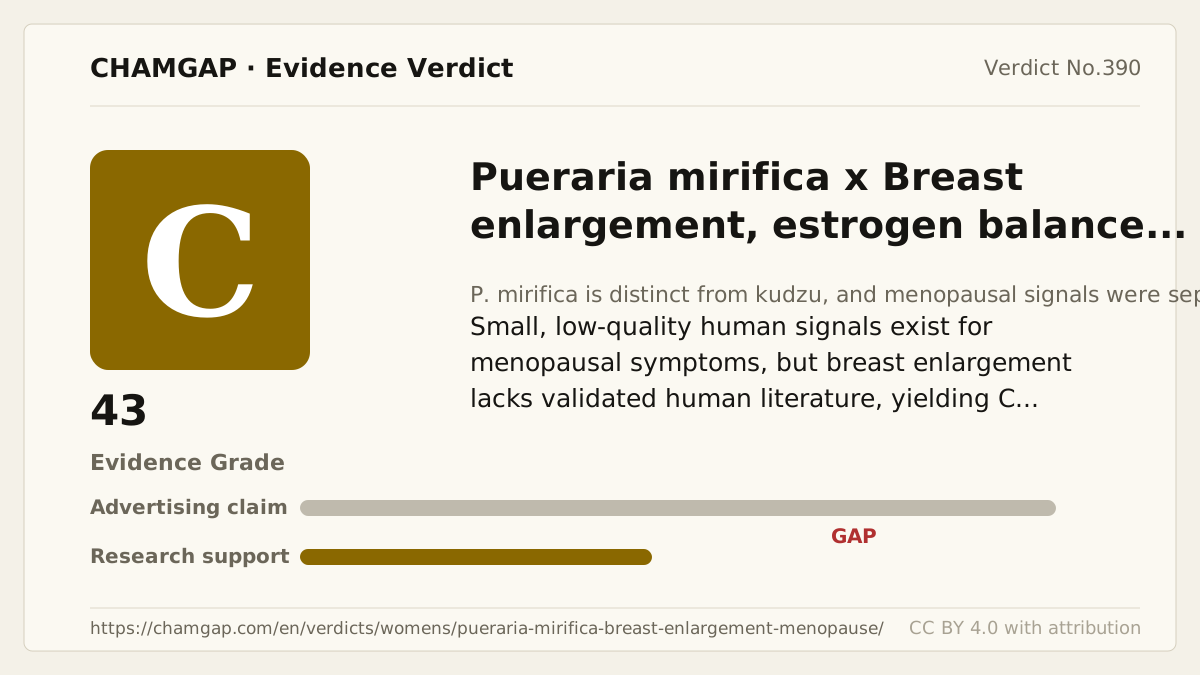
[Chamgap] Pueraria mirifica x breast enlargement, estrogen balance, and menopause — Evidence Grade C·43. 4 cited sources checked. Source: https://chamgap.com/en/verdicts/womens/pueraria-mirifica-breast-enlargement-menopause/ · CC BY 4.0CC BY 4.0 — free to use with attribution; do not distort grades, numbers, or verdict meaning.
What this document does and does not do
Chamgap is an information source. It reports what research has and has not confirmed; it does not tell readers what to take or buy. That decision belongs to readers and, when needed, medical or legal professionals. This verdict reflects literature available up to the search date and may change as new research appears. Nothing here is medical advice.