
Ginger root,
does it really help with Pain relief in primary dysmenorrhea?
research showsRandomized trials and meta-analyses indicate that oral ginger can reduce pain intensity and duration versus placebo in primary dysmenorrhea. Outcomes are limited to subjective self-rated pain, however, and trials are generally small with heterogeneous formulations, doses, timing, and risk of bias. The boundary rule therefore caps the rating at C, and small comparisons showing no difference from NSAIDs cannot establish ginger as an equivalent substitute.
ads claimClaims such as 'identical to ibuprofen,' 'treats period pain without analgesics,' or 'removes uterine inflammation' overstate the evidence. The studies concern short-term pain in primary dysmenorrhea without an identified cause and cannot be generalized to secondary pain from endometriosis, adenomyosis, pelvic inflammatory disease, or other conditions. This is separate from the digestive and nausea ginger claim in verdict 085 and from black ginger in verdict 441.
Useful facts when choosing a product
- Ginger powders and extracts are sold alone and in combinations in South Korea, but no generic ginger ingredient recognized specifically for dysmenorrhea functionality was identified.
- Powder doses in dysmenorrhea trials generally ranged from 750 to 2,000 mg/day, commonly 500 mg three times daily or 250 mg four times daily for three to five days around menstruation.
- Ginger powder, ordinary extracts, and steamed ginger extracts differ in gingerol and shogaol content and manufacturing and cannot be equated by the dose number alone.
- Serious events were uncommon in short trials, but safety reporting was incomplete. Gastrointestinal symptoms, anticoagulant or antiplatelet use, unusually heavy bleeding, and new or worsening pain warrant separate attention.
Chamgap Semantic Classification Code
Candidate index · review held
S.ginger-root-powder-or-extract-from-zingiber-officinale.UNK.pain-relief-in-primary-dysmenorrhea.relieve.MULTISupplements and nutraceuticals > Ginger root powder or extract from Zingiber officinale > Unknown > Pain relief in primary dysmenorrhea > Symptom-relief claim > Multiple: primary unresolved
An automated migration candidate, not an issued permanent code; exact claim scope remains under review. This machine-generated migration candidate helps retrieval but is not a permanent assignment. The original verdict ID and URL remain authoritative.
What the research actually shows
The 2024 Moshfeghinia review qualitatively assessed 24 studies and pooled 12, reporting lower pain intensity and duration than placebo, but intensity heterogeneity was 81% and the authors highlighted risk of bias and an unclear risk-benefit balance. The 2012 Rahnama placebo-controlled trial used 500 mg three times daily from two days before menstruation through the first three days, or during the first three days, and reported pain improvement. The 2009 Ozgoli study compared ginger 250 mg four times daily, mefenamic acid 250 mg, and ibuprofen 400 mg for three days and found no group difference, but alternating allocation, one-cycle follow-up, and absence of a noninferiority test prevent a claim of confirmed equivalence.
Why this is classified as C (57)
Direct trials and repeated positive meta-analyses support an efficacy signal, but the subjective self-rated pain ceiling, high heterogeneity, small trials, and formulation differences place it at high C with 57 points.
Counterpoint. There is a reasonable signal for short-term adjunctive use in primary dysmenorrhea, but equivalence to standard NSAIDs and treatment of secondary dysmenorrhea are not established.
Rejudgment record. New verdict — The assessment evaluated randomized and pooled pain intensity and duration in primary dysmenorrhea while applying the subjective-outcome ceiling and accounting for formulation, timing, risk of bias, and overinterpretation of NSAID comparisons.
Cross-check — AI research and Codex final gate
Evidence Table
| Study | Design | Sample | Funding | Endpoint | Result | Weight |
|---|---|---|---|---|---|---|
| Study 1 | Systematic review and random-effects meta-analysis | 12 | Academic institutions; funding varied across original studies | Dysmenorrhea pain intensity and duration | Versus placebo, intensity SMD was -1.13 and duration SMD -0.29; intensity heterogeneity was 81.05%. No difference from NSAIDs was found, but safety data were sparse. | Key; high heterogeneity |
| Rahnama et al. 2012 RCT | Double-blind randomized placebo-controlled trial | 59 | Supported by Shahed University | Pain intensity and duration | Ginger root powder 500 mg three times daily for three to five days around menstruation reduced pain intensity and duration in some protocol analyses. | Key positive |
| Study 3 | Double-blind comparative clinical trial with alternating allocation | 50 | Unknown | Dysmenorrhea severity, pain relief, and satisfaction | No group difference after three days comparing ginger 250 mg four times daily, mefenamic acid 250 mg, and ibuprofen 400 mg. | Supportive; not proof of equivalence |
Receipt — 4 References
All 4 cited sources were verified for existence at the original page (as of 2026-07-18).
Final verification and publication gate: Codex · Evidence date: 2026-07-18 · Corrections: none
Cite this verdict
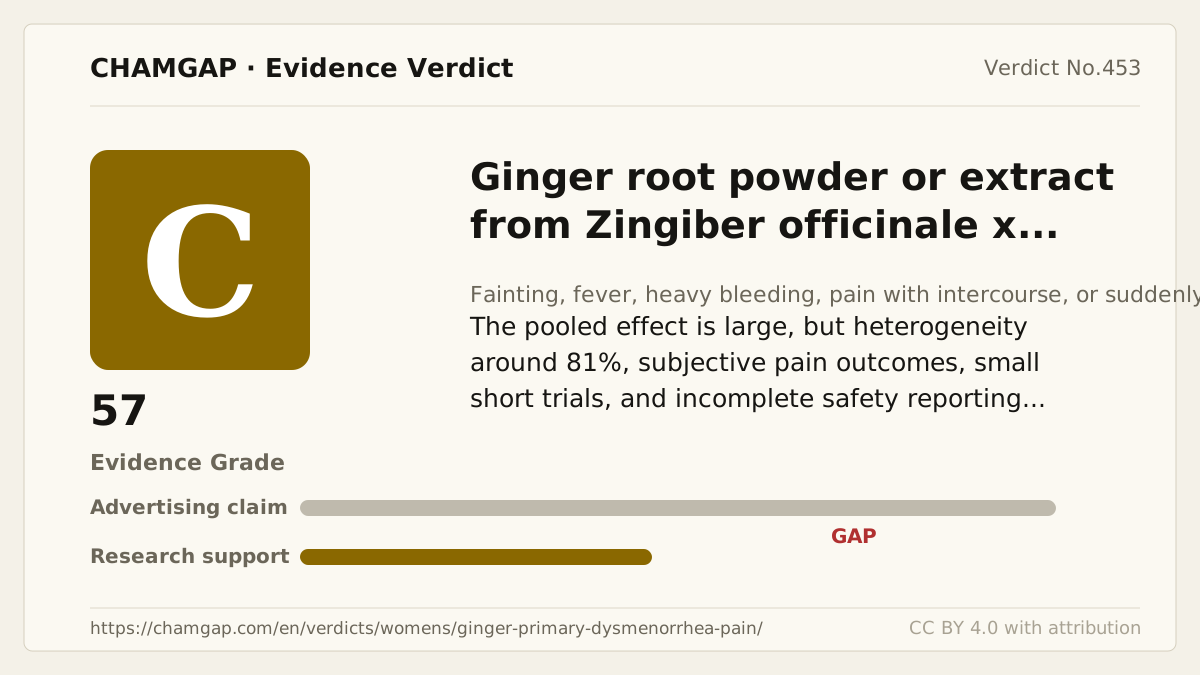
[Chamgap] Ginger root x pain relief in primary dysmenorrhea — Evidence Grade C·57. 4 cited sources checked. Source: https://chamgap.com/en/verdicts/womens/ginger-primary-dysmenorrhea-pain/ · CC BY 4.0CC BY 4.0 — free to use with attribution; do not distort grades, numbers, or verdict meaning.
What this document does and does not do
Chamgap is an information source. It reports what research has and has not confirmed; it does not tell readers what to take or buy. That decision belongs to readers and, when needed, medical or legal professionals. This verdict reflects literature available up to the search date and may change as new research appears. Nothing here is medical advice.