
Coenzyme Q10,
does it really help with Improved IVF or ICSI pregnancy success in women with diminished ovarian reserve?
research showsCoQ10 pretreatment may improve the number of retrieved oocytes and clinical pregnancy in women with diminished ovarian reserve, but improvement in live birth has not been established. A 2024 meta-analysis of six randomized trials with 1,529 participants reported a clinical-pregnancy odds ratio of 1.84 and 1.30 more retrieved oocytes on average, but no trial was blinded and allocation concealment was not reported. A 2026 trial of 100 women increased oocyte yield without improving pregnancy rates. Intermediate outcomes and low methodological quality support C.
ads claimAdvertising groups together 'better egg quality,' 'higher implantation,' and 'greater pregnancy success.' Oocyte and embryo counts, estradiol, clinical pregnancy, and live birth are different stages. A positive result at an earlier stage does not guarantee successful live birth.
Useful facts when choosing a product
- CoQ10 100 mg capsules and softgels are widely distributed in Korea as standardized health-functional-food products and imported supplements.
- Female assisted-reproduction studies commonly used 400 to 600 mg/day for one to two months before treatment, higher than the usual 90 to 100 mg/day in Korean general health-functional-food products.
- Ubiquinone, ubiquinol, oil softgels, absorption-enhanced formulations, and branded ingredients differ, so a marketed 100 mg product cannot be assumed equivalent to a specific 400 to 600 mg trial product.
- CoQ10 is generally associated with mild effects such as digestive upset or insomnia, but it may interact with warfarin or insulin. Use during fertility treatment should be disclosed to the reproductive-care team.
Chamgap Semantic Classification Code
Candidate index · review held
S.coenzyme-q10.UNK.ivf-or-icsi-pregnancy-success-with-diminished-ovarian-reserve.improve.UNKSupplements and nutraceuticals > Coenzyme Q10 > Unknown > IVF or ICSI pregnancy success with diminished ovarian reserve > Improvement claim > Unknown
An automated migration candidate, not an issued permanent code; exact claim scope remains under review. This machine-generated migration candidate helps retrieval but is not a permanent assignment. The original verdict ID and URL remain authoritative.
What the research actually shows
The 2024 meta-analysis by Lin and colleagues pooled six trials with 1,529 women with diminished ovarian reserve and reported clinical pregnancy OR 1.84 (95% CI 1.33 to 2.53), 1.30 more retrieved oocytes, 0.59 more optimal embryos, and cycle cancellation OR 0.60. All six trials lacked blinding and did not report allocation-concealment details. The 2020 meta-analysis by Florou and colleagues included five trials and 449 infertile women; clinical pregnancy increased, but live birth and miscarriage did not. The 2018 open-label trial by Xu and colleagues used GNC CoQ10 200 mg three times daily for 60 days and improved ovarian response and embryo measures, while clinical pregnancy and live birth differences were not significant. The 2026 open-label trial by Abdelrahman and colleagues used a branded 400 mg/day product, improved oocyte yield, and found equivalent chemical and clinical pregnancy rates.
Why this is classified as C (52)
Positive signals across several randomized trials for oocyte yield and clinical pregnancy argue against D. However, lack of blinding, unreported allocation concealment, branded products and no-treatment controls, a later null pregnancy trial, and unestablished live birth support C with 52 points.
Counterpoint. An adjunctive increase of one or two retrieved oocytes or a higher chance of clinical pregnancy remains possible. It cannot be expanded into guaranteed live birth or a recommendation for every woman with infertility.
Rejudgment record. New verdict — Separated positive oocyte and clinical-pregnancy signals from absent blinding, unreported allocation concealment, branded products, a later null pregnancy trial, and unestablished live birth
Sub-claim grades by effect
This ingredient is marketed for several effects. A single overall grade blends strong and weak claims together, so each effect is graded separately here. The overall grade reflects the strongest disconfirming or core claim.
| Effect (sub-claim) | Grade | Basis |
|---|---|---|
| Oocyte yield, embryo count, and ovarian response | C | Several trials found improvements, but these are intermediate outcomes with open-label, branded-product, and no-treatment-control limitations. |
| Clinical pregnancy rate | C | The 2024 meta-analysis was positive, but a 2026 trial was null and methodological reporting was weak. |
| Live-birth rate | D | A live-birth meta-analysis (5 RCTs, 449 women) was null (OR 1.67, 0.66–4.25), and a 2026 100-person RCT was also null for clinical pregnancy. Trials exist but the final outcome was null, so this is D rather than a deferred (?) judgment. |
Cross-check — AI research and Codex final gate
Evidence Table
| Study | Design | Sample | Funding | Endpoint | Result | Weight |
|---|---|---|---|---|---|---|
| Lin G et al. 2024 | Systematic review and meta-analysis of randomized trials | 1,529 | Shanghai Science and Technology Commission; authors reported no conflicts | Clinical pregnancy, oocyte yield, embryos, cycle cancellation, and miscarriage | Clinical pregnancy OR was 1.84 and 1.30 more oocytes were retrieved, but every trial was unblinded and allocation concealment was unreported. | Key |
| Florou P et al. 2020 | Systematic review and meta-analysis of randomized trials | 449 | No external funding reported | Clinical pregnancy, live birth, and miscarriage | Clinical pregnancy increased, but live birth at OR 1.67 and miscarriage at OR 0.61 were not significant. | Key |
| Xu Y et al. 2018 | Open-label randomized controlled trial | 169 | Public research funding; a branded GNC product was used | Ovarian response, embryo quality, clinical pregnancy, and live birth | After 600 mg/day for 60 days, oocyte and embryo measures improved, but clinical pregnancy and live-birth differences were not significant. | Key |
| Abdelrahman MA et al. 2026 | Open-label randomized controlled trial | 100 | King Khalid University grant; branded Synapse product | Oocyte count, ovarian-reserve measures, and chemical and clinical pregnancy | CoQ10 400 mg/day with folic acid improved oocyte count and some ovarian measures, but chemical and clinical pregnancy rates were equivalent to folic acid alone. | Key |
Receipt — 4 References
All 4 cited sources were verified for existence at the original page (as of 2026-07-18).
Final verification and publication gate: Codex · Evidence date: 2026-07-18 · Corrections: none
Cite this verdict
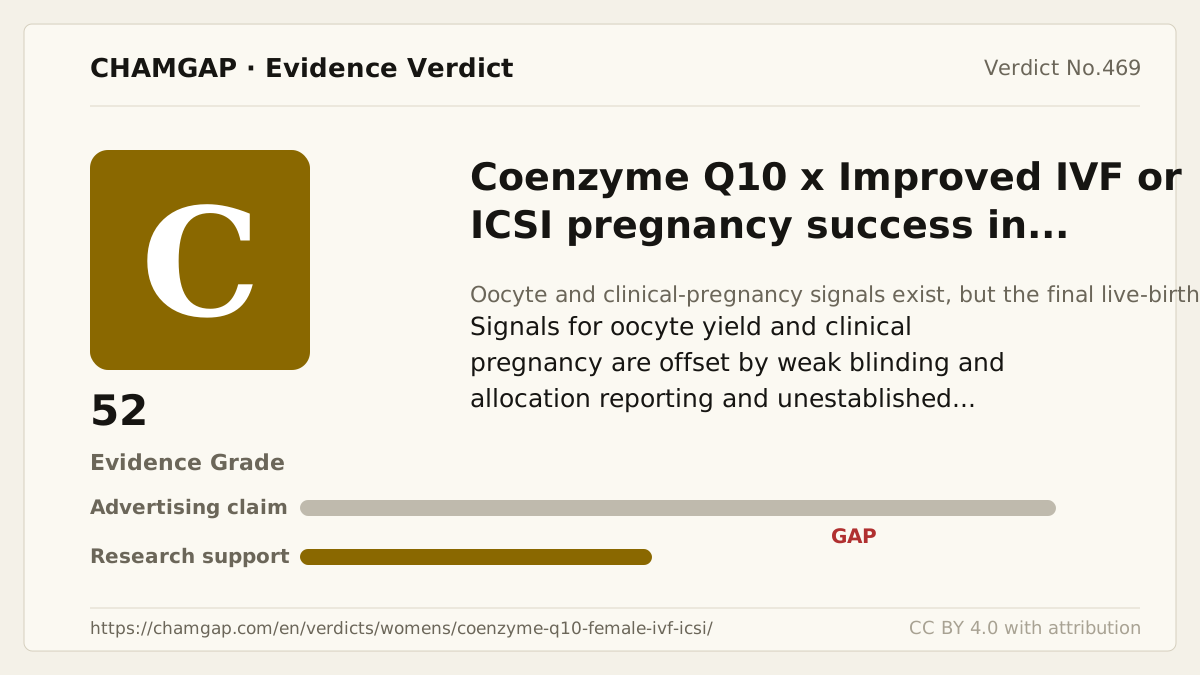
[Chamgap] Coenzyme Q10 x IVF or ICSI success in women with diminished ovarian reserve — Evidence Grade C·52. 4 cited sources checked. Source: https://chamgap.com/en/verdicts/womens/coenzyme-q10-female-ivf-icsi/ · CC BY 4.0CC BY 4.0 — free to use with attribution; do not distort grades, numbers, or verdict meaning.
What this document does and does not do
Chamgap is an information source. It reports what research has and has not confirmed; it does not tell readers what to take or buy. That decision belongs to readers and, when needed, medical or legal professionals. This verdict reflects literature available up to the search date and may change as new research appears. Nothing here is medical advice.