
Calcium supplementation,
does it really help with Prevention of preeclampsia and related hypertensive disorders of pregnancy?
research showsThe claim that calcium supplementation during pregnancy prevents preeclampsia is rated D. The 2025 Cochrane update reassessed 10 trials with 37,504 participants after trustworthiness screening, and its sensitivity analysis restricted to four large placebo-controlled trials with 14,730 participants found high-certainty evidence of little to no preventive effect. The World Health Organization still recommends calcium for pregnant women with low intake, but that recommendation does not replace the null evidence from large efficacy trials.
ads claimMarketing may combine bone health and preeclampsia prevention or present one prevention rate for every pregnancy. This verdict concerns hypertensive disorders rather than bone outcomes and does not transfer a high-dose low-intake protocol to an ordinary prenatal multivitamin.
Useful facts when choosing a product
- Standalone calcium products and prenatal multivitamins are marketed in Korea, but combination products may contain far less calcium than the World Health Organization regimen.
- The regimen is 1.5-2.0 g/day of elemental calcium in low-intake populations; elemental amount differs from total compound weight.
- The World Health Organization advises divided doses with meals and separation from iron by several hours.
- Total intake, kidney stones or kidney disease, and hypercalcemia risk should be reviewed in prenatal care before high-dose use.
Chamgap Semantic Classification Code
Candidate index · review held
UNK.calcium-supplementation.UNK.preeclampsia-and-related-hypertensive-disorders-of-pregnancy.prevent.placeboUnknown > Calcium supplementation > Unknown > preeclampsia and related hypertensive disorders of pregnancy > Occurrence-prevention claim > Placebo
An automated migration candidate, not an issued permanent code; exact claim scope remains under review. This machine-generated migration candidate helps retrieval but is not a permanent assignment. The original verdict ID and URL remain authoritative.
What the research actually shows
The 2025 Cochrane update included 10 randomized trials with 37,504 participants. Six calcium-versus-placebo trials with 15,364 participants found little to no difference in preeclampsia, and restriction to four trials with more than 500 participants, totaling 14,730, produced high-certainty null evidence. In the 8,325-participant World Health Organization trial, preeclampsia occurred in 4.1% versus 4.5%, a nonsignificant result. By contrast, the 2018 Cochrane reduction in low-intake populations had low certainty and high heterogeneity.
Why this is classified as D (28)
After trustworthiness screening, four large placebo-controlled trials with 14,730 participants found no preventive effect on preeclampsia with high certainty, supporting D with 28 points. The low-intake population covered by the World Health Organization recommendation remains a disputed subgroup, but a recommendation does not replace efficacy grading. This is not F because confirmatory contradiction has not been repeated.
Counterpoint. The World Health Organization recommendation and some secondary severity outcomes remain relevant for women with low calcium intake. Individual use should be decided in prenatal care and should not replace standard prevention such as low-dose aspirin when indicated.
Rejudgment record. Reassessment (cross-check reflected) — Prioritized the high-certainty null evidence from four large placebo-controlled trials with 14,730 participants after the 2025 Cochrane trustworthiness review, while retaining the World Health Organization low-intake recommendation as a disputed subgroup
Sub-claim grades by effect
This ingredient is marketed for several effects. A single overall grade blends strong and weak claims together, so each effect is graded separately here. The overall grade reflects the strongest disconfirming or core claim.
| Effect (sub-claim) | Grade | Basis |
|---|---|---|
| Preeclampsia prevention in pregnant women with low calcium intake | C | WHO recommends it for low-intake women, but after the 2025 Cochrane trustworthiness review the evidence is low-certainty and conflicting |
| Preeclampsia prevention in general or calcium-replete pregnant women | D | Large placebo-controlled trials (WHO 8,325; 2025 Cochrane 4 trials, 14,730) were null with high certainty |
Cross-check — AI research and Codex final gate
Evidence Table
| Study | Design | Sample | Funding | Endpoint | Result | Weight |
|---|---|---|---|---|---|---|
| Cluver CA et al. 2025 | Cochrane systematic review and meta-analysis with trustworthiness assessment | 14,730 | Partly funded by the World Health Organization | Preeclampsia, preterm birth, and severe maternal outcomes | The overall placebo-controlled analysis found little to no difference, and the large-trial sensitivity analysis found no preventive effect on preeclampsia with high certainty. | Decisive null evidence |
| Villar J et al. 2006 WHO trial | Multinational double-blind randomized placebo-controlled trial | 8,325 | World Health Organization and public support | Preeclampsia, eclampsia, and severe gestational hypertension | The primary preeclampsia endpoint was null at 4.1% versus 4.5% (RR 0.91, 95% CI 0.69–1.19), while eclampsia and some secondary severity outcomes declined. | Large direct null evidence |
| World Health Organization recommendation 2018, updated 2023 | Evidence-based international guideline | World Health Organization | Prevention of preeclampsia in low-calcium-intake populations | Recommends 1.5-2.0 g/day of elemental calcium. | Guideline |
Receipt — 3 References
All 3 cited sources were verified for existence at the original page (as of 2026-07-18).
Final verification and publication gate: Codex · Evidence date: 2026-07-18 · Corrections: none
Cite this verdict
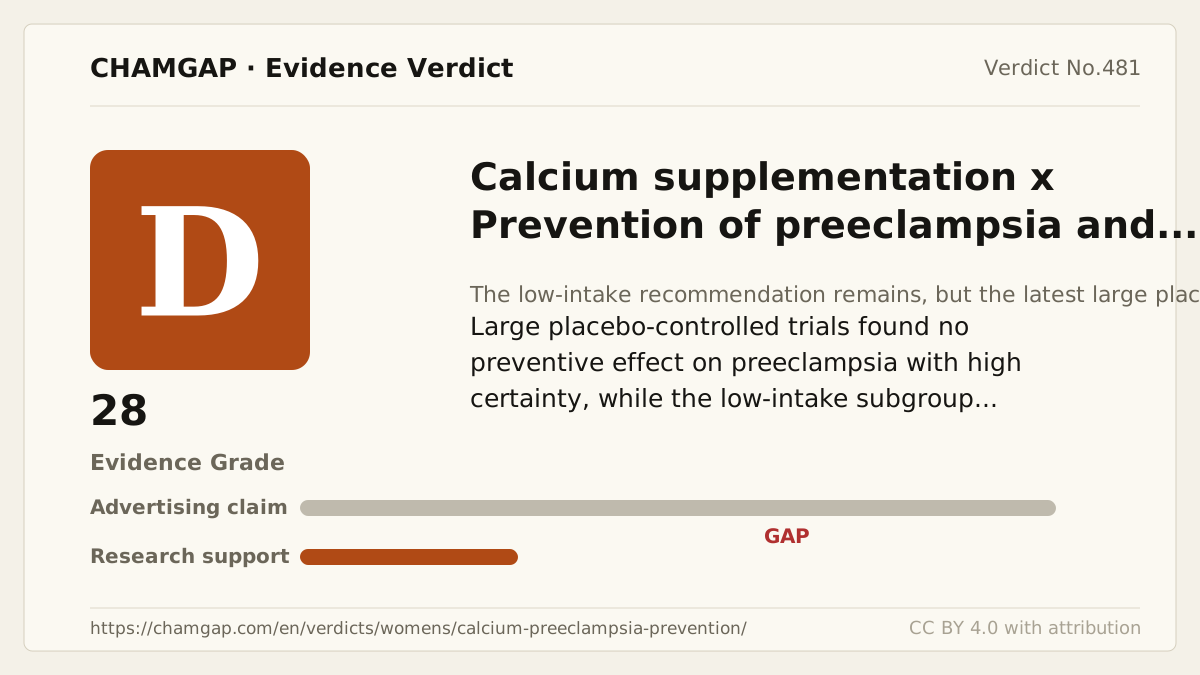
[Chamgap] Calcium supplementation x prevention of preeclampsia — Evidence Grade D·28. 3 cited sources checked. Source: https://chamgap.com/en/verdicts/womens/calcium-preeclampsia-prevention/ · CC BY 4.0CC BY 4.0 — free to use with attribution; do not distort grades, numbers, or verdict meaning.
What this document does and does not do
Chamgap is an information source. It reports what research has and has not confirmed; it does not tell readers what to take or buy. That decision belongs to readers and, when needed, medical or legal professionals. This verdict reflects literature available up to the search date and may change as new research appears. Nothing here is medical advice.