
Weekly group meetings in the commercial WW weight-management program for 52 weeks,
does it really help with Greater weight loss at 12 months than a 12-week program?
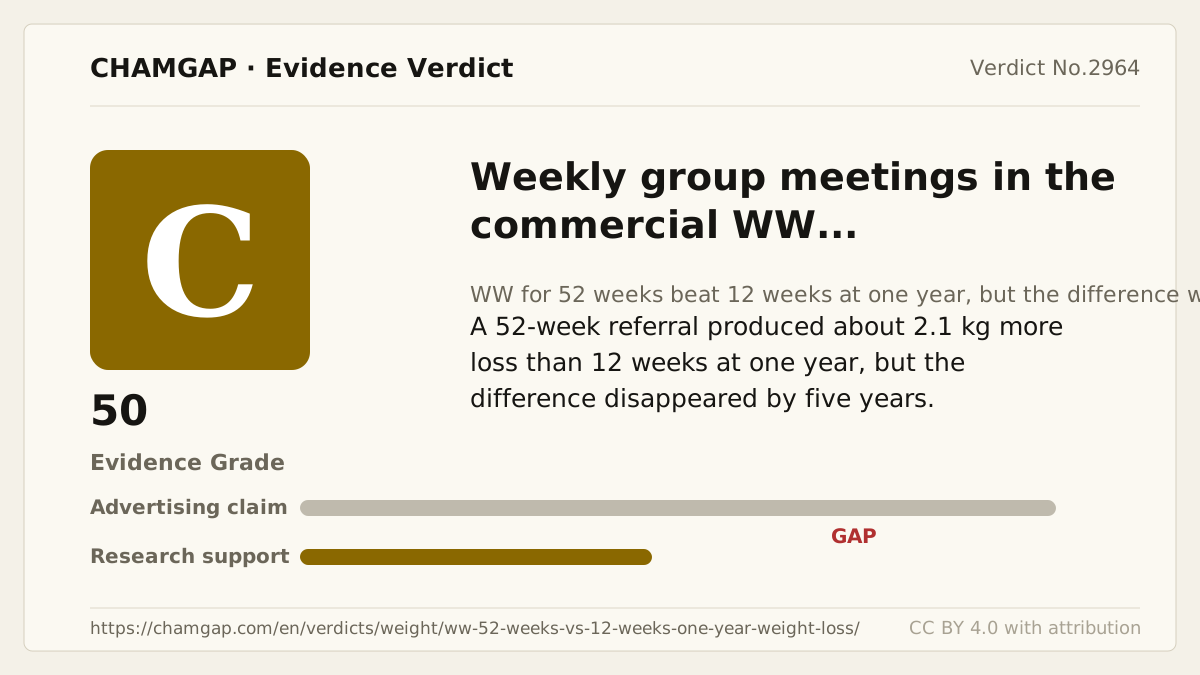
research showsGrade C. In WRAP, 12-month weight change was -4.75 kg with 12 weeks and -6.76 kg with 52 weeks; adjusted difference -2.14 kg (95% CI -3.05 to -1.22), P<.0001.
ads claimThe established result is 12-month superiority of a 52-week referral. It cannot be expanded to durable maintenance or equal safety.
Useful facts when choosing a product
- The comparator was an active 12-week referral to the same WW program.
- Measured 12-month weight was missing in 35% and addressed by multiple imputation.
- The five-year 52- versus 12-week difference was null.
Chamgap Semantic Classification Code
Candidate index · review held
UNK.group-meetings-in-the-commercial-ww-weight-management-program.UNK.greater-weight-loss-at-than-a-program.assess.noneUnknown > group meetings in the commercial WW weight-management program > Unknown > Greater weight loss at than a program > Association or change assessment > No intervention
An automated migration candidate, not an issued permanent code; exact claim scope remains under review. This machine-generated migration candidate helps retrieval but is not a permanent assignment. The original verdict ID and URL remain authoritative.
What the research actually shows
In UK primary care, 1,267 adults with BMI at least 28 were randomized to brief intervention, n=211, or WW for 12 weeks, n=528, or 52 weeks, n=528. The primary endpoint was weight at one year. Prespecified hierarchical testing first compared both program groups with brief intervention, -2.71 kg (95% CI -3.86 to -1.55), P<.0001, then compared 52 with 12 weeks. The 1,200-person sample assumed detection of 1.3 kg, but this was not a declared minimum clinically important difference. Alongside public and nonprofit funders, Weight Watchers International funded the UK MRC Industrial Collaboration Award as industry partner and supplied program access. Five authors disclosed that their institutions had received WW research funding. Registration preceded recruitment. The paper reported no intervention-related adverse events but provided no arm-level table of all events.
Why this is classified as C (50)
The adjusted one-year difference was significant, but 35% missing measurement, active-only comparison, and WW funding give C with 50 points.
Counterpoint. A small difference remained at 24 months, but five-year superiority was not shown.
Rejudgment record. Cross-check applied — Positive prespecified hierarchical 12-month result with 35% measured-weight missingness, an active same-program comparator, and mixed funding
| Endpoint | S | Surrogate marker - laboratory or imaging measures |
| Replication | R1 | Single confirmatory trial |
| Independence | I1 | Mixed funding sources |
| Effect size | E+ | Meets the clinically important threshold |
Stored derived and displayed grades match; this is not a current recalculation or validity check (C).
Sub-claim grades by effect
This ingredient is marketed for several effects. A single overall grade blends strong and weak claims together, so each effect is graded separately here. The overall grade reflects the strongest disconfirming or core claim.
| Effect (sub-claim) | Grade | Basis |
|---|---|---|
| Weight loss at 12 months | C | The 52-week referral produced 2.14 kg more loss. |
| Maintained superiority at five years | D | Difference was -0.80 kg, 95% CI -2.13 to 0.54, a null result. |
Cross-check — AI research and Codex final gate
Evidence Table
| Study | Design | Sample | Funding | Endpoint | Result | Weight |
|---|---|---|---|---|---|---|
| Ahern AL et al. 2017 WRAP | Three-arm randomized controlled trial | 1,267 randomized, 211/528/528; measured at 12 months in 823 | Public and nonprofit consortium funding plus Weight Watchers International industry-partner funding and program access | Weight at 12 months | 52 versus 12 weeks adjusted difference -2.14 kg (95% CI -3.05 to -1.22), P<.0001 | Pivotal 12-month evidence |
Receipt — 2 References
All 2 cited sources were verified for existence at the original page (as of 2026-08-26).
Final verification and publication gate: Codex · Evidence date: 2026-08-26 · Corrections: none
Cite this verdict
[Chamgap] Benefit of a 52-Week WW Program for 12-Month Weight Loss — Evidence Grade C·50. 2 cited sources checked. Source: https://chamgap.com/en/verdicts/weight/ww-52-weeks-vs-12-weeks-one-year-weight-loss/ · CC BY 4.0CC BY 4.0 — free to use with attribution; do not distort grades, numbers, or verdict meaning.
What this document does and does not do
Chamgap is an information source. It reports what research has and has not confirmed; it does not tell readers what to take or buy. That decision belongs to readers and, when needed, medical or legal professionals. This verdict reflects literature available up to the search date and may change as new research appears. Nothing here is medical advice.