
Waist trainer,
does it really help with Persistent reduction of abdominal fat and waist circumference with continued wear?
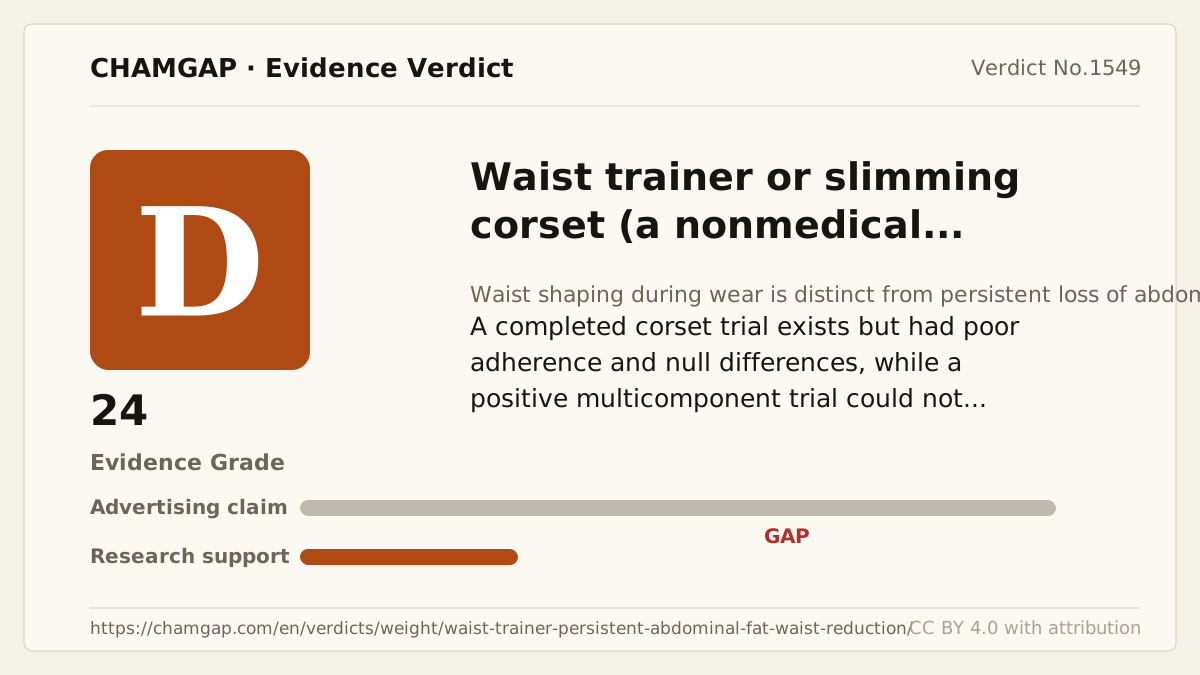
research showsWaist trainers are rated D rather than `?` because completed human intervention trials exist. In a 2010 study, 77 adults who had first lost at least 8 kg with a very-low-calorie diet were randomized to nine months of corset use or no corset, but adherence was only 20% at three months and weight differences at one and two years were not significant, leaving the corset effect unevaluable. A 2023 trial in 69 people combined mild compression shapewear with goal setting and self-monitoring and found 1.3 kg greater weight loss at 12 weeks, but it did not isolate compression or assess abdominal-fat loss. Persistent fat or waist reduction is not confirmed.
ads claimMarketing can represent a compressed silhouette during wear, temporary water loss from sweating, or weight measured with concurrent behavior change as adipocyte loss or waist reduction that remains after garment removal. Direct trials have not established persistent abdominal-fat loss.
Useful facts when choosing a product
- A waist trainer is a nonmedical garment that compresses the abdomen and waist to alter shape while worn; it is distinct from cryolipolysis and postoperative abdominal binders.
- Much of the immediate visible change can disappear when compression is released and must be distinguished from a change in body-fat mass.
- Prolonged strong compression can restrict rib-cage expansion and deep breathing and may cause post-meal reflux, abdominal discomfort, skin irritation, and pressure marks.
- Pain, numbness, breathlessness, severe heartburn, or skin injury represent compression-related adverse effects.
Chamgap Semantic Classification Code
Candidate index · review held
M.waist-trainer-or-slimming-corset.UNK.persistent-reduction-of-abdominal-fat-and-waist-circumference-with-continued-wear.reduce.UNKMedicinal interventions > Waist trainer or slimming corset > Unknown > Persistent reduction of abdominal fat and waist circumference with continued wear > Reduction claim > Unknown
An automated migration candidate, not an issued permanent code; exact claim scope remains under review. This machine-generated migration candidate helps retrieval but is not a permanent assignment. The original verdict ID and URL remain authoritative.
What the research actually shows
Wikstrand et al. 2010 enrolled 91 adults with BMI 30 to below 45 in a three-month very-low-calorie diet, then randomized the 77 who lost at least 8 kg to corset use (39) or no corset (38). Corset adherence was 20% at three months; weight loss was 11.7 versus 9.3 kg at one year (p=0.23) and 6.1 versus 4.4 kg at two years (p=0.94). Kanda et al. 2023 randomized 69 adults with BMI at least 25 to a program combining mild abdominal and hip compression shapewear with goal setting and self-monitoring or control; weight fell 1.3 kg more at 12 weeks, but there was no garment-only arm. Postoperative abdominal-binder studies on pain and recovery do not address this fat or circumference endpoint.
Why this is classified as D (24)
The 77-person corset trial had 20% adherence and nonsignificant weight differences, while the positive 69-person study could not separate behavior change from compression, giving D with 24 points.
Counterpoint. A temporary silhouette change during compression is not evidence of abdominal-fat loss or waist reduction that persists after removal.
Rejudgment record. New verdict — Excluded `?` under rule ③ because a completed 77-person randomized corset trial exists, but applied D to persistent abdominal-fat and waist reduction because of poor adherence and nonsignificant weight results and because a 69-person positive multicomponent trial did not isolate mild compression from behavior change
Sub-claim grades by effect
This ingredient is marketed for several effects. A single overall grade blends strong and weak claims together, so each effect is graded separately here. The overall grade reflects the strongest disconfirming or core claim.
| Effect (sub-claim) | Grade | Basis |
|---|---|---|
| Persistent reduction of abdominal fat | D | Completed garment studies did not establish compression-only abdominal-fat loss by imaging or body composition. |
| Persistent reduction of waist circumference | D | No reliable controlled trial separated compression during wear from a waist effect persisting after removal. |
| Weight loss or maintenance | D | The corset trial had poor adherence and null differences, while the positive shapewear trial did not isolate the garment from behavior change. |
Cross-check — AI research and Codex final gate
Evidence Table
| Study | Design | Sample | Funding | Endpoint | Result | Weight |
|---|---|---|---|---|---|---|
| Wikstrand I, Torgerson J, and Bengtsson Boström K. 2010 | Randomized controlled corset trial after a preceding very-low-calorie diet | 91 adults with obesity enrolled; 77 who lost at least 8 kg were randomized, 39 versus 38 | Regional primary-care and academic study; no commercial funding reported | Weight maintenance at one and two years after a nine-month corset assignment | Adherence was 20% at three months; weight loss was 11.7 versus 9.3 kg at one year (p=0.23) and 6.1 versus 4.4 kg at two years (p=0.94), both nonsignificant. | Completed intervention-specific trial limited by adherence failure |
| Kanda A et al. 2023 | Single-blind randomized controlled multicomponent trial | 69 adults with BMI at least 25; 35 intervention and 34 control | Garment-manufacturer employees were coauthors with product-related interests | Twelve-week weight, waist and metabolic measures, eating behavior, and body appreciation | The compression-garment plus goal-setting and self-monitoring group lost 1.3 kg more, but garment-only effects and abdominal-fat loss were not isolated. | Related multicomponent evidence with limited directness |
Receipt — 2 References
All 2 cited sources were verified for existence at the original page (as of 2026-07-23).
Final verification and publication gate: Codex · Evidence date: 2026-07-23 · Corrections: none
Cite this verdict
[Chamgap] Waist trainer x persistent reduction of abdominal fat and waist circumference — Evidence Grade D·24. 2 cited sources checked. Source: https://chamgap.com/en/verdicts/weight/waist-trainer-persistent-abdominal-fat-waist-reduction/ · CC BY 4.0CC BY 4.0 — free to use with attribution; do not distort grades, numbers, or verdict meaning.
What this document does and does not do
Chamgap is an information source. It reports what research has and has not confirmed; it does not tell readers what to take or buy. That decision belongs to readers and, when needed, medical or legal professionals. This verdict reflects literature available up to the search date and may change as new research appears. Nothing here is medical advice.