
The Track program combining an app, cellular smart scale, 18 dietitian calls, and primary-care counseling,
does it really help with Weight loss at 12 months?
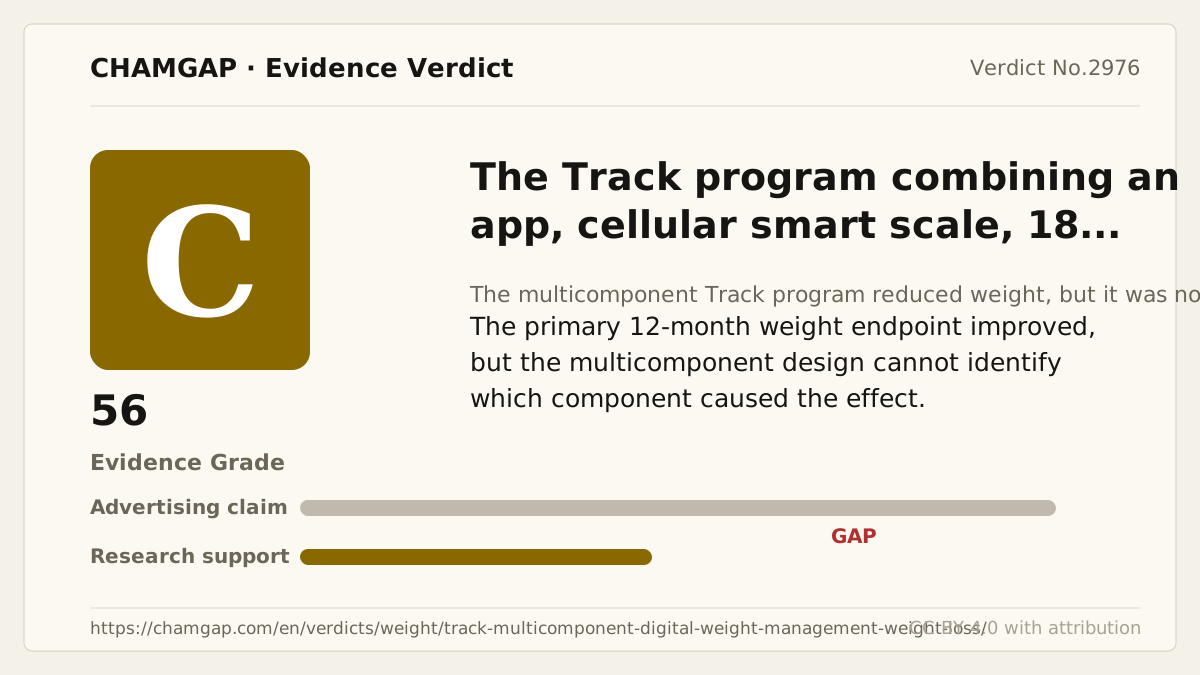
research showsGrade C. In a 351-person, 12-month community-health-center trial, weight changed by -4.0 kg (95% CI -4.9 to -3.0) with the bundled program versus -0.1 kg (-1.0 to 0.8) with usual care; the between-group difference was -3.8 kg (-5.0 to -2.5), P<.001. The trial tested an app, smart scale, 18 dietitian calls, and clinician counseling together, not an app alone.
ads claimThe accurate claim is that a coordinated app-scale-dietitian-clinician program reduced weight, not that an app alone did. Claims about fewer blood-pressure, glucose, or disease events are not established here.
Useful facts when choosing a product
- Track is a multicomponent service, not a stand-alone app.
- NCT01827800 was posted April 10, 2013, before randomization began June 18, 2013.
- The authors interpreted digital tools as adjuncts to counseling rather than replacements.
Chamgap Semantic Classification Code
Candidate index · review held
X.track-program-combining-an-app.behavioral.weight-loss-at.assess.usual-careBehaviors, exposures and policies > Track program combining an app > Behavioral delivery > Weight loss at > Association or change assessment > Usual care
An automated migration candidate, not an issued permanent code; exact claim scope remains under review. This machine-generated migration candidate helps retrieval but is not a permanent assignment. The original verdict ID and URL remain authoritative.
What the research actually shows
Track randomized 351 adults aged 21-65 with obesity plus hypertension, diabetes, or hyperlipidemia to intervention (176) or usual care (175). The primary endpoint was standardized measured weight change at 12 months. The intervention combined app-based goal self-monitoring, algorithm-tailored feedback, daily cellular-scale weighing, 18 dietitian calls, and clinician counseling based on electronic-record recommendations. NIH NIDDK grant R01DK093829 funded the trial; the main paper did not report commercial sponsorship, donated scales, outsourced analysis, medical writing, or publication support. A later paper disclosed that Gary Bennett was then a WW scientific adviser and held equity in Coeus Health; this was a later disclosure after the pivotal trial.
Axis 6 B0 evidence ① Allocation concealment: "The randomization sequence was generated by a statistician and concealed from study staff until assignment." ② Masking: "Study staff who collected outcome measurements were masked to treatment assignment." Participants could not be masked to the intervention, but the primary endpoint was standardized scale-measured weight. ③ Analysis population and missing data: "Analyses followed the intention-to-treat principle." Missing observations were estimated by maximum likelihood in the prespecified model. ④ Prespecified primary endpoint: "The primary outcome was 12-month weight change." — matches NCT01827800
Why this is classified as C (56)
A publicly funded single randomized trial supports 12-month weight loss, but the surrogate endpoint and bundled single-trial evidence give C with 56 points.
Counterpoint. Null results from other lower-intensity digital programs are not direct refutations because the interventions differ, but they block product-wide generalization.
Rejudgment record. Cross-check applied — Prospectively registered publicly funded single RCT, its 12-month between-group weight difference, and inability to separate components
| Endpoint | S | Surrogate marker - laboratory or imaging measures |
| Replication | R1 | Single confirmatory trial |
| Independence | I2 | Decisive evidence is publicly or non-profit funded |
| Effect size | E+ | Meets the clinically important threshold |
Stored derived and displayed grades match; this is not a current recalculation or validity check (C).
Sub-claim grades by effect
This ingredient is marketed for several effects. A single overall grade blends strong and weak claims together, so each effect is graded separately here. The overall grade reflects the strongest disconfirming or core claim.
| Effect (sub-claim) | Grade | Basis |
|---|---|---|
| Mean weight loss at 12 months | C | The between-group difference was -3.8 kg. |
| At least 5% weight loss | C | Rates were 40% versus 17%, but this was a secondary responder endpoint. |
Cross-check — AI research and Codex final gate
Evidence Table
| Study | Design | Sample | Funding | Endpoint | Result | Weight |
|---|---|---|---|---|---|---|
| Bennett GG et al. 2018 Track | Community-health-center randomized usual-care-controlled effectiveness trial | 351 randomized, 176/175 | US NIH NIDDK grant R01DK093829 | Standardized measured weight change at 12 months | -4.0 kg vs -0.1 kg; between-group difference -3.8 kg (95% CI -5.0 to -2.5), P<.001 | Primary weight endpoint for the multicomponent bundle |
Receipt — 1 References
All 1 cited sources were verified for existence at the original page (as of 2026-08-26).
Final verification and publication gate: Codex · Evidence date: 2026-08-26 · Corrections: none
Cite this verdict
[Chamgap] Benefit of Multicomponent Digital Weight Management for 12-Month Weight Loss — Evidence Grade C·56. 1 cited sources checked. Source: https://chamgap.com/en/verdicts/weight/track-multicomponent-digital-weight-management-weight-loss/ · CC BY 4.0CC BY 4.0 — free to use with attribution; do not distort grades, numbers, or verdict meaning.
What this document does and does not do
Chamgap is an information source. It reports what research has and has not confirmed; it does not tell readers what to take or buy. That decision belongs to readers and, when needed, medical or legal professionals. This verdict reflects literature available up to the search date and may change as new research appears. Nothing here is medical advice.