
Tactile-kinesthetic massage in preterm infants,
does it really help with Faster short-term daily weight gain during hospitalization?
research showsThe grade is C. In a pivotal 60-infant trial, three 15-minute sessions daily for five days produced median daily gain of 19.3 versus 6.2 g/day. A 2023 synthesis found an SMD of 0.67 (95% CI 0.31 to 1.02) across 11 trials and 564 infants for combined massage and passive movement, while massage alone across seven trials and 324 infants was null at 1.14 (-0.22 to 2.49).
ads claimA five-day gram difference is a short NICU weight outcome. It cannot be extended to massage of healthy term infants, post-discharge growth curves, height, muscle, or neurodevelopment.
Useful facts when choosing a product
- The pivotal protocol used three 15-minute tactile-movement-tactile sessions daily for five days.
- Absolute daily gain in the pivotal trial was 19.3 versus 6.2 g/day.
- The 2023 synthesis included 11 trials and 564 infants for the combined intervention and seven trials and 324 infants for massage alone, with different conclusions.
Chamgap Semantic Classification Code
Candidate index · review held
P.massage-combining-tactile-stimulation-and-passive-limb-movement-in-medically-stable-preterm-infants.device.faster-short-term-daily-weight-gain-during-hospitalization.improve.UNKProcedures, devices and tests > Massage combining tactile stimulation and passive limb movement in medically stable preterm infants > Device delivered > Faster short-term daily weight gain during hospitalization > Improvement claim > Unknown
An automated migration candidate, not an issued permanent code; exact claim scope remains under review. This machine-generated migration candidate helps retrieval but is not a permanent assignment. The original verdict ID and URL remain authoritative.
What the research actually shows
The Egyptian pivotal trial randomized medically stable infants born before 32 weeks at 35 weeks corrected gestational age, 30 per group. The protocol used five minutes tactile, five minutes limb flexion-extension, then five minutes tactile stimulation, three times daily for five days, with daily weight gain primary. Of 218 screened, 86 were eligible and 60 consented and were randomized. NCT03412578 was posted in 2018 after the September 2014 trial start. No long-term growth or neurodevelopmental follow-up was reported.
Why this is classified as C (50)
A medium-sized short-term weight signal for the combined intervention is limited by a surrogate outcome, small short trials, intervention heterogeneity, and unassessed publication bias, giving C with 50 points.
Counterpoint. Statistical heterogeneity for the combined intervention was 43% at 32 weeks or less, 83% at 32 to 36 weeks, and 73% overall. High heterogeneity alone is not directional conflict, but it shows that magnitude may vary by setting.
Rejudgment record. Cross-check applied — Medium short-term weight effect from combined tactile and passive movement, null massage-alone synthesis, and small brief heterogeneous trials
| Endpoint | S | Surrogate marker - laboratory or imaging measures |
| Replication | R1 | Single confirmatory trial |
| Independence | I1 | Mixed funding sources |
| Effect size | E+ | Meets the clinically important threshold |
Stored derived and displayed grades match; this is not a current recalculation or validity check (C).
Sub-claim grades by effect
This ingredient is marketed for several effects. A single overall grade blends strong and weak claims together, so each effect is graded separately here. The overall grade reflects the strongest disconfirming or core claim.
| Effect (sub-claim) | Grade | Basis |
|---|---|---|
| Short-term weight gain with combined tactile stimulation and passive movement | C | The 11-trial pooled SMD was 0.67, but trials were small and short. |
| Short-term weight gain with massage alone | D | The seven-trial synthesis included the null. |
| Improved long-term growth or development | ? | The pivotal five-day trial did not provide long-term follow-up. |
Cross-check — AI research and Codex final gate
Evidence Table
| Study | Design | Sample | Funding | Endpoint | Result | Weight |
|---|---|---|---|---|---|---|
| Abd Elmoneim M et al. 2021 | Open-label, single-blind randomized trial | 60 randomized, 30 per group | Mansoura University Children's Hospital was registry sponsor; article funding could not be verified | Mean daily weight gain over five days | 19.3 (IQR 10 to 34.3) versus 6.2 (2.5 to 18.4) g/day, P=.01 | Objective but small and very short pivotal trial |
| Molla-Casanova S et al. 2023 | Systematic review and meta-analysis of randomized trials | Combined intervention 11 trials and 564 infants; massage alone seven trials and 324 infants | Spanish government and EU FEDER support; funding of included trials was incompletely verified | Short-term weight gain | Combined SMD 0.67 (95% CI 0.31 to 1.02), I-squared=73%; massage alone 1.14 (-0.22 to 2.49), I-squared=96% to 97% | Definitive synthesis separating intervention components |
Receipt — 4 References
All 4 cited sources were verified for existence at the original page (as of 2026-08-04).
Final verification and publication gate: Codex · Evidence date: 2026-08-04 · Corrections: none
Cite this verdict
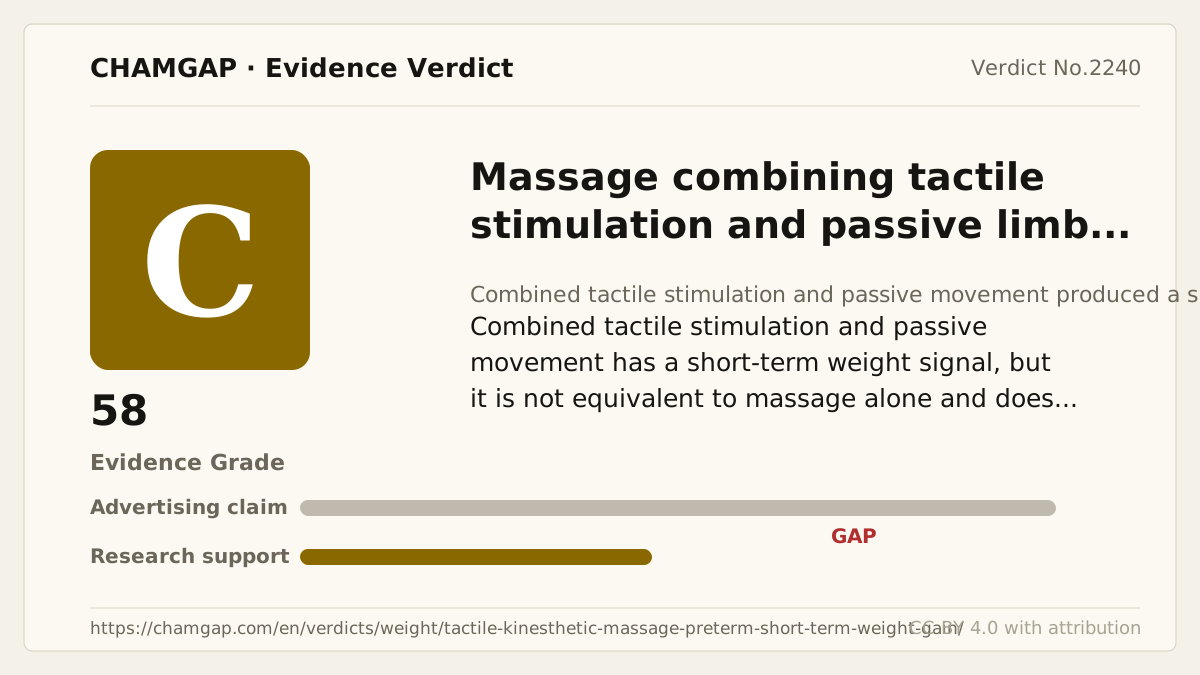
[Chamgap] Tactile-kinesthetic massage in preterm infants x short-term weight gain — Evidence Grade C·50. 4 cited sources checked. Source: https://chamgap.com/en/verdicts/weight/tactile-kinesthetic-massage-preterm-short-term-weight-gain/ · CC BY 4.0CC BY 4.0 — free to use with attribution; do not distort grades, numbers, or verdict meaning.
What this document does and does not do
Chamgap is an information source. It reports what research has and has not confirmed; it does not tell readers what to take or buy. That decision belongs to readers and, when needed, medical or legal professionals. This verdict reflects literature available up to the search date and may change as new research appears. Nothing here is medical advice.