
Red wine 150 mL/day,
does it really help with Weight and abdominal visceral-fat loss?
research showsThe grade is D. In a randomized two-year MRI substudy, weight and visceral-fat changes did not differ between red wine and water. The analysis was restricted to 48 completers from the 224-person parent trial, and the paper concluded no promotion of fat accumulation, not weight loss.
ads claimComposition is not a slimming outcome. The 0.362-1.979 mg/L range was measured in French Pinot Noir and is not a universal red-wine range; it implies about 0.054-0.297 mg in 150 mL. Supplement trials commonly used 150-1,000 mg/day, so those results do not transfer to wine containing ethanol.
Useful facts when choosing a product
- The trial wine supplied 16.9 g ethanol, 270.1 mg gallic-acid-equivalent total phenols, and 120 kcal per 150 mL.
- The 0.362-1.979 mg/L measured in French Pinot Noir yields about 0.054-0.297 mg per 150 mL, roughly 500-18,000 times below 150-1,000 mg supplement doses.
- The paper concluded no promotion of abdominal adiposity, not fat loss.
Chamgap Semantic Classification Code
Candidate index · review held
F.red-wine.food.weight-and-abdominal-visceral-fat-loss.assess.UNKFoods and beverages > Red wine > Food consumption > Weight and abdominal visceral-fat loss > Association or change assessment > Unknown
An automated migration candidate, not an issued permanent code; exact claim scope remains under review. This machine-generated migration candidate helps retrieval but is not a permanent assignment. The original verdict ID and URL remain authoritative.
What the research actually shows
CASCADE randomized 224 adults to water, white wine, or red wine. Sixty-five red-wine or water participants had baseline MRI, while the two-year analysis included only 48 repeat-MRI completers. Eight white-wine MRI participants were excluded. Image analysis was blinded, but the small sample and completer analysis are two avoidable defects. The European Foundation for the Study of Diabetes funded the work, while Golan Heights Winery and Mey Eden supplied beverages.
Why this is classified as D (28)
A 48-person completer MRI substudy found no weight or visceral-fat benefit, and its reported intervals were wide, giving D with 28 points.
Counterpoint. The neutral result in adults with controlled diabetes following a Mediterranean diet does not establish weight-gain effects in every population.
Rejudgment record. Cross-check applied — A 48-completer MRI substudy found no greater weight or visceral-fat loss with red wine than with water
| Endpoint | S | Surrogate marker - laboratory or imaging measures |
| Replication | R1 | Single confirmatory trial |
| Independence | I1 | Mixed funding sources |
| Effect size | E0 | Null |
| Precision | C0 | The confidence interval leaves room for benefit |
Stored derived and displayed grades match; this is not a current recalculation or validity check (D).
Sub-claim grades by effect
This ingredient is marketed for several effects. A single overall grade blends strong and weak claims together, so each effect is graded separately here. The overall grade reflects the strongest disconfirming or core claim.
| Effect (sub-claim) | Grade | Basis |
|---|---|---|
| Weight loss | D | There was no between-group difference versus water. |
| Abdominal visceral-fat loss | D | MRI changes were similar between groups. |
| No promotion of abdominal-fat accumulation | C | This narrow neutrality conclusion differs from a weight-loss claim. |
Cross-check — AI research and Codex final gate
Evidence Table
| Study | Design | Sample | Funding | Endpoint | Result | Weight |
|---|---|---|---|---|---|---|
| Golan R et al. 2017 CASCADE MRI substudy | Two-year randomized parallel-group completer substudy | 65 with baseline MRI; 48 analyzed at two years (27 red wine, 21 water) | European Foundation for the Study of Diabetes funding; beverages supplied in kind | Weight and MRI abdominal-fat distribution | Weight -1.3±3.9 vs -1.0±4.2 kg, P=0.8; visceral fat -3.0% (-8.0 to 2.0) vs -3.2% (-8.9 to 2.5). | Direct randomized evidence limited by a small completer analysis |
Receipt — 2 References
All 2 cited sources were verified for existence at the original page (as of 2026-08-04).
Final verification and publication gate: Codex · Evidence date: 2026-08-04 · Corrections: none
Cite this verdict
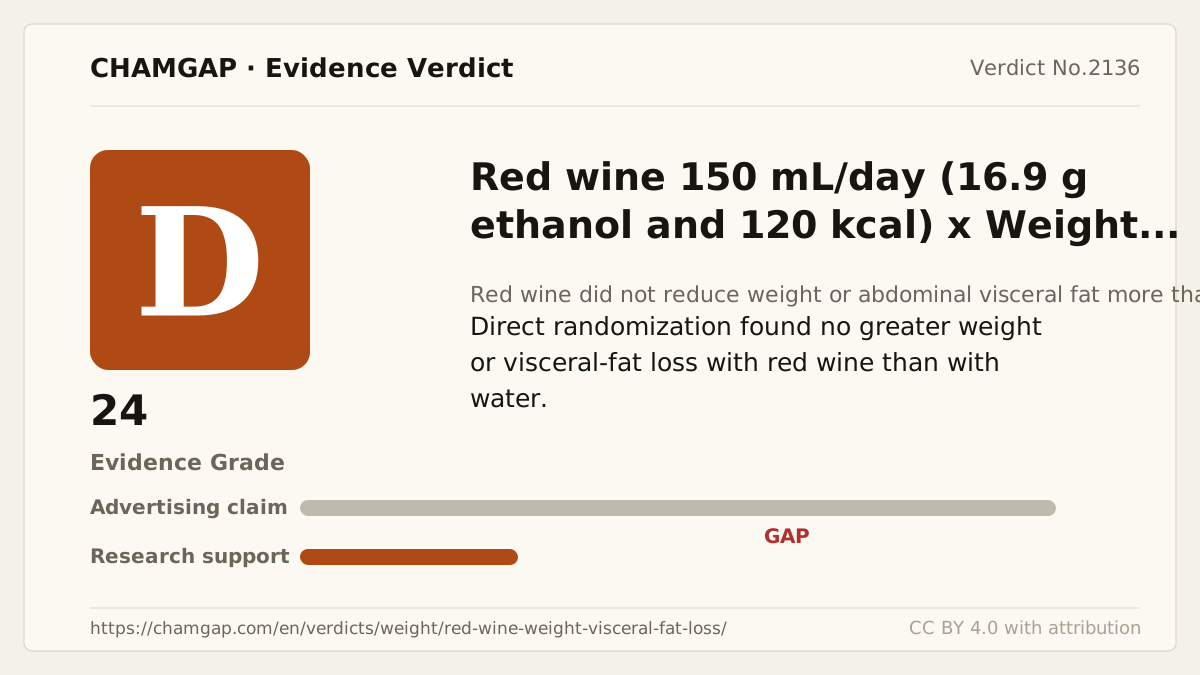
[Chamgap] Red wine 150 mL/day x weight and abdominal-fat loss — Evidence Grade D·28. 2 cited sources checked. Source: https://chamgap.com/en/verdicts/weight/red-wine-weight-visceral-fat-loss/ · CC BY 4.0CC BY 4.0 — free to use with attribution; do not distort grades, numbers, or verdict meaning.
What this document does and does not do
Chamgap is an information source. It reports what research has and has not confirmed; it does not tell readers what to take or buy. That decision belongs to readers and, when needed, medical or legal professionals. This verdict reflects literature available up to the search date and may change as new research appears. Nothing here is medical advice.