
Premeal 500 mL water,
does it really help with Greater 12-week weight loss than a hypocaloric diet alone?
research showsThe grade is C. A 12-week trial randomized 48 adults aged 55 to 75 years with overweight or obesity. The premeal-water group lost weight faster, summarized by the investigators as about 2 kg more. However, the adjusted between-group contrast, standard error, and confidence interval from the official mixed model were not reported, so the standardized magnitude cannot be recovered. One 48-person trial gives C with 50 points.
ads claimPremeal water and a faster loss signal were observed. Removing calorie restriction and counseling from this small older-adult trial turns a tested combined strategy into an unsupported water-only formula.
Useful facts when choosing a product
- The intervention instructed 500 mL of Aquafina 30 minutes before each of three meals, totaling 1.5 L/day.
- The formal primary weight analysis used maximum-likelihood weekly observations from all 48 randomized participants, not only 41 completers.
- Urine specific gravity declined more with water, but change in 24-hour urine volume did not significantly differ between groups.
- Verdict 1088 is D with 30 points for postexercise rehydration; this verdict concerns 12-week weight change when premeal water was added to a hypocaloric diet.
Chamgap Semantic Classification Code
Candidate index · review held
D.drinking-of-water-before-each-meal-during-a-hypocaloric-diet.dietary.greater-weight-loss-than-a-hypocaloric-diet-alone.assess.UNKDietary patterns and eating practices > Drinking of water before each meal during a hypocaloric diet > Dietary regimen > Greater weight loss than a hypocaloric diet alone > Association or change assessment > Unknown
An automated migration candidate, not an issued permanent code; exact claim scope remains under review. This machine-generated migration candidate helps retrieval but is not a permanent assignment. The original verdict ID and URL remain authoritative.
What the research actually shows
Dennis randomized 48 adults aged 55 to 75 years with BMI 25 to 40, 23 to premeal water and 25 to control. Forty-one completed post-testing, but the formal weekly-weight analysis used all available observations from all 48 under full-information maximum likelihood. The intervention used 500 mL of Aquafina 30 minutes before three meals daily, with mean reported adherence of 90%. Urine specific gravity declined more with water, but change in 24-hour urine volume did not differ between groups. Public tables contain baseline and endpoint means with standard errors, but not the uncertainty for the official adjusted between-group weight effect; an unadjusted endpoint calculation was therefore not substituted. The nonprofit Institute for Public Health and Water Research funded the study. No PepsiCo research role beyond Aquafina provision, trial registration, or registered primary endpoint was confirmed.
Why this is classified as C (50)
The all-randomized mixed model produced a positive signal, but the official between-group magnitude cannot be recovered and the evidence is one 48-person trial, giving C with 50 points.
Counterpoint. The reported approximately 2-kg difference is not denied, but without uncertainty for the adjusted contrast it cannot be promoted to a settled clinical magnitude.
Rejudgment record. Cross-check applied — Positive weekly-weight mixed model using all 48 randomized participants, limited by unrecoverable adjusted magnitude and one small trial
| Endpoint | P | Symptom or function itself is the target - including patient reports and performance tests |
| Replication | R1 | Single confirmatory trial |
| Independence | I2 | Decisive evidence is publicly or non-profit funded |
| Effect size | EX | The clinical size of the effect could not be judged |
Stored derived and displayed grades match; this is not a current recalculation or validity check (C).
Sub-claim grades by effect
This ingredient is marketed for several effects. A single overall grade blends strong and weak claims together, so each effect is graded separately here. The overall grade reflects the strongest disconfirming or core claim.
| Effect (sub-claim) | Grade | Basis |
|---|---|---|
| Additional 12-week weight loss during a hypocaloric diet | C | The all-available-data analysis was positive, but uncertainty for the official adjusted contrast cannot be recovered. |
Cross-check — AI research and Codex final gate
Evidence Table
| Study | Design | Sample | Funding | Endpoint | Result | Weight |
|---|---|---|---|---|---|---|
| Dennis EA et al. 2010 | Twelve-week parallel randomized hypocaloric-diet trial | 48 randomized (23/25), 41 completing post-testing, all 48 in the formal weekly-weight analysis | Grant from the nonprofit Institute for Public Health and Water Research; Aquafina provided | Weekly weight change over 12 weeks | A steeper weight-loss slope with water, summarized as about 2 kg more; SE and CI for the official adjusted between-group contrast not reported | Pivotal single small-trial evidence |
Receipt — 1 References
All 1 cited sources were verified for existence at the original page (as of 2026-08-04).
Final verification and publication gate: Codex · Evidence date: 2026-08-04 · Corrections: none
Cite this verdict
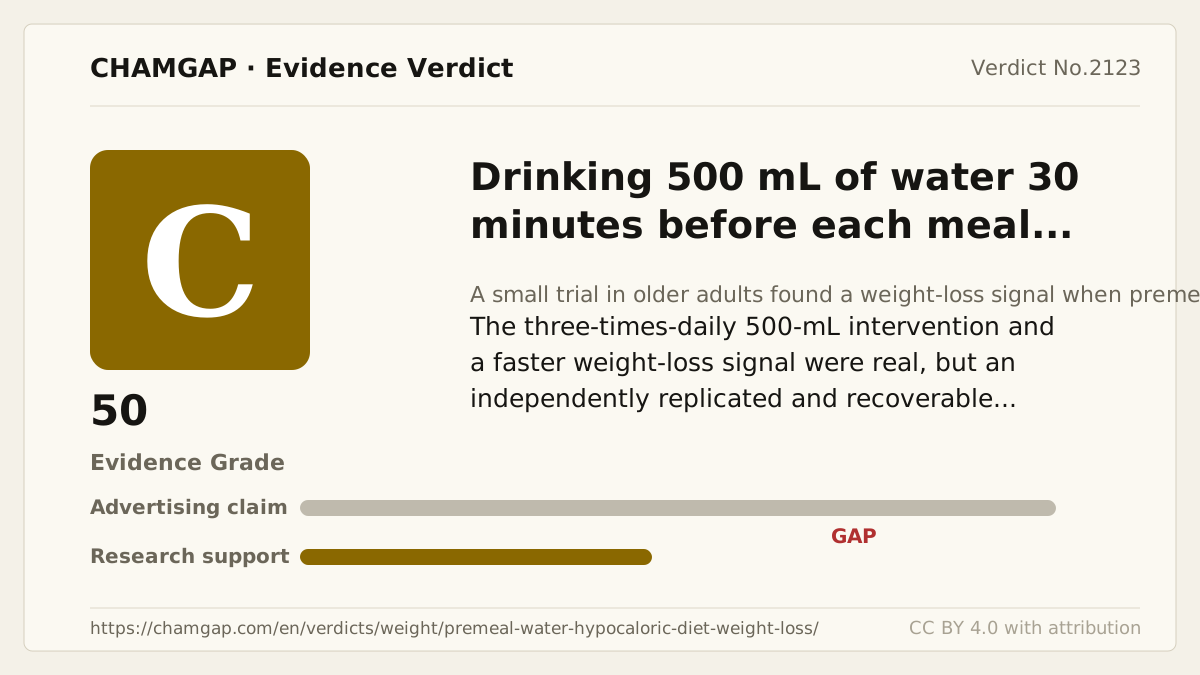
[Chamgap] Premeal 500 mL water x additional weight loss during a hypocaloric diet — Evidence Grade C·50. 1 cited sources checked. Source: https://chamgap.com/en/verdicts/weight/premeal-water-hypocaloric-diet-weight-loss/ · CC BY 4.0CC BY 4.0 — free to use with attribution; do not distort grades, numbers, or verdict meaning.
What this document does and does not do
Chamgap is an information source. It reports what research has and has not confirmed; it does not tell readers what to take or buy. That decision belongs to readers and, when needed, medical or legal professionals. This verdict reflects literature available up to the search date and may change as new research appears. Nothing here is medical advice.