
Phentermine,
does it really help with Extension of short-term appetite suppression and weight loss to long-term loss and maintenance?
research showsLong-term weight loss and maintenance with phentermine monotherapy is rated at the bottom of C. Six placebo-controlled trials found 3.6 kg of additional mean loss over two to 24 weeks, and a 108-participant 36-week randomized trial found losses of 12.2 kg with continuous treatment and 13.0 kg with intermittent treatment versus 4.8 kg with placebo. An observational cohort of 13,972 adults also associated longer use with weight loss at 24 months. Short- and medium-term human efficacy is therefore real. However, no modern monotherapy randomized trial lasting at least one year or post-discontinuation maintenance trial is available, and observational associations cannot establish causality, yielding C with 41 points.
ads claimPromotion connects early appetite reduction and weight change over several weeks to long-term loss and maintenance after stopping. Short-term authorization and early scale change do not prove one-to-two-year persistence, prevention of regain after discontinuation, or cardiovascular clinical benefit.
Useful facts when choosing a product
- Phentermine monotherapy is a short-term prescription adjunct to diet, physical activity, and behavioral change, and United States labeling limits it to a few weeks.
- Insomnia, dry mouth, agitation, palpitations, and increased pulse or blood pressure can occur, and late dosing can worsen insomnia.
- Cardiovascular disease, uncontrolled hypertension, hyperthyroidism, glaucoma, pregnancy, a history of drug misuse, and monoamine oxidase inhibitor use are important contraindications or avoidance conditions.
- Phentermine is a United States Schedule IV controlled substance with potential tolerance and dependence. Longer prescribing may be off label and requires repeated assessment of blood pressure, pulse, benefit, and adverse effects.
Chamgap Semantic Classification Code
Candidate index · review held
M.phentermine.UNK.extension-of-short-term-appetite-suppression-and-weight-loss-to-long-term-loss-and-maintenance.maintain.placeboMedicinal interventions > Phentermine > Unknown > Extension of short-term appetite suppression and weight loss to long-term loss and maintenance > Maintenance claim > Placebo
An automated migration candidate, not an issued permanent code; exact claim scope remains under review. This machine-generated migration candidate helps retrieval but is not a permanent assignment. The original verdict ID and URL remain authoritative.
What the research actually shows
Across six short trials, phentermine 15 to 30 mg daily produced 3.6 kg more weight loss than placebo over two to 24 weeks. In the 108-participant, 36-week double-blind Munro trial, reported losses were 12.2 kg with continuous therapy, 13.0 kg with intermittent therapy, and 4.8 kg with placebo, although only 64 participants completed it. The 13,972-participant electronic-health-record cohort by Lewis associated longer use with weight loss at 24 months but did not randomize treatment or test maintenance after stopping. No modern monotherapy randomized outcome lasting at least one year is available, and the 2026 LEAP publication reports design and baseline characteristics rather than efficacy outcomes.
Why this is classified as C (41)
C. Six trials found 3.6 kg of additional loss over two to 24 weeks, the 108-participant 36-week trial found 12.2 and 13.0 kg versus 4.8 kg, and a 13,972-participant cohort reported a 24-month association. These establish human efficacy signals, but no modern monotherapy randomized trial lasting at least one year or post-discontinuation maintenance trial exists, yielding the bottom-of-band C score of 41. Cardiovascular, blood-pressure, insomnia, dependence, and short-term-authorization issues remain under safety.
Counterpoint. Longer use may be considered individually in practice after weighing chronic obesity, alternatives, initial response, and risk. That clinical option is not equivalent to a high evidence grade for this specific long-term efficacy claim.
Rejudgment record. Reassessment (cross-check reflected) — Accepted human efficacy from six two-to-24-week trials with 3.6 kg of additional loss, the positive 108-participant 36-week randomized trial, and the 24-month association in 13,972 observational participants, but applied the bottom of C because no modern monotherapy randomized trial lasting at least one year or post-discontinuation maintenance trial exists
Sub-claim grades by effect
This ingredient is marketed for several effects. A single overall grade blends strong and weak claims together, so each effect is graded separately here. The overall grade reflects the strongest disconfirming or core claim.
| Effect (sub-claim) | Grade | Basis |
|---|---|---|
| Long-term weight loss and maintenance | C | Weight loss is positive through 36 weeks, but no monotherapy randomized trial lasting at least one year or maintenance trial establishes long-term maintenance. |
| Short-term appetite suppression and weight loss | ? | Weight loss over several weeks is separately established and is not the axis of this verdict. |
| Weight maintenance after discontinuation | ? | No trial has tested maintenance after discontinuation. |
Cross-check — AI research and Codex final gate
Evidence Table
| Study | Design | Sample | Funding | Endpoint | Result | Weight |
|---|---|---|---|---|---|---|
| Haddock CK et al. 2002; summarized by Yanovski 2014 | Meta-analysis of short-term placebo-controlled trials | Six trials lasting two to 24 weeks | Academic evidence synthesis | On-treatment body-weight change | Phentermine produced 3.6 kg more mean weight loss than placebo but did not test long-term maintenance. | Supports short-term efficacy but is indirect for the target long-term claim |
| Munro JF et al. 1968 | Randomized double-blind placebo-controlled continuous and intermittent treatment trial | 108 women with obesity; 64 completers; 36 weeks | Inadequately reported; 1960s drug trial | On-treatment body-weight change | Completer losses were 12.2 kg continuous, 13.0 kg intermittent, and 4.8 kg placebo, but attrition was high and follow-up was under one year. | Limited historical near-long-term evidence |
| Lewis KH et al. 2019 | Electronic-health-record observational cohort | 13,972 adults with weight follow-up through 24 months | Academic research | Association between duration of phentermine use and weight change at 24 months | Longer use was associated with weight loss at 24 months, but nonrandomized data could not establish causality or maintenance after discontinuation. | Large long-term observational association with causal limitations |
| Young CB et al. LEAP design, 2026 | Design and baseline report for a 24-month multicenter randomized double-blind placebo-controlled trial | Approximately 1,000 planned participants across five United States sites | Patient-Centered Outcomes Research Institute funding | Planned 24-month weight, blood pressure, cardiovascular-risk, and safety outcomes | Only design and baseline characteristics have been published; long-term efficacy results are not yet available. | Confirms the current direct-evidence gap |
Receipt — 5 References
All 5 cited sources were verified for existence at the original page (as of 2026-07-19).
Final verification and publication gate: Codex · Evidence date: 2026-07-19 · Corrections: none
Cite this verdict
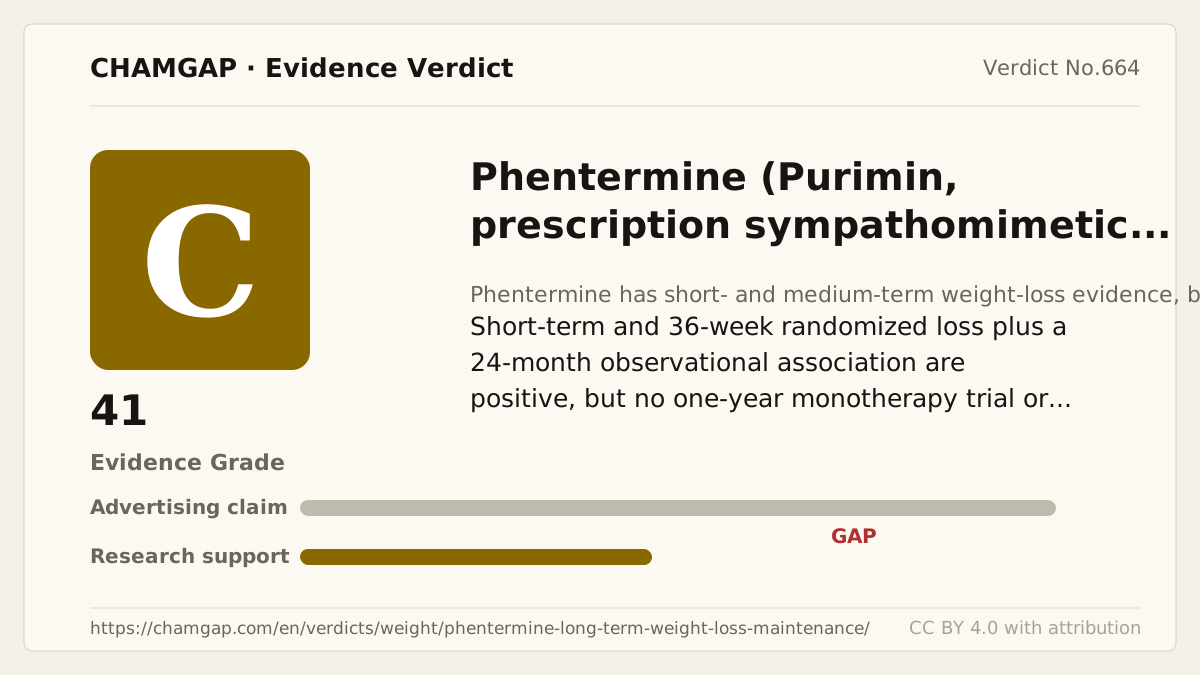
[Chamgap] Phentermine x long-term weight loss and maintenance — Evidence Grade C·41. 5 cited sources checked. Source: https://chamgap.com/en/verdicts/weight/phentermine-long-term-weight-loss-maintenance/ · CC BY 4.0CC BY 4.0 — free to use with attribution; do not distort grades, numbers, or verdict meaning.
What this document does and does not do
Chamgap is an information source. It reports what research has and has not confirmed; it does not tell readers what to take or buy. That decision belongs to readers and, when needed, medical or legal professionals. This verdict reflects literature available up to the search date and may change as new research appears. Nothing here is medical advice.