
Oolong tea,
does it really help with Reduced body weight and body fat in adults with overweight or obesity through daily consumption?
research showsDaily oolong tea for weight and body-fat reduction is rated D. The central direct study gave 8 g per day for six weeks to 102 adults with overweight or obesity, but it was an uncontrolled before-and-after study, so diet, activity, regression to the mean, and the tea effect cannot be separated. A randomized three-day crossover study in 12 participants assessed only energy expenditure and fat oxidation, while a 14-day crossover study in 12 participants also measured body weight and fat but found no significant between-condition differences, leaving only a surrogate fat-oxidation signal. Effects in a high-catechin oolong beverage trial are attributable to the added catechins rather than oolong tea itself.
ads claimClaims that daily oolong tea burns fat and causes weight loss turn brief metabolic experiments and uncontrolled before-and-after change into durable weight reduction. Sweeteners and creamers can add energy, while sustained weight loss still depends chiefly on total energy intake, diet quality, activity, and sleep.
Useful facts when choosing a product
- Oolong tea is brewed from Camellia sinensis leaves oxidized to a degree between typical green and black tea. Caffeine and polyphenol content varies widely with processing and brewing.
- The 2009 weight study used 8 g of dry tea leaves per day for six weeks but had no control group. This cannot be interpreted as a validated weight-loss dose.
- Trials that add high-dose green-tea catechin extract to an oolong beverage matrix are green-tea-extract trials, not tests of ordinary oolong tea itself. This verdict is separate from existing green-tea and catechin verdicts.
- Caffeine can cause insomnia, palpitations, anxiety, headache, and gastrointestinal discomfort. Pregnancy, caffeine sensitivity, arrhythmia, and reflux warrant adjustment of amount and timing.
Chamgap Semantic Classification Code
Candidate index · review held
S.oolong-tea.UNK.body-weight-and-body-fat-with-overweight-or-obesity-through-daily-consumption.reduce.placeboSupplements and nutraceuticals > Oolong tea > Unknown > body weight and body fat with overweight or obesity through daily consumption > Reduction claim > Placebo
An automated migration candidate, not an issued permanent code; exact claim scope remains under review. This machine-generated migration candidate helps retrieval but is not a permanent assignment. The original verdict ID and URL remain authoritative.
What the research actually shows
He 2009 gave 8 g of oolong tea daily for six weeks to 102 adults with overweight or obesity and reported that many lost more than 1 kg, but there was no control group. Rumpler 2001 found that three days of full-strength oolong tea increased 24-hour energy expenditure by 2.9% and fat oxidation by 12% versus water in a randomized crossover study of 12 men. Zhang 2020 found about 20% higher fat oxidation after 14 days in 12 nonobese men, while energy expenditure and sleep architecture were unchanged. Body weight was reported as 62.0, 61.6, and 61.6 kg and body-fat percentage as 18.5%, 17.8%, and 17.5%, with no significant between-condition differences, so the findings remained predominantly surrogate-based. A 2024 network meta-analysis of tea and coffee drinking did not include oolong tea as a separate intervention and rated even the green-tea weight evidence as low or very low certainty.
Why this is classified as D (24)
Direct human evidence for body weight and fat centers on an uncontrolled six-week before-and-after study of 102 participants. The 14-day randomized crossover trial measured body weight and fat but found no significant between-condition differences, leaving only a metabolic-surrogate signal. With no direct randomized controlled evidence of weight reduction and no causal attribution from the main study, the grade is D with 24 points. Effects in a high-catechin oolong beverage trial are attributed to the added catechins rather than oolong tea itself, and caffeine safety plus beverage calories are assessed separately.
Counterpoint. Unsweetened oolong tea can reduce total energy intake when it replaces a caloric drink. That substitution effect differs from a claim that oolong-specific constituents directly reduce body fat.
Rejudgment record. Cross-check applied — Applied D for low-quality uncontrolled evidence because the direct six-week weight study in 102 adults lacked a randomized control and the 14-day randomized crossover study measured weight and body fat but found no significant between-condition differences, leaving predominantly energy-expenditure and fat-oxidation surrogates; attributed effects in high-catechin oolong beverages to the added catechins rather than oolong tea itself
Sub-claim grades by effect
This ingredient is marketed for several effects. A single overall grade blends strong and weak claims together, so each effect is graded separately here. The overall grade reflects the strongest disconfirming or core claim.
| Effect (sub-claim) | Grade | Basis |
|---|---|---|
| Body-weight reduction in adults with overweight or obesity | D | The direct six-week evidence was an uncontrolled single-arm before-and-after study, preventing causal attribution. |
| Body-fat reduction in adults with overweight or obesity | D | No randomized controlled trial has shown body-fat reduction in adults with overweight or obesity; a 14-day crossover study in 12 nonobese men measured body fat but found no significant between-condition difference. |
| Increased energy expenditure and fat oxidation with daily intake | D | Three-to-fourteen-day metabolic studies in 12 participants signaled fat oxidation, but energy-expenditure results were inconsistent and do not establish weight loss. |
Cross-check — AI research and Codex final gate
Evidence Table
| Study | Design | Sample | Funding | Endpoint | Result | Weight |
|---|---|---|---|---|---|---|
| He RR et al. 2009 | Six-week single-arm before-and-after consumption study | 102 adults with overweight or obesity | Inadequately reported; some authors were affiliated with tea-related corporate research | Body weight, waist circumference, abdominal subcutaneous-fat thickness, and lipids | Weight reduction was reported after 8 g per day for six weeks, but the absence of a control prevented causal attribution to oolong tea. | Direct evidence with a critical uncontrolled-design limitation |
| Rumpler W et al. 2001 | Randomized crossover metabolic study | 12 adult men | Inadequately reported; authors included affiliations with the United States Department of Agriculture and Suntory | Twenty-four-hour energy expenditure and fat oxidation on day three | Full-strength oolong tea increased energy expenditure by 2.9% and fat oxidation by 12% versus water but did not assess body weight or fat. | Small short-term surrogate evidence |
| Zhang S et al. 2020 | Randomized placebo-controlled double-blind crossover trial | 12 nonobese adult men | Japanese JSPS and NARO public and matching grants | Twenty-four-hour energy metabolism, fat oxidation, polysomnography, body weight, and body fat on day 14 | Fat oxidation increased by about 20%, but energy expenditure did not. Body weight of 62.0, 61.6, and 61.6 kg and body-fat percentage of 18.5%, 17.8%, and 17.5% were measured and reported, with no significant between-condition differences, leaving predominantly surrogate findings. | Modern small surrogate study |
Receipt — 4 References
All 4 cited sources were verified for existence at the original page (as of 2026-07-24).
Final verification and publication gate: Codex · Evidence date: 2026-07-24 · Corrections: none
Cite this verdict
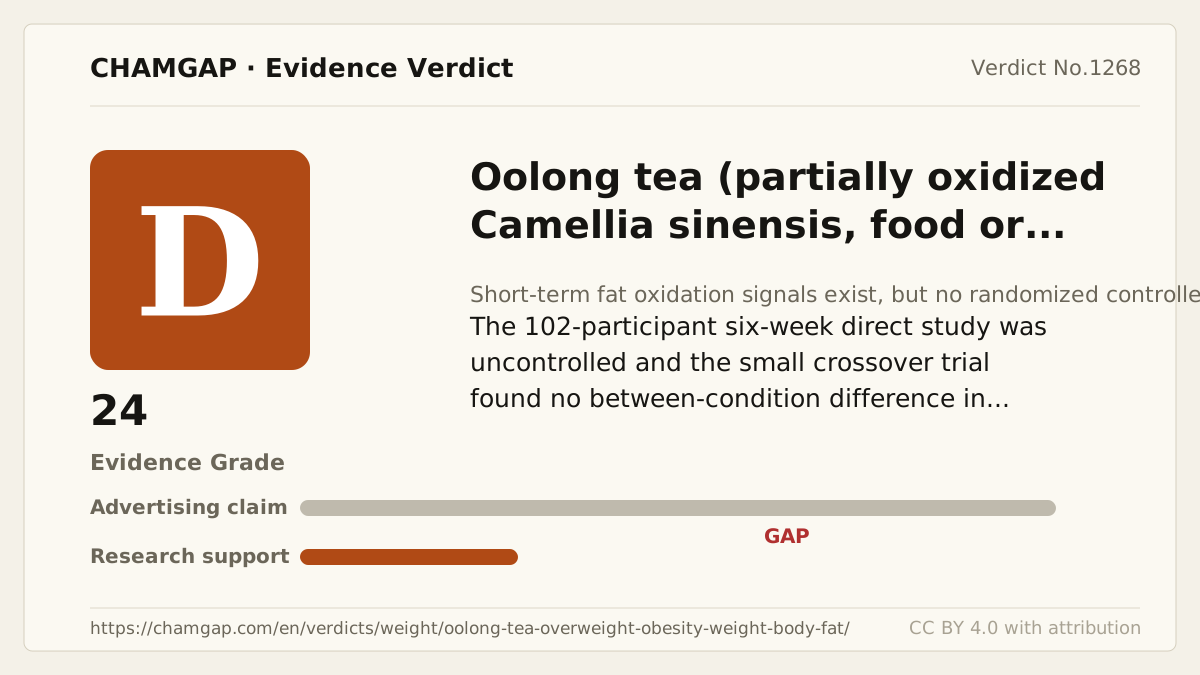
[Chamgap] Oolong tea x reduced body weight and body fat in adults with overweight or obesity — Evidence Grade D·24. 4 cited sources checked. Source: https://chamgap.com/en/verdicts/weight/oolong-tea-overweight-obesity-weight-body-fat/ · CC BY 4.0CC BY 4.0 — free to use with attribution; do not distort grades, numbers, or verdict meaning.
What this document does and does not do
Chamgap is an information source. It reports what research has and has not confirmed; it does not tell readers what to take or buy. That decision belongs to readers and, when needed, medical or legal professionals. This verdict reflects literature available up to the search date and may change as new research appears. Nothing here is medical advice.