
Modified baby-led weaning,
does it really help with Healthier growth and prevention of overweight?
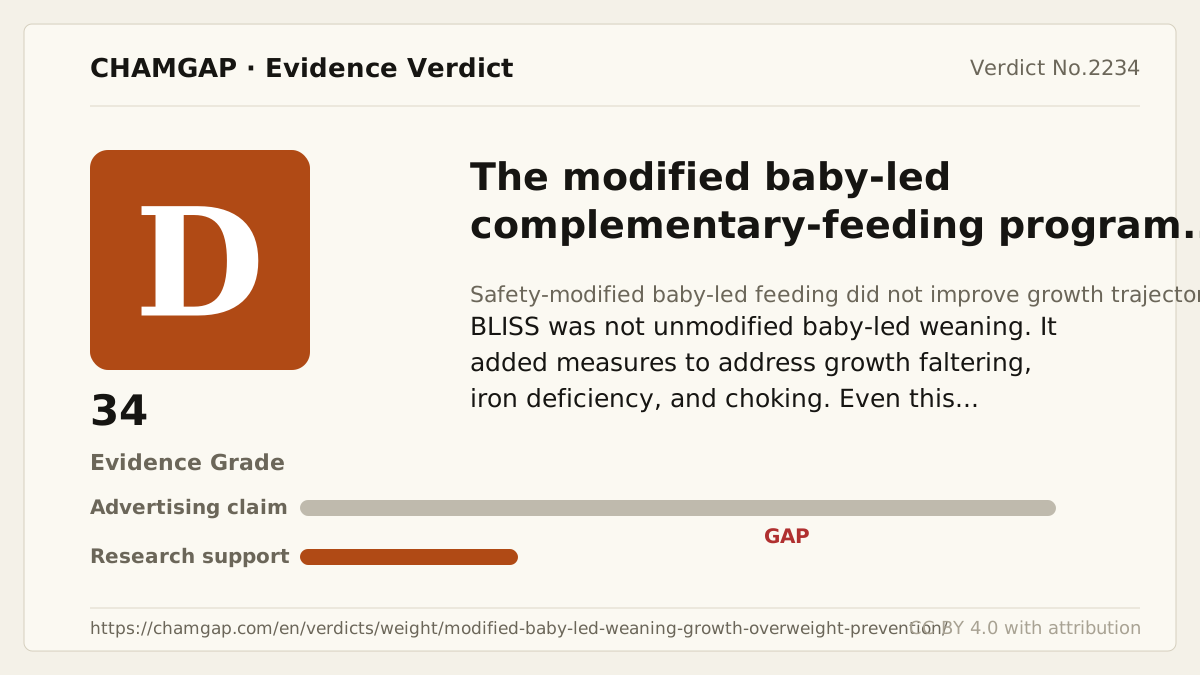
research showsThe grade is D. BLISS randomized 206 healthy term infants to modified baby-led feeding, 105, or usual complementary feeding, 101. Among 166 completing 24-month anthropometry, BMI z score was 0.39 versus 0.24; the registered multiple-imputation primary analysis gave adjusted difference 0.16 (95% CI -0.13 to 0.45). Overweight occurred in 10.3% versus 6.4%, RR 1.8 (0.6 to 5.7). Neither healthier growth nor overweight prevention was demonstrated, giving D with 28 points.
ads claimInfant self-feeding does not by itself prove appetite self-regulation or overweight prevention. The tested intervention was safety-modified BLISS, which must also be distinguished from unmodified baby-led weaning.
Useful facts when choosing a product
- At 24 months, measured mean BMI z score was 0.39 with BLISS and 0.24 with control; adjusted difference 0.16 (95% CI -0.13 to 0.45).
- Overweight at 24 months occurred in 10.3% versus 6.4%, RR 1.8 (95% CI 0.6 to 5.7).
- BLISS modified baby-led weaning with iron, energy, and choking-prevention guidance.
Chamgap Semantic Classification Code
Candidate index · review held
UNK.modified-baby-led-complementary-feeding-program-bliss-from-about-through.UNK.healthier-growth-and-prevention-of-overweight.prevent.usual-careUnknown > modified baby-led complementary-feeding program BLISS from about through > Unknown > Healthier growth and prevention of overweight > Occurrence-prevention claim > Usual care
An automated migration candidate, not an issued permanent code; exact claim scope remains under review. This machine-generated migration candidate helps retrieval but is not a permanent assignment. The original verdict ID and URL remain authoritative.
What the research actually shows
The New Zealand BLISS trial randomized 206 families in late pregnancy to usual care, 101, or BLISS, 105. Beginning around six months, BLISS emphasized self-feeding while offering an iron-rich, energy-rich, and easy-to-eat food at each meal and avoiding choking hazards. BMI z score was measured in 84 versus 93 at 12 months and 78 versus 88 at 24 months. The official analysis used multiple imputation and covariate adjustment. ACTRN12612001133820 and the prospectively published protocol identified 12-month BMI z score as primary and planned 24-month follow-up. Funding included Lottery Health Research and the University of Otago as well as Meat & Livestock Australia and KPS Limited.
Why this is classified as D (28)
Blinded anthropometry in a prospectively registered trial found null primary growth outcomes at both 12 and 24 months. Without a validated refutation threshold, remaining possible benefit prevents F and gives D with 28 points.
Counterpoint. This verdict does not assess family convenience, shared-meal experience, or dietary variety. It addresses only healthier growth and overweight prevention.
Rejudgment record. Cross-check applied — Null prospectively registered BMI z-score outcomes at 12 and 24 months with a wide overweight interval
| Endpoint | S | Surrogate marker - laboratory or imaging measures |
| Replication | R1 | Single confirmatory trial |
| Independence | I1 | Mixed funding sources |
| Effect size | E0 | Null |
| Precision | C0 | The confidence interval leaves room for benefit |
Stored derived and displayed grades match; this is not a current recalculation or validity check (D).
Sub-claim grades by effect
This ingredient is marketed for several effects. A single overall grade blends strong and weak claims together, so each effect is graded separately here. The overall grade reflects the strongest disconfirming or core claim.
| Effect (sub-claim) | Grade | Basis |
|---|---|---|
| Improved BMI z score at 12 and 24 months | D | Adjusted between-group differences were null at both time points. |
| Prevention of overweight at 24 months | D | Rates were 10.3% versus 6.4%, with a wide RR interval. |
Cross-check — AI research and Codex final gate
Evidence Table
| Study | Design | Sample | Funding | Endpoint | Result | Weight |
|---|---|---|---|---|---|---|
| Taylor et al. 2017 BLISS growth trial | Prospectively registered randomized controlled trial | 206 randomized, 105 versus 101; 166 with 24-month anthropometry, 88 versus 78 | Mixed support including Lottery Health Research, University of Otago, Meat & Livestock Australia, and KPS Limited | Registered 12-month primary BMI z score, 24-month follow-up, and overweight | Adjusted BMI z-score difference 0.21 (-0.07 to 0.48) at 12 months and 0.16 (-0.13 to 0.45) at 24 months; 24-month overweight RR 1.8 (0.6 to 5.7) | Decisive randomized growth and overweight evidence |
Receipt — 3 References
All 3 cited sources were verified for existence at the original page (as of 2026-08-04).
Final verification and publication gate: Codex · Evidence date: 2026-08-04 · Corrections: none
Cite this verdict
[Chamgap] Modified baby-led weaning x healthier growth and overweight prevention — Evidence Grade D·28. 3 cited sources checked. Source: https://chamgap.com/en/verdicts/weight/modified-baby-led-weaning-growth-overweight-prevention/ · CC BY 4.0CC BY 4.0 — free to use with attribution; do not distort grades, numbers, or verdict meaning.
What this document does and does not do
Chamgap is an information source. It reports what research has and has not confirmed; it does not tell readers what to take or buy. That decision belongs to readers and, when needed, medical or legal professionals. This verdict reflects literature available up to the search date and may change as new research appears. Nothing here is medical advice.