
Long-term lorcaserin,
does it really help with Long-term weight loss?
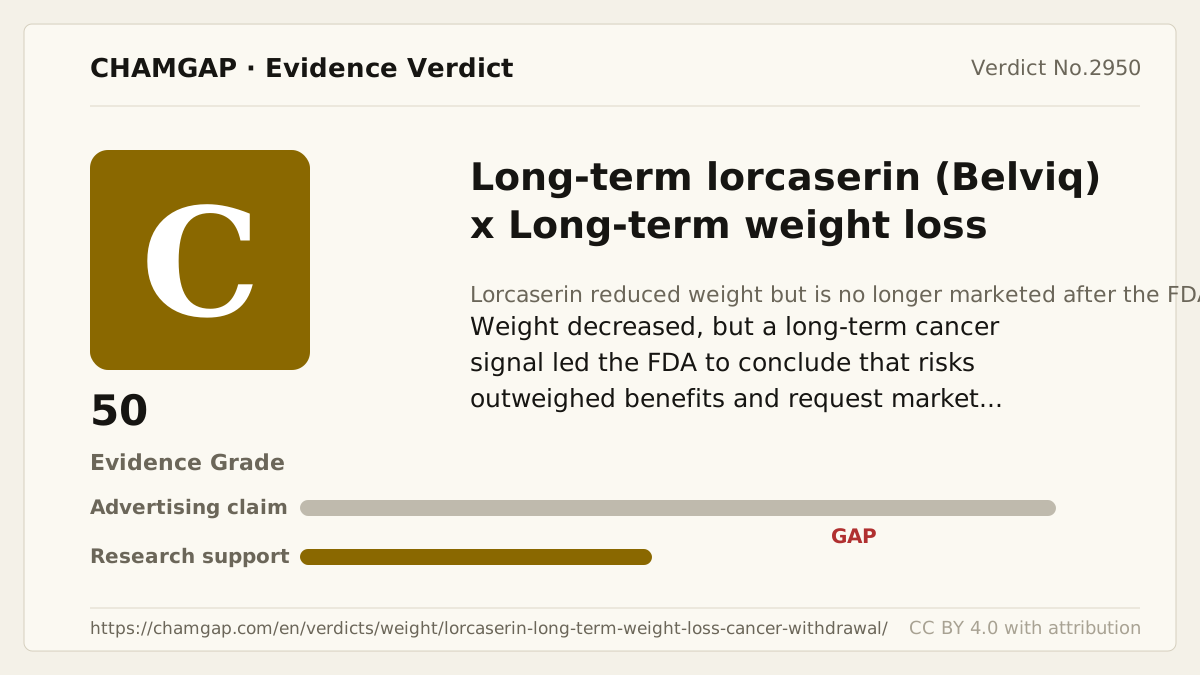
research showsAfter reviewing completed data, the FDA found cancer diagnoses in 462 lorcaserin patients (7.7%; 520 primary cancers) versus 423 placebo patients (7.1%; 470 cancers), with imbalances in pancreatic, colorectal, and lung cancers contributing. The estimate was about one additional cancer per 470 patient-years of treatment, and the imbalance increased over time. On February 13, 2020, the FDA requested voluntary withdrawal and Eisai withdrew the drug; it is no longer marketed. Weight-loss evidence itself is C with 50 points, but that does not mean the drug is acceptable to take.
ads claimAdvertising only the one-year 5% response rate omits current withdrawal status and the long-term cancer signal. Other serotonergic weight-loss drugs were withdrawn for different reasons—valvulopathy with fenfluramine, cardiovascular harm with sibutramine, and psychiatric harm with rimonabant—so lorcaserin findings should not be generalized across the class.
Useful facts when choosing a product
- Lorcaserin was a serotonin 2C receptor agonist used for weight management.
- Eisai voluntarily withdrew it from the US market after the FDA request in 2020.
- No prespecified clinical threshold existed for cancer, and the public FDA safety communication did not report an overall-cancer HR, CI, or P value.
Chamgap Semantic Classification Code
Candidate index · review held
UNK.long-term-lorcaserin.UNK.long-term-weight-loss.assess.placeboUnknown > Long-term lorcaserin > Unknown > Long-term weight loss > Association or change assessment > Placebo
An automated migration candidate, not an issued permanent code; exact claim scope remains under review. This machine-generated migration candidate helps retrieval but is not a permanent assignment. The original verdict ID and URL remain authoritative.
What the research actually shows
CAMELLIA randomized 12,000 participants, 6,000 per arm, in a double-blind placebo-controlled trial with median follow-up of 3.3 years. Eisai fully funded it and company employees were authors. BLOOM and CAMELLIA belonged to the same developer program with overlapping funding and authors, so they are not independent confirmation by separate investigators and funders; axis 2 remains R1. The public FDA safety communication did not provide an overall-cancer hazard ratio, confidence interval, or P value. Regulatory judgment is therefore distinguished from statistically confirmed overall-cancer harm. A paper summarizing the FDA's CAMELLIA review exists (PMID 32905671).
Why this is classified as C (50)
Several randomized trials confirmed weight-loss responses, but weight was a surrogate, BLOOM and CAMELLIA came from the same developer program rather than independent replication, and long-term maintenance results were inconsistent, giving C with 50 points. The cancer signal and withdrawal separately warrant a Warning label.
Counterpoint. Cardiovascular safety noninferiority was met, but MACE+ superiority was null and cancer was a separate long-term safety judgment. Evidence grade and present usability must not be conflated.
Rejudgment record. Cross-check applied — Weight response in CAMELLIA-TIMI 61 with a surrogate endpoint, manufacturer-only evidence, and noninferiority design
| Endpoint | S | Surrogate marker - laboratory or imaging measures |
| Replication | R1 | Single confirmatory trial |
| Independence | I0 | Evidence comes only from manufacturer studies |
| Effect size | E+ | Meets the clinically important threshold |
Stored derived and displayed grades match; this is not a current recalculation or validity check (C).
Sub-claim grades by effect
This ingredient is marketed for several effects. A single overall grade blends strong and weak claims together, so each effect is graded separately here. The overall grade reflects the strongest disconfirming or core claim.
| Effect (sub-claim) | Grade | Basis |
|---|---|---|
| At least 5% weight loss at one year | C | Rates were 38.7% versus 17.4%, P<.001. |
| Cardiovascular event superiority | D | MACE+ was null, HR 0.97, P=.55. |
Cross-check — AI research and Codex final gate
Evidence Table
| Study | Design | Sample | Funding | Endpoint | Result | Weight |
|---|---|---|---|---|---|---|
| Bohula EA et al. 2018 CAMELLIA-TIMI 61 | Multicenter double-blind placebo-controlled cardiovascular noninferiority randomized trial | 12,000 randomized, 6,000 per arm; median follow-up 3.3 years | Fully funded by Eisai; sponsor co-designed the trial and participated in the manuscript | At least 5% weight loss at one year; MACE safety and MACE+ efficacy | At least 5% loss 38.7% vs 17.4%, P<.001; MACE HR 0.99 (0.85-1.14); MACE+ HR 0.97 (0.87-1.07), P=.55 | Pivotal large manufacturer-funded trial |
| FDA 2020 cancer reanalysis of CAMELLIA-TIMI 61 | Regulatory reanalysis of the completed clinical trial | The same 12,000-participant CAMELLIA-TIMI 61 trial | US FDA regulatory review | Cancer diagnoses and primary cancers | 462 patients (7.7%, 520 cancers) vs 423 (7.1%, 470 cancers); about one additional cancer per 470 patient-years, with divergence over time | Safety reanalysis of the same trial, not counted as a separate efficacy trial |
| Smith SR et al. 2010 BLOOM | Multicenter double-blind placebo-controlled randomized trial | 3,182 randomized | Same developer program as CAMELLIA, with overlapping funding and authors | At least 5% weight loss at 52 weeks | 47.5% vs 20.3%; one-year retention 55.4% (883/1595) vs 45.1% (716/1587) | Positive weight evidence, limited by low retention and nonindependent program |
| Wadden TA et al. 2018 maintenance trial | Randomized maintenance trial after at least 5% loss on a low-calorie diet | 137 participants | As reported in the original paper | Coprimary weight-loss maintenance outcomes at 24 and 52 weeks | At 24 weeks, maintenance of at least 5% loss was 73.9% vs 57.4% (P=.033), with -2.4±0.8 kg additional loss vs +0.6±0.8 kg gain (P=.010); at 52 weeks neither coprimary outcome differed between groups | Maintenance context positive at 24 weeks and null at 52 weeks |
Receipt — 5 References
All 5 cited sources were verified for existence at the original page (as of 2026-08-26).
Final verification and publication gate: Codex · Evidence date: 2026-08-26 · Corrections: none
Cite this verdict
[Chamgap] Benefit of Lorcaserin for Long-Term Weight Loss — Evidence Grade C·50. 5 cited sources checked. Source: https://chamgap.com/en/verdicts/weight/lorcaserin-long-term-weight-loss-cancer-withdrawal/ · CC BY 4.0CC BY 4.0 — free to use with attribution; do not distort grades, numbers, or verdict meaning.
What this document does and does not do
Chamgap is an information source. It reports what research has and has not confirmed; it does not tell readers what to take or buy. That decision belongs to readers and, when needed, medical or legal professionals. This verdict reflects literature available up to the search date and may change as new research appears. Nothing here is medical advice.