
Irish sea moss,
does it really help with Appetite suppression and weight loss?
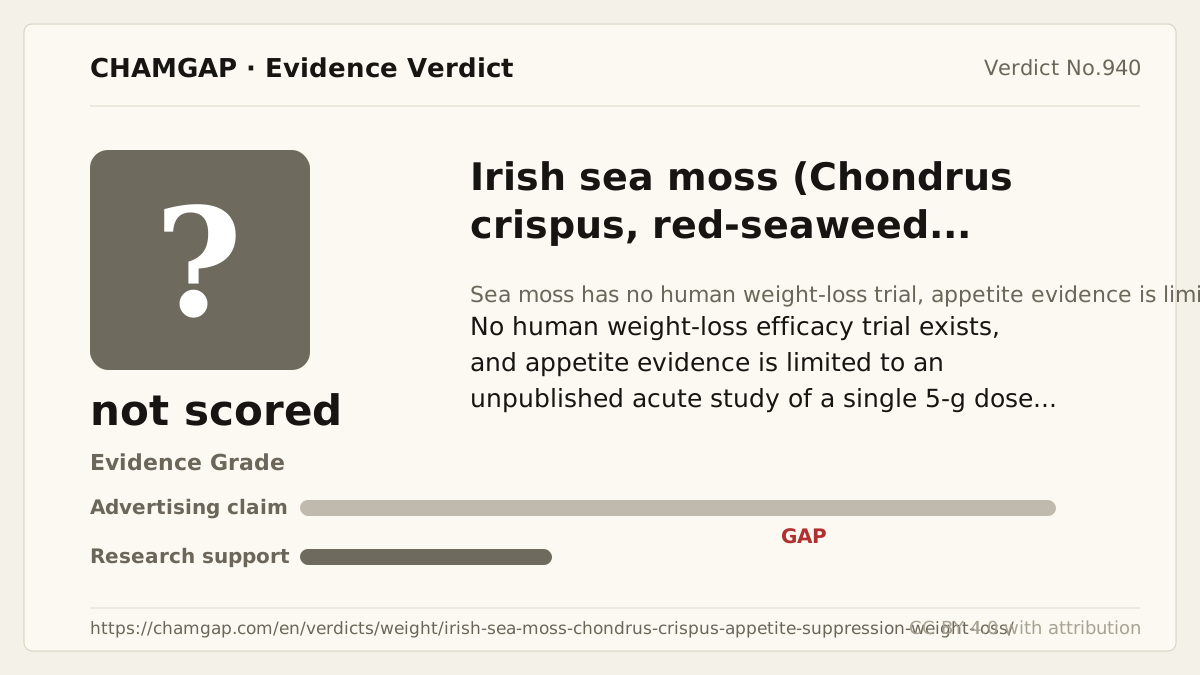
research showsIrish sea moss receives a question-mark grade because no human efficacy trial has evaluated weight loss, and the appetite evidence is insufficient to establish efficacy. A 2022 unpublished master's thesis used a randomized controlled single-blind crossover design in 30 healthy men to assess satiety and subsequent food intake after a single meal containing 5 g of Chondrus crispus. This evidence is unpublished, acute, and small and did not test longer-term weight or body fat. The published evidence reviewed in 2023 and the 2024 Chondrus review otherwise centers on other seaweeds or composition, laboratory, and animal studies. Carrageenan, mucilage, iodine, or preclinical mechanisms cannot be attributed to weight-loss efficacy for C. crispus. Claim-matched efficacy is therefore unestablished, so the question-mark grade and null score remain. Excess iodine and potential heavy-metal accumulation are separate safety issues.
ads claimMarketing links mucilage, minerals, iodine, and possible prebiotic activity to greater satiety, faster thyroid metabolism, and fat burning. These are constituent or mechanistic stories, not human weight-loss outcomes for sea moss.
Useful facts when choosing a product
- Chondrus crispus is a red seaweed containing polysaccharides such as carrageenan, but gel viscosity or fiber content alone does not establish appetite suppression or weight loss in humans.
- Drying, heating, and harvest location can alter nutrient, mineral, and bioactive composition, so study material cannot automatically be equated with retail gels or capsules.
- Seaweeds can accumulate iodine and heavy metals including arsenic, lead, cadmium, and mercury, creating substantial uncertainty when a product lacks a species name, serving size, iodine content, and independent test results.
- People with thyroid disease or thyroid medicines require particular caution, and LactMed advises avoiding sea moss during breastfeeding unless iodine and heavy-metal levels are demonstrated to be sufficiently low.
Chamgap Semantic Classification Code
Candidate index · review held
S.irish-sea-moss.UNK.appetite-suppression-and-weight-loss.assess.UNKSupplements and nutraceuticals > Irish sea moss > Unknown > Appetite suppression and weight loss > Association or change assessment > Unknown
An automated migration candidate, not an issued permanent code; exact claim scope remains under review. This machine-generated migration candidate helps retrieval but is not a permanent assignment. The original verdict ID and URL remain authoritative.
What the research actually shows
Trigo and colleagues searched whole-seaweed randomized trials from 2000 through May 2023 and reviewed 25 published studies covering appetite, anthropometry, and metabolic markers; most had moderate to high risk of bias, and the review emphasized a published-trial gap for red seaweeds. A 2022 unpublished master's thesis used a randomized controlled single-blind crossover design in 30 healthy men who consumed one meal with 5 g of C. crispus and assessed two-hour satiety and subsequent intake. The Park review showed that reported Chondrus health activities were otherwise centered on laboratory and animal studies, while the Liu rat study was not a human weight-loss trial. The 2026 LactMed sea-moss entry likewise states that medicinal value has not been proven and highlights iodine and heavy-metal exposure.
Why this is classified as ?
No human C. crispus efficacy trial has assessed weight loss, and appetite evidence consists only of a 2022 unpublished acute master's thesis testing one 5-g meal in 30 healthy men. This small study cannot establish sustained appetite suppression or weight efficacy, so the grade is a question mark and the score is null. Composition studies, rat work, iodine mechanisms, and research on other seaweeds were not upgraded into weight-efficacy evidence, while iodine and heavy metals remain separate safety concerns.
Counterpoint. This differs in efficacy target from sea moss and thyroid claims, but both apply the same question-mark principle when no direct human literature matches the claim.
Rejudgment record. New verdict — Applied the question-mark grade because no Chondrus crispus trial measured weight or body-fat reduction and appetite evidence was limited to a 2022 unpublished acute master's thesis testing one 5-g meal in 30 healthy men; composition, iodine mechanisms, rat data, and other seaweed species were not attributed to weight efficacy
Sub-claim grades by effect
This ingredient is marketed for several effects. A single overall grade blends strong and weak claims together, so each effect is graded separately here. The overall grade reflects the strongest disconfirming or core claim.
| Effect (sub-claim) | Grade | Basis |
|---|---|---|
| Appetite suppression from Irish sea moss | ? | Only a 2022 unpublished acute master's thesis tested a single 5-g dose in 30 healthy men, leaving sustained appetite-suppression efficacy unestablished. |
| Weight loss from Irish sea moss | ? | No controlled human C. crispus trial was identified that measured change in body weight or body fat. |
| Long-term weight maintenance from Irish sea moss | ? | No claim-matched human literature evaluated either initial weight loss or long-term weight maintenance. |
Cross-check — AI research and Codex final gate
Evidence Table
| Study | Design | Sample | Funding | Endpoint | Result | Weight |
|---|---|---|---|---|---|---|
| Trigo JP et al. 2023 | Critical review of randomized human trials of whole-seaweed consumption | Twenty-five randomized trials | Academic review with mixed funding among included trials | Appetite, anthropometry, glucose, lipids, blood pressure, thyroid function, iodine, and other outcomes | Published whole-seaweed evidence was limited and mostly at moderate to high risk of bias, with a highlighted published-trial gap for red and non-Asian cultivated species. | Human-literature gap assessment with species mismatch |
| Park SJ et al. 2024 | Review of chemical constituents and biological properties of the Chondrus genus | Literature from 1995 through October 2023 | Academic review; funding was not reported in the PubMed abstract | Laboratory and animal biological activities including antioxidant and anti-inflammatory effects | Potential health activities were based mainly on laboratory and animal evidence, without a published human C. crispus appetite or weight-loss trial. | Species-specific confirmation of a preclinical evidence base |
| Liu J et al. 2015 | Three-week preclinical rat feeding study of C. crispus supplementation | Six rats per group | Three employees of Acadian Seaplants Limited were coauthors | Gut microbiota, short-chain fatty acids, colon histology, and immunoglobulins | Microbiota and short-chain fatty acids changed, but the study did not test human appetite or clinical weight loss. | Mechanistic preclinical evidence not matched to the claim |
| LactMed Sea Moss monograph. 2026 | United States National Library of Medicine lactation and safety evidence summary | Evidence summary revised February 15, 2026 | Public database of the National Institute of Child Health and Human Development | Medicinal value, iodine, heavy metals, and lactation safety | Medicinal value was not proven, and avoidance during breastfeeding was advised unless iodine and heavy metals are demonstrated to be sufficiently low. | Updated safety and efficacy-gap summary |
Receipt — 5 References
All 5 cited sources were verified for existence at the original page (as of 2026-07-21).
Final verification and publication gate: Codex · Evidence date: 2026-07-21 · Corrections: none
Cite this verdict
[Chamgap] Irish sea moss x appetite suppression and weight loss — Evidence Grade ?. 5 cited sources checked. Source: https://chamgap.com/en/verdicts/weight/irish-sea-moss-chondrus-crispus-appetite-suppression-weight-loss/ · CC BY 4.0CC BY 4.0 — free to use with attribution; do not distort grades, numbers, or verdict meaning.
What this document does and does not do
Chamgap is an information source. It reports what research has and has not confirmed; it does not tell readers what to take or buy. That decision belongs to readers and, when needed, medical or legal professionals. This verdict reflects literature available up to the search date and may change as new research appears. Nothing here is medical advice.