
Inositol,
does it really help with Reduced BMI and waist circumference and improved weight management in adults with metabolic disorders or polycystic ovary syndrome?
research showsThe broad weight-management claim for inositol is rated D. The 2025 GRADE review included 18 randomized trials and 898 participants overall, but the BMI synthesis used 10 trials. Its pooled BMI estimate of -0.57 kg/m² was positive only in trials at high risk of bias. The three good or fair trials gave a null estimate of +0.33, the polycystic ovary syndrome subgroup was also null at -0.51, and even the overall mean did not reach the prespecified clinically important difference of 0.95 kg/m². Reliable evidence is effectively null, yielding D with 38 points.
ads claimMarketing can expand small average changes in BMI and waist circumference into claims of normalized polycystic-ovary-syndrome weight, belly-fat loss, or accelerated dieting. The evidence pools different metabolic populations and formulations, while individual response, actual fat-mass change, and long-term maintenance remain uncertain.
Useful facts when choosing a product
- Commercial inositol products contain myo-inositol alone, D-chiro-inositol alone, or mixtures of the two. Doses and ratios vary, so results from one formulation cannot automatically be transferred to another.
- The meta-analyses pooled different populations, including polycystic ovary syndrome, overweight or obesity, and metabolic disorders, under varying dietary and medication co-interventions. Generalization to independent weight loss in healthy adults is difficult.
- BMI and waist circumference are surrogate anthropometric measures. An average change does not prove reduced body fat, loss of at least 5% of body weight, long-term weight maintenance, or fewer complications.
- Inositol is generally well tolerated, but higher doses can cause nausea, abdominal discomfort, gas, loose stools, or diarrhea. People who are pregnant or use glucose-lowering medicines should review the product and dose with their clinician.
Chamgap Semantic Classification Code
Candidate index · review held
S.inositol.UNK.bmi-and-waist-circumference-and-improved-weight-management-with-metabolic-disorders-or-polycystic-ovary-syndrome.reduce.UNKSupplements and nutraceuticals > Inositol > Unknown > BMI and waist circumference and improved weight management with metabolic disorders or polycystic ovary syndrome > Reduction claim > Unknown
An automated migration candidate, not an issued permanent code; exact claim scope remains under review. This machine-generated migration candidate helps retrieval but is not a permanent assignment. The original verdict ID and URL remain authoritative.
What the research actually shows
The 2025 GRADE systematic review and meta-analysis by Agajani Delavar and colleagues included 18 randomized trials and 898 participants across all outcomes, while the BMI synthesis comprised 10 trials. The overall weighted mean difference for BMI was -0.57 kg/m² (95% CI -1.10 to -0.03; I²=88.6%; low certainty), but benefit was confined to trials at high risk of bias. The three good or fair trials gave a null estimate of +0.33, and the polycystic ovary syndrome subgroup was also null at -0.51. Waist circumference changed by -2.36 cm (95% CI -4.39 to -0.33; I²=55%; very low certainty), and the overall BMI difference was smaller than the prespecified minimal clinically important difference of 0.95 kg/m². Trials mixed myo-inositol, D-chiro-inositol, pinitol, doses, co-interventions, and durations. The heterogeneous 2022 estimate of -0.41 kg/m² does not override the null findings in more reliable trials.
Why this is classified as D (38)
The pooled BMI estimate of -0.57 kg/m² was positive only in high-risk-of-bias trials; the three good or fair trials at +0.33 and the polycystic ovary syndrome subgroup at -0.51 were null. The prespecified 0.95-kg/m² clinically important difference was not reached, certainty was low to very low, and myo-inositol, D-chiro-inositol, pinitol, and doses were mixed. Under boundary rule 2 for effectively null reliable evidence, the result is D with 38 points.
Counterpoint. A clinician may choose inositol as an adjunct within a treatment plan for polycystic ovary syndrome or insulin resistance. When weight management is the goal, weight and waist trends should be checked over a defined interval and the assumption of continued benefit reconsidered if there is no change.
Rejudgment record. Cross-validation incorporated — The 18 randomized trials and 898 participants across all outcomes were separated from the 10-trial BMI synthesis. The pooled BMI estimate of -0.57 kg/m² was positive only in poor-quality trials at high risk of bias; the three good or fair trials at +0.33 and the polycystic ovary syndrome subgroup at -0.51 were null, and the prespecified clinically important difference of 0.95 kg/m² was not reached. The waist-circumference signal was isolated and of very low certainty, while forms and doses were mixed. Boundary rule 2 therefore assigns D when reliable evidence is effectively null.
Sub-claim grades by effect
This ingredient is marketed for several effects. A single overall grade blends strong and weak claims together, so each effect is graded separately here. The overall grade reflects the strongest disconfirming or core claim.
| Effect (sub-claim) | Grade | Basis |
|---|---|---|
| Reduced BMI in adults with metabolic disorders or polycystic ovary syndrome | D | The positive mean in the 10-trial BMI synthesis was driven by high-risk-of-bias trials, while three good or fair trials at +0.33 and the polycystic ovary syndrome subgroup at -0.51 were null. Myo-inositol, D-chiro-inositol, pinitol, and doses were mixed. |
| Reduced waist circumference in adults with metabolic disorders or polycystic ovary syndrome | C | The recent meta-analysis reported -2.36 cm, but this was an isolated signal with very low certainty and mixed forms and doses. |
| Clinically meaningful weight loss and long-term weight maintenance | D | Even the overall mean BMI difference was below the prespecified 0.95 minimal clinically important difference, reliable trials were null, and there was no direct evidence of at least 5% weight loss or durable maintenance. |
Cross-check — AI research and Codex final gate
Evidence Table
| Study | Design | Sample | Funding | Endpoint | Result | Weight |
|---|---|---|---|---|---|---|
| Agajani Delavar M et al. 2025 | GRADE-assessed systematic review and meta-analysis of randomized controlled trials | 18 randomized trials and 898 participants overall; 10 trials in the BMI synthesis | No funds, grants, or other support were received for the manuscript; no competing interests declared | BMI, waist circumference, waist-to-hip ratio, and metabolic markers | Among 18 trials and 898 participants across all outcomes, the BMI synthesis used 10 trials. The overall BMI estimate of -0.57 kg/m² was positive only in high-risk-of-bias trials; three good or fair trials at +0.33 and the polycystic ovary syndrome subgroup at -0.51 were null. The -2.36-cm waist-circumference estimate had very low certainty, and the BMI change was below the prespecified 0.95 minimal clinically important difference. | Key recent synthesis, but reliable BMI trials were null |
| Zarezadeh M et al. 2022 | Systematic review and meta-analysis of randomized clinical trials | 15 controlled trials | Research support from Tabriz University of Medical Sciences; no conflict of interest reported | Body mass index | BMI was 0.41 kg/m² lower with inositol than control (95% CI -0.78 to -0.04), with substantial heterogeneity of I²=73.9%. | Supporting synthesis with a repeated positive direction but substantial heterogeneity |
Receipt — 2 References
All 2 cited sources were verified for existence at the original page (as of 2026-07-21).
Final verification and publication gate: Codex · Evidence date: 2026-07-21 · Corrections: none
Cite this verdict
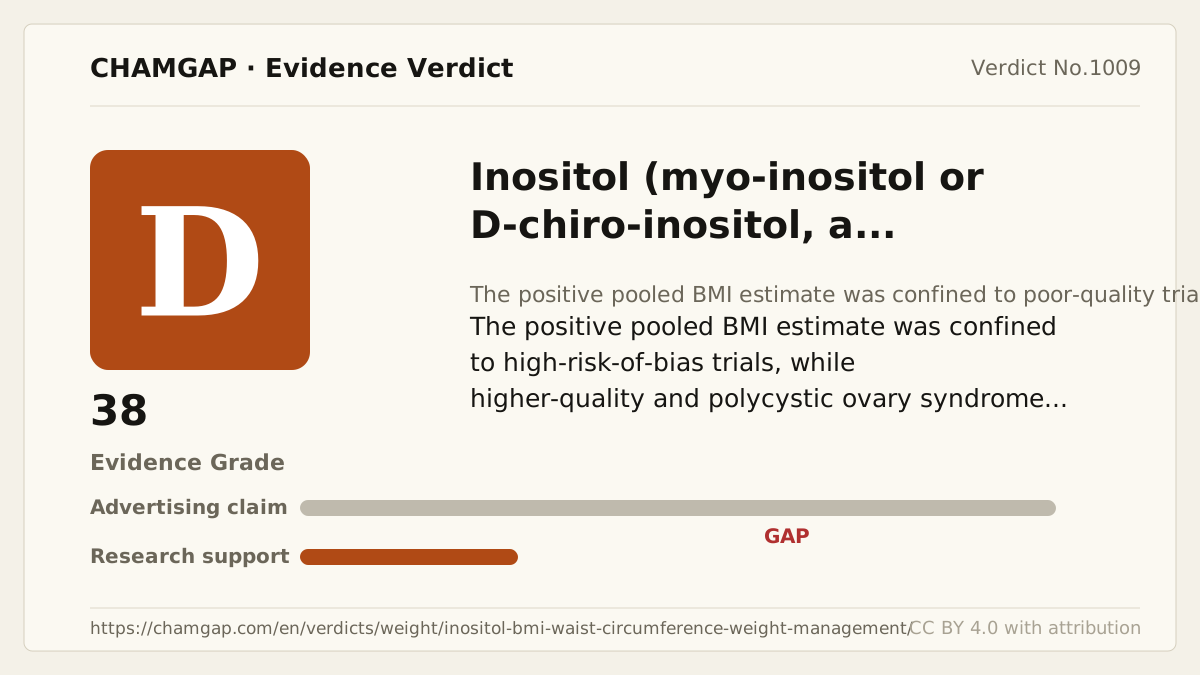
[Chamgap] Inositol x reduced BMI and waist circumference for weight management — Evidence Grade D·38. 2 cited sources checked. Source: https://chamgap.com/en/verdicts/weight/inositol-bmi-waist-circumference-weight-management/ · CC BY 4.0CC BY 4.0 — free to use with attribution; do not distort grades, numbers, or verdict meaning.
What this document does and does not do
Chamgap is an information source. It reports what research has and has not confirmed; it does not tell readers what to take or buy. That decision belongs to readers and, when needed, medical or legal professionals. This verdict reflects literature available up to the search date and may change as new research appears. Nothing here is medical advice.