
Healthy low-carbohydrate diet,
does it really help with Greater 12-month weight loss than a healthy low-fat diet?
research showsThe grade is D. DIETFITS randomized 609 adults with overweight or obesity and no diabetes. Twelve-month weight change was -6.0 kg with healthy low carbohydrate and -5.3 kg with healthy low fat; the adjusted between-group difference was -0.7 kg (95% CI -1.6 to 0.2). Both groups lost weight, but low carbohydrate was not superior, giving D with 30 points.
ads claimLower carbohydrate intake was real, but it did not translate into superior weight loss over the matched low-fat program.
Useful facts when choosing a product
- At 12 months, reported carbohydrate intake was about 132 g/day in the low-carbohydrate group versus 212 g/day in the low-fat group.
- Reported fat intake was about 87 versus 57 g/day.
- Both arms emphasized food quality and behavioral education without a prescribed calorie target.
- Verdict 1647 is D with 34 points for eight-hour time-restricted eating, and verdict 1718 is D with 35 points for alternate-day fasting; this is a macronutrient-pattern comparison.
Chamgap Semantic Classification Code
Candidate index · review held
D.healthy-low-carbohydrate-diet.dietary.greater-weight-loss-than-a-healthy-low-fat-diet.assess.UNKDietary patterns and eating practices > Healthy low-carbohydrate diet > Dietary regimen > Greater weight loss than a healthy low-fat diet > Association or change assessment > Unknown
An automated migration candidate, not an issued permanent code; exact claim scope remains under review. This machine-generated migration candidate helps retrieval but is not a permanent assignment. The original verdict ID and URL remain authoritative.
What the research actually shows
DIETFITS randomized 609 adults aged 18 to 50 years with BMI 28 to 40 and no diabetes: 305 to healthy low fat and 304 to healthy low carbohydrate. The primary mixed model included missing observations; 481 had measured 12-month weights. Both groups reduced fat or digestible carbohydrate to 20 g/day for 8 weeks, then titrated upward. Unannounced 24-hour recalls at 12 months showed about 212 versus 132 g/day carbohydrate and 57 versus 87 g/day fat. The planned extreme diets were not maintained, but the groups remained meaningfully separated for comparison. There was no calorie target, and reported energy fell similarly in both groups. A submission change on July 27, 2017, after follow-up ended, narrowed the existing 3-, 6-, and 12-month primary time frame to 12 months. This was a post hoc narrowing of the existing primary time frame, not outcome replacement or selection of a secondary outcome after primary failure, and it does not fit any of the three precedent 27 categories exactly. Funding included US public grants and Nutrition Science Initiative support.
Why this is classified as D (30)
A large publicly and nonprofit-funded direct trial found no superiority on the registered primary endpoint while allowing a small residual benefit, giving D with 30 points.
Counterpoint. Both groups lost about 5 to 6 kg. D applies to superiority, not to whether either program can produce weight loss.
Rejudgment record. Cross-check applied — Failure of low-carbohydrate superiority on the registered 12-month primary weight endpoint in DIETFITS
| Endpoint | P | Symptom or function itself is the target - including patient reports and performance tests |
| Replication | R1 | Single confirmatory trial |
| Independence | I2 | Decisive evidence is publicly or non-profit funded |
| Effect size | E0 | Null |
| Precision | C0 | The confidence interval leaves room for benefit |
Stored derived and displayed grades match; this is not a current recalculation or validity check (D).
Sub-claim grades by effect
This ingredient is marketed for several effects. A single overall grade blends strong and weak claims together, so each effect is graded separately here. The overall grade reflects the strongest disconfirming or core claim.
| Effect (sub-claim) | Grade | Basis |
|---|---|---|
| Greater 12-month weight loss than low fat | D | The -0.7-kg between-group difference had a confidence interval crossing zero. |
Cross-check — AI research and Codex final gate
Evidence Table
| Study | Design | Sample | Funding | Endpoint | Result | Weight |
|---|---|---|---|---|---|---|
| Gardner CD et al. 2018 DIETFITS | Twelve-month parallel randomized clinical trial | 609 randomized (305/304), 481 with measured 12-month weight, primary mixed-model analysis | NIDDK, NHLBI, Stanford CTSA, and Nutrition Science Initiative | Primary endpoint of 12-month weight change | -6.0 versus -5.3 kg; adjusted difference -0.7 kg (95% CI -1.6 to 0.2) | Pivotal direct-comparison evidence |
| DIETFITS registration and analysis plan | Trial registry and prespecified analysis plan | Planned randomization of 609 participants | Public and nonprofit research support | Twelve-month weight change | After follow-up, a July 27, 2017 change narrowed the existing 3-, 6-, and 12-month primary time frame to 12 months | Supporting evidence for endpoint prespecification |
Receipt — 2 References
All 2 cited sources were verified for existence at the original page (as of 2026-08-04).
Final verification and publication gate: Codex · Evidence date: 2026-08-04 · Corrections: none
Cite this verdict
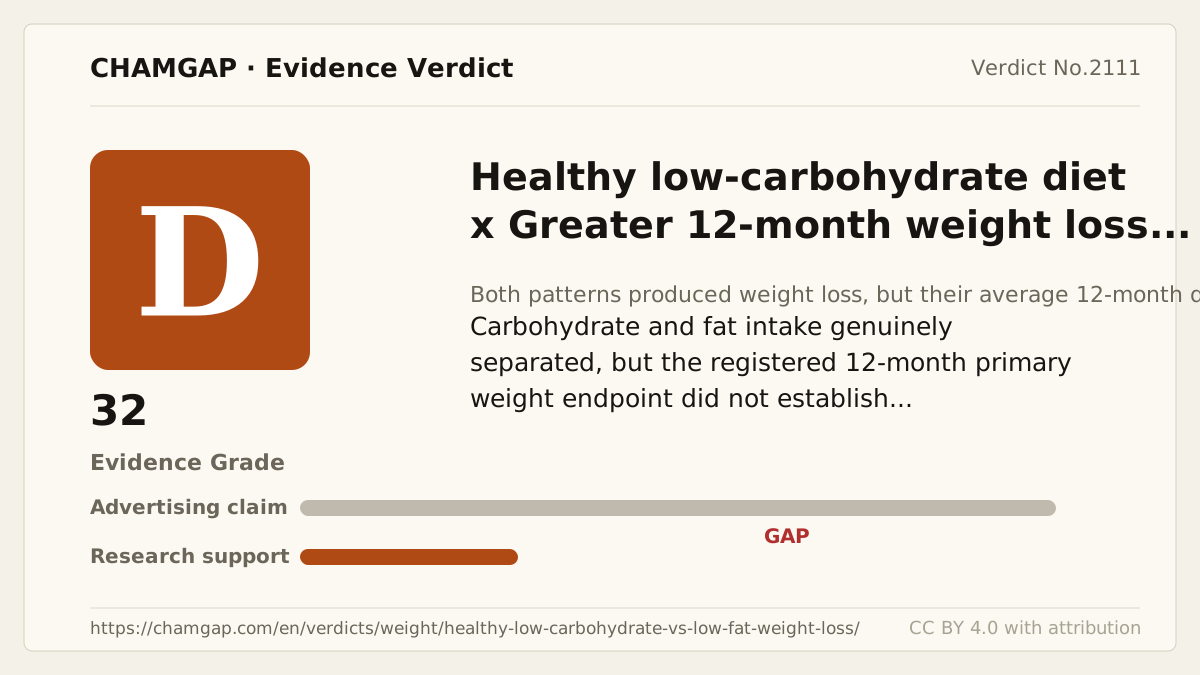
[Chamgap] Healthy low-carbohydrate diet x greater weight loss than a low-fat diet — Evidence Grade D·30. 2 cited sources checked. Source: https://chamgap.com/en/verdicts/weight/healthy-low-carbohydrate-vs-low-fat-weight-loss/ · CC BY 4.0CC BY 4.0 — free to use with attribution; do not distort grades, numbers, or verdict meaning.
What this document does and does not do
Chamgap is an information source. It reports what research has and has not confirmed; it does not tell readers what to take or buy. That decision belongs to readers and, when needed, medical or legal professionals. This verdict reflects literature available up to the search date and may change as new research appears. Nothing here is medical advice.