
Frozen portion-controlled entrees,
does it really help with Greater 12-week weight loss than a self-selected-food program?
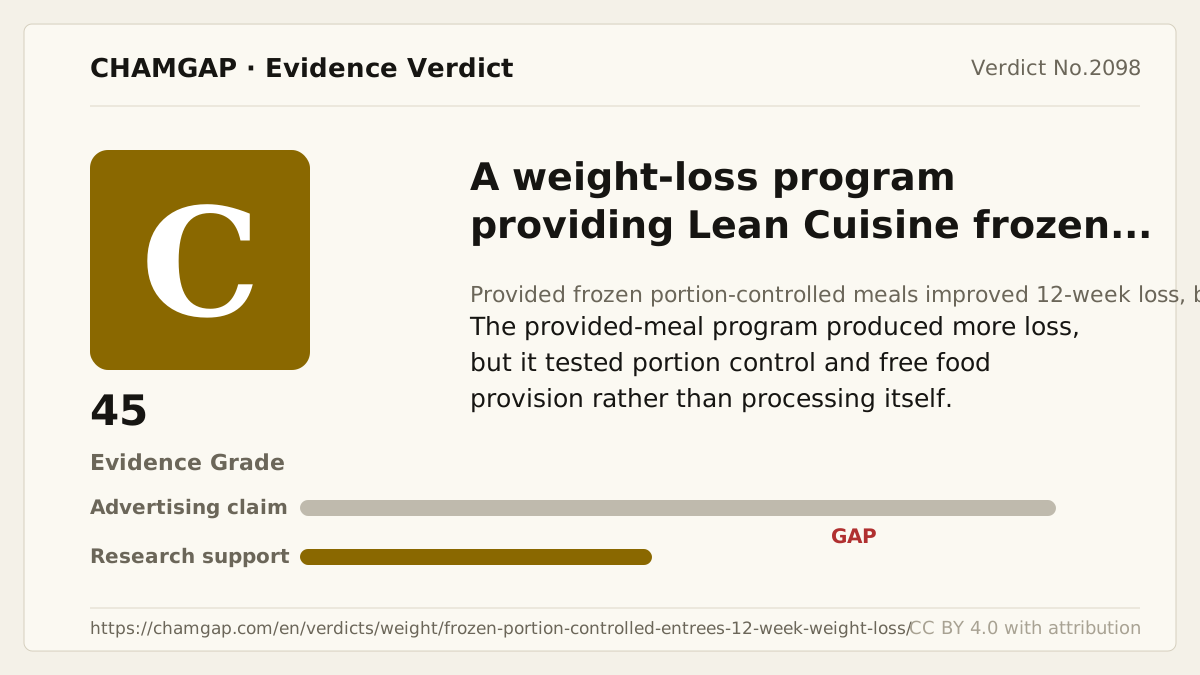
research showsThe grade is C. The study recruited 184 adults, excluded one after pregnancy was identified, analyzed 183, and had 12-week weights for 180. Weight loss was 8.6 plus or minus 3.9%, 7.8 plus or minus 5.1%, and 6.0 plus or minus 4.4% in regular-entree, higher-protein-entree, and self-selected groups. The prespecified pooled entree comparison was positive, but food provision, counseling, and a manufacturer-funded product were bundled.
ads claimThe study did not isolate frozen-food processing. It tested free provision of predetermined portions from one brand inside a behavioral program.
Useful facts when choosing a product
- Study entrees averaged 281 kcal, 16.3 g protein, 6.2 g fat, and 40 g carbohydrate each.
- Mean sodium, total sugar, saturated fat, and fiber across all 50 products were not reported; current labels cannot be retrofitted as trial-era values.
- Verdict 1504 is B with 75 points for total low-calorie diet replacement and diabetes remission; this verdict concerns two daily frozen entrees during a 12-week weight-loss program.
Chamgap Semantic Classification Code
Candidate index · review held
F.weight-loss-program-providing-lean-cuisine-frozen-portion-controlled-lunch-and-dinner-entrees.food.greater-weight-loss-than-a-self-selected-food-program.assess.UNKFoods and beverages > weight-loss program providing Lean Cuisine frozen portion-controlled lunch and dinner entrees > Food consumption > Greater weight loss than a self-selected-food program > Association or change assessment > Unknown
An automated migration candidate, not an issued permanent code; exact claim scope remains under review. This machine-generated migration candidate helps retrieval but is not a permanent assignment. The original verdict ID and URL remain authoritative.
What the research actually shows
Rock and colleagues randomized 184 participants, excluded one after pregnancy was identified, analyzed 183, and had week-12 weights for 180. Nominal arm counts were 67 regular-entree, 71 higher-protein-entree, and 45 self-selected participants; the arm allocation of the three without week-12 data could not be confirmed. The primary analysis pooled the two packaged-food arms against control. Nestle USA funded the trial, supplied food, and discussed design. One author disclosed institutional clinical-trial funding from Jenny Craig and Nestle; another was a former Nestle Research employee who currently received consulting fees.
Why this is classified as C (46)
A positive primary outcome is limited by a single small manufacturer-funded active-control trial and a boundary-near standardized approximation based on nominal arm counts, giving C with 46 points.
Counterpoint. C does not mean frozen foods are inherently slimming; it describes limited evidence for this specific portion-provision strategy.
Rejudgment record. Cross-check applied — Cross-checked the registered primary analysis, analysis sample, standardized between-group magnitude, product composition, and Nestle role
| Endpoint | P | Symptom or function itself is the target - including patient reports and performance tests |
| Replication | R1 | Single confirmatory trial |
| Independence | I0 | Evidence comes only from manufacturer studies |
| Effect size | E~ | Statistically positive but below the threshold |
Stored derived and displayed grades match; this is not a current recalculation or validity check (C).
Sub-claim grades by effect
This ingredient is marketed for several effects. A single overall grade blends strong and weak claims together, so each effect is graded separately here. The overall grade reflects the strongest disconfirming or core claim.
| Effect (sub-claim) | Grade | Basis |
|---|---|---|
| Greater 12-week weight loss than self-selected foods | C | The prespecified pooled comparison was positive but bundled food provision with counseling. |
Cross-check — AI research and Codex final gate
Evidence Table
| Study | Design | Sample | Funding | Endpoint | Result | Weight |
|---|---|---|---|---|---|---|
| Rock CL et al., 2016 | Three-arm randomized behavioral weight-loss trial | 184 randomized, one pregnancy exclusion, 183 analyzed, and 180 with week-12 weights | Nestle USA funding and food provision | Primary percent weight change at 12 weeks | 8.6 plus or minus 3.9%, 7.8 plus or minus 5.1%, and 6.0 plus or minus 4.4%; pooled packaged arms versus control P<0.005 | Positive registered primary outcome in a single manufacturer-funded short program |
Receipt — 2 References
All 2 cited sources were verified for existence at the original page (as of 2026-08-03).
Final verification and publication gate: Codex · Evidence date: 2026-08-03 · Corrections: none
Cite this verdict
[Chamgap] Frozen portion-controlled entrees x 12-week weight loss — Evidence Grade C·46. 2 cited sources checked. Source: https://chamgap.com/en/verdicts/weight/frozen-portion-controlled-entrees-12-week-weight-loss/ · CC BY 4.0CC BY 4.0 — free to use with attribution; do not distort grades, numbers, or verdict meaning.
What this document does and does not do
Chamgap is an information source. It reports what research has and has not confirmed; it does not tell readers what to take or buy. That decision belongs to readers and, when needed, medical or legal professionals. This verdict reflects literature available up to the search date and may change as new research appears. Nothing here is medical advice.