
Forty chews per bite,
does it really help with Reduced ad-libitum energy intake at one meal?
research showsThe grade is C with 50 points. In a crossover experiment of 16 lean and 14 obese men, energy intake was 2304.4±490.4 kJ with 40 chews versus 2614.7±511.6 kJ with 15 chews, an 11.9% reduction (P=0.034). The parallel-group-style approximation, which cannot use within-person correlation, gives a standardized difference of about 0.62; this was one meal in 30 young men and cannot establish long-term weight loss.
ads claimEating less at that meal is supported. Losing weight over weeks or months was not tested.
Useful facts when choosing a product
- Calories were intentionally not matched because ad-libitum intake was the outcome.
- The 15- versus 40-chew instruction applied to each 10-g bite and all 30 participants were analyzed.
- Verdict 1416 is C with 55 points for vegetable-and-protein-first meal order; this verdict concerns chewing count and one-meal intake.
Chamgap Semantic Classification Code
Candidate index · review held
D.forty-chews-per-bite.oral.ad-libitum-energy-intake-at-one-meal.reduce.UNKDietary patterns and eating practices > Forty chews per bite > Oral > ad-libitum energy intake at one meal > Reduction claim > Unknown
An automated migration candidate, not an issued permanent code; exact claim scope remains under review. This machine-generated migration candidate helps retrieval but is not a permanent assignment. The original verdict ID and URL remain authoritative.
What the research actually shows
Li et al. studied 16 lean and 14 obese young men using the same food in 10-g bites, chewed 15 or 40 times in randomized order. All 30 were analyzed. Intake was 310.3 kJ lower with 40 chews, P=0.034. The paper listed ChiCTR-OCC-10001181, but registration timing and a prespecified primary endpoint were not recovered from publicly verified material. Public funding came from the National Natural Science Foundation of China grant 30872108 and NCET-08-0672. An author declaration on personal or financial conflicts was not verified.
Why this is classified as C (50)
A medium direct one-meal effect was observed, but one small acute experiment gives C with 50 points.
Counterpoint. C accepts the meal-level finding while withholding a long-term weight-loss conclusion.
Rejudgment record. Cross-check applied — An 11.9% one-meal intake reduction in a 30-person randomized-order crossover experiment, parallel-group-style approximate standardized difference 0.62, limited by small size and acute duration
| Endpoint | P | Symptom or function itself is the target - including patient reports and performance tests |
| Replication | R1 | Single confirmatory trial |
| Independence | I1 | Mixed funding sources |
| Effect size | E+ | Meets the clinically important threshold |
Stored derived and displayed grades match; this is not a current recalculation or validity check (C).
Sub-claim grades by effect
This ingredient is marketed for several effects. A single overall grade blends strong and weak claims together, so each effect is graded separately here. The overall grade reflects the strongest disconfirming or core claim.
| Effect (sub-claim) | Grade | Basis |
|---|---|---|
| Reduced one-meal intake with 40 chews | C | A 30-person crossover experiment found an 11.9% reduction. |
Cross-check — AI research and Codex final gate
Evidence Table
| Study | Design | Sample | Funding | Endpoint | Result | Weight |
|---|---|---|---|---|---|---|
| Li et al. 2011 | Randomized-order acute crossover experiment | 16 lean and 14 obese men; all 30 analyzed | National Natural Science Foundation of China grant 30872108 and NCET-08-0672; conflict declaration not verified | Ad-libitum energy intake at one meal | 2614.7±511.6 with 15 chews versus 2304.4±490.4 kJ with 40 chews, 11.9% lower, P=0.034 | Direct positive evidence but small and acute |
Receipt — 1 References
All 1 cited sources were verified for existence at the original page (as of 2026-08-03).
Final verification and publication gate: Codex · Evidence date: 2026-08-03 · Corrections: none
Cite this verdict
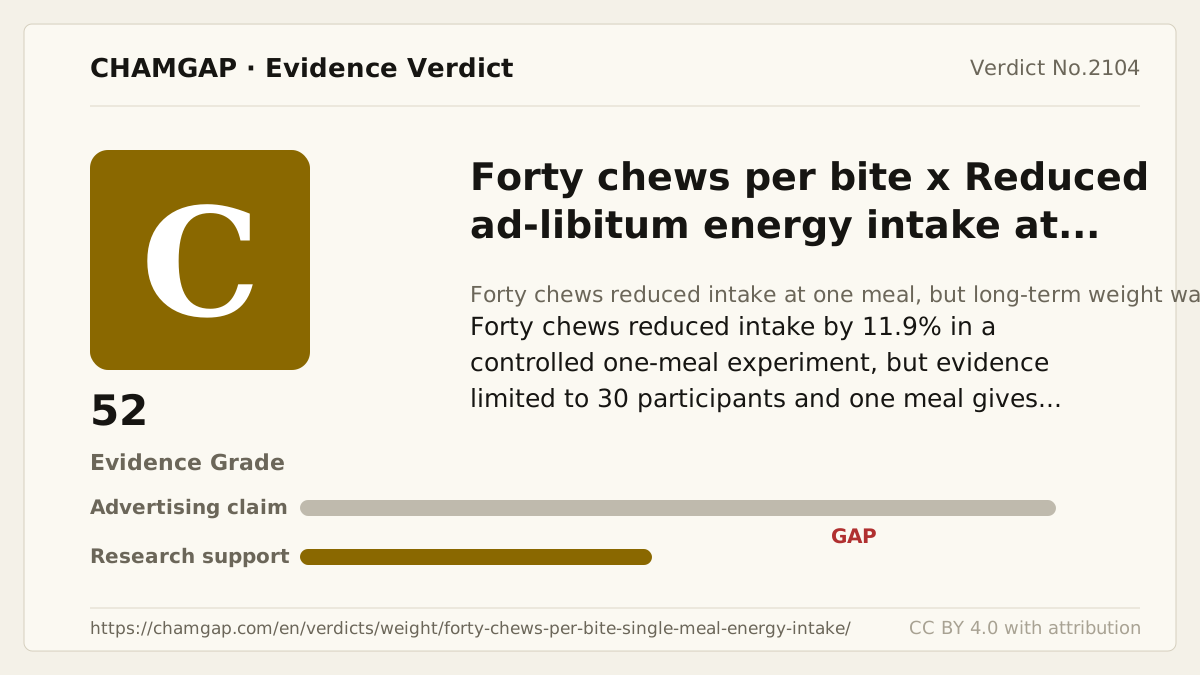
[Chamgap] Forty chews per bite x lower single-meal energy intake — Evidence Grade C·50. 1 cited sources checked. Source: https://chamgap.com/en/verdicts/weight/forty-chews-per-bite-single-meal-energy-intake/ · CC BY 4.0CC BY 4.0 — free to use with attribution; do not distort grades, numbers, or verdict meaning.
What this document does and does not do
Chamgap is an information source. It reports what research has and has not confirmed; it does not tell readers what to take or buy. That decision belongs to readers and, when needed, medical or legal professionals. This verdict reflects literature available up to the search date and may change as new research appears. Nothing here is medical advice.