
Fingerroot extract, or panduratin,,
does it really help with Reduction of body fat?
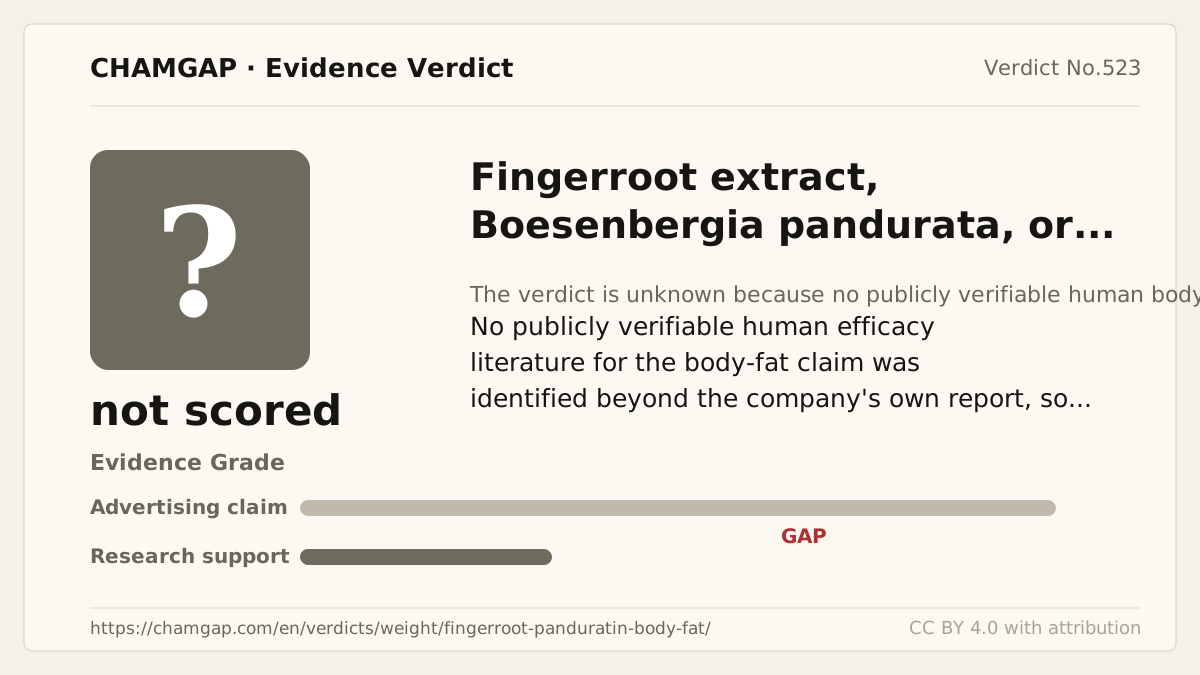
research showsThe body-fat reduction claim for fingerroot extract, or panduratin, is unresolved. A company proposal reports a human application study in 150 Korean participants but does not disclose randomization, a control group, a prespecified primary endpoint, effect sizes, attrition, or statistical analyses. The public randomized trial in 92 people measured skin hydration, gloss, wrinkling, and elasticity rather than body fat, while public anti-obesity research is preclinical.
ads claimMarketing may combine the number of participants in the unpublished body-fat report, individual recognition, a skin trial, and animal mechanisms as if they jointly proved body-fat reduction in humans. The publicly verifiable record does not support that conclusion.
Useful facts when choosing a product
- Fingerroot extract powder, or panduratin, is distributed in Korea in health-functional-food products using an individually recognized functional ingredient.
- Some Korean products label 26.4 mg panduratin A per daily serving; tablet count and total product mass vary.
- The recognized material is a specific standardized extract. Plain fingerroot powder, tea, or products using other origins and extraction methods should not be treated as equivalent.
- Korean labels advise avoidance by children and during pregnancy or lactation and consultation for liver or kidney disease, allergy, or medication use. Independent long-term safety data are limited.
Chamgap Semantic Classification Code
Candidate index · review held
S.fingerroot-extract.UNK.body-fat.reduce.placeboSupplements and nutraceuticals > Fingerroot extract > Unknown > body fat > Reduction claim > Placebo
An automated migration candidate, not an issued permanent code; exact claim scope remains under review. This machine-generated migration candidate helps retrieval but is not a permanent assignment. The original verdict ID and URL remain authoritative.
What the research actually shows
The H&B Holdings and Kolmar BNH proposal labels a body-fat study as involving 150 Korean participants but provides neither the design details nor numerical results needed for verification. The 2017 trial by Kim and colleagues randomized 92 people to twelve weeks of the same plant extract or placebo but measured only skin hydration, gloss, wrinkling, and elasticity. The 2012 study by Kim and colleagues and related mechanistic work examined AMPK, lipid metabolism, and fat accumulation in high-fat-diet mice and cells. Neither the skin trial nor the preclinical studies establish human body-fat efficacy.
Why this is classified as ?
The company proposal's report of 150 participants does not disclose the methods or results needed for efficacy grading. The public trial in 92 people concerns skin, and the anti-obesity evidence is preclinical. With no publicly verifiable human body-fat efficacy literature, the grade is unknown and the score is null.
Counterpoint. An assessable body-fat trial may exist in undisclosed regulatory submissions. The claim can be reassessed if the original protocol and complete results become public.
Rejudgment record. Reassessment (cross-check reflected) — The company and individual-recognition materials are treated only as claims that a trial exists; the public 92-person skin trial is excluded as a different efficacy domain, and no publicly verifiable human body-fat efficacy literature was identified
Cross-check — AI research and Codex final gate
Evidence Table
| Study | Design | Sample | Funding | Endpoint | Result | Weight |
|---|---|---|---|---|---|---|
| Study 1 | Company-proposal claim that a human application study exists; randomization, control group, primary endpoint, effect sizes, attrition, and statistics are not disclosed | 150 | Company and distribution materials | Labeled as body-fat reduction without verifiable endpoint details | The proposal reports that a trial exists and claims body-fat reduction, but no public source report or numerical results permit independent verification. | Company self-report of trial existence; not efficacy evidence |
| Kim DU et al. 2017 | Randomized, double-blind, placebo-controlled twelve-week human trial | n=92 | Author affiliations include the ingredient developer Newtree | Skin hydration, gloss, wrinkling, and elasticity | Reported skin outcomes and did not assess a body-fat endpoint. | Different efficacy domain; not body-fat evidence |
| Kim DY et al. 2012 | High-fat-diet mouse experiment and cellular mechanistic work | 6 | Academic preclinical research | Weight gain, fat accumulation, AMPK, and lipid metabolism | Reported weight-gain, fat-accumulation, and mechanistic findings in mice but did not evaluate human body-fat efficacy. | Preclinical; not human efficacy evidence |
| Study 4 | Verification of regulatory and product-distribution facts | Company filing and product materials | Use of an individually recognized functional ingredient and Korean distribution | Confirms Korean individual recognition and distribution of products using standardized fingerroot extract powder. | Product facts; not efficacy-grade evidence |
Receipt — 4 References
All 4 cited sources were verified for existence at the original page (as of 2026-07-18).
Final verification and publication gate: Codex · Evidence date: 2026-07-18 · Corrections: none
Cite this verdict
[Chamgap] Fingerroot extract, or panduratin, x body-fat reduction — Evidence Grade ?. 4 cited sources checked. Source: https://chamgap.com/en/verdicts/weight/fingerroot-panduratin-body-fat/ · CC BY 4.0CC BY 4.0 — free to use with attribution; do not distort grades, numbers, or verdict meaning.
What this document does and does not do
Chamgap is an information source. It reports what research has and has not confirmed; it does not tell readers what to take or buy. That decision belongs to readers and, when needed, medical or legal professionals. This verdict reflects literature available up to the search date and may change as new research appears. Nothing here is medical advice.