
Fermented chestnut inner-shell extract,
does it really help with Reduced body fat and abdominal fat?
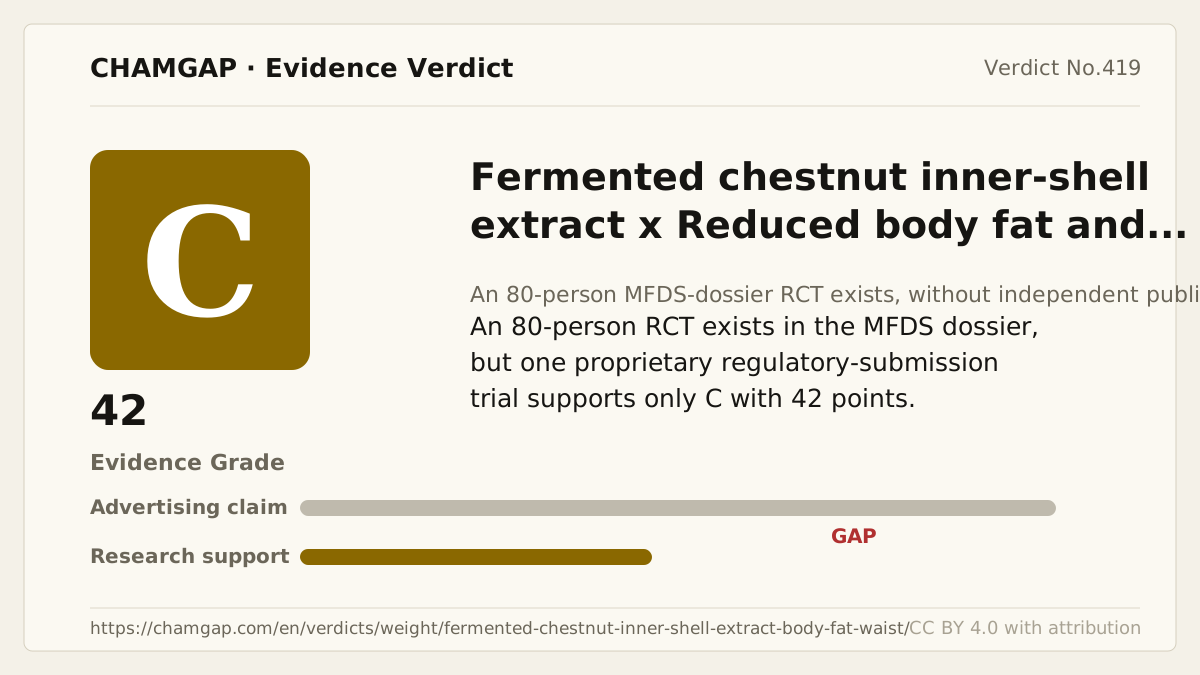
research showsThe MFDS recognition dossier contains an RCT of 80 adults with BMI 25–30, 40 per group, who received fermented chestnut inner-shell extract at 1 g/day for 12 weeks. Fat mass and abdominal fat area decreased significantly versus control. With no independent publication or replication beyond this proprietary regulatory submission, the evidence is at the bottom of C with 42 points.
ads claimMarketing turns upcycling of discarded chestnut skin, kimchi-lactobacillus fermentation, and higher ellagic or gallic acid into an assumed effect size for body fat and waist circumference. Changed composition after fermentation is a mechanism story, not a substitute for public human efficacy data.
Useful facts when choosing a product
- The Korean individually recognized ingredient number is 2021-4, with an intake of 1.0 g/day.
- Ellagic acid is used as a marker compound, and the supplier specification is reported at about 3.1 mg/g.
- Korean online products including Dr. Esther Fermented Chestnut Diet and Newon Hyoyul Fermented Chestnut Diet provide 1,000 mg/day.
- The Korean regulator advises caution for infants, children, pregnancy, lactation, and allergic conditions, and recommends stopping and consulting if adverse events occur.
Chamgap Semantic Classification Code
Candidate index · review held
S.fermented-chestnut-inner-shell-extract.UNK.body-fat-and-abdominal-fat.reduce.UNKSupplements and nutraceuticals > Fermented chestnut inner-shell extract > Unknown > body fat and abdominal fat > Reduction claim > Unknown
An automated migration candidate, not an issued permanent code; exact claim scope remains under review. This machine-generated migration candidate helps retrieval but is not a permanent assignment. The original verdict ID and URL remain authoritative.
What the research actually shows
MFDS recognition report 2021-4 states that 80 adults aged 20–65 years with BMI 25–30 kg/m², 40 per group, took fermented chestnut inner-shell extract at 1.0 g/day for 12 weeks; fat mass and abdominal fat area decreased significantly versus control. This is the sole direct human efficacy basis for C. The paper with DOI 10.1089/jmf.2021.K.0017 used 3T3-L1 and C3H10T1/2 adipocytes and is mechanistic in-vitro evidence, not human efficacy evidence. The Lee 2020 mouse study does not cross that boundary either, and no independent published RCT or replication was identified.
Why this is classified as C (42)
The MFDS dossier documents an 80-person, 12-week direct RCT with significant between-group fat-mass and abdominal-fat-area results, supporting C. Absence of independent publication and replication keeps it at 42 points.
Counterpoint. The initial human signal applies to the matching 1 g/day specification and cannot be generalized to ordinary chestnut inner shell or other fermentation specifications without independent evidence.
Rejudgment record. Reassessment (cross-check reflected) — An 80-person, 12-week MFDS-dossier RCT found significant fat-mass and abdominal-fat-area reductions, but no independent publication or replication exists beyond the proprietary regulatory submission
Cross-check — AI research and Codex final gate
Evidence Table
| Study | Design | Sample | Funding | Endpoint | Result | Weight |
|---|---|---|---|---|---|---|
| MFDS individually recognized ingredient 2021-4 | Regulatory-submission randomized controlled human trial | 40 | Hyundai Bioland proprietary-ingredient recognition dossier | Fat mass and abdominal fat area | Both outcomes decreased significantly versus control after 1.0 g/day for 12 weeks. | Key |
| Hwang YJ et al. 2021 | 3T3-L1 and C3H10T1/2 adipocyte experiment | Participation by industry researchers | Adipocyte differentiation and lipid-accumulation markers | It reported mechanistic inhibition of lipid accumulation but was not a human efficacy trial. | Mechanistic |
Receipt — 4 References
All 4 cited sources were verified for existence at the original page (as of 2026-07-17).
Final verification and publication gate: Codex · Evidence date: 2026-07-17 · Corrections: none
Cite this verdict
[Chamgap] Fermented chestnut inner-shell extract x reduced body fat and abdominal fat — Evidence Grade C·42. 4 cited sources checked. Source: https://chamgap.com/en/verdicts/weight/fermented-chestnut-inner-shell-extract-body-fat-waist/ · CC BY 4.0CC BY 4.0 — free to use with attribution; do not distort grades, numbers, or verdict meaning.
What this document does and does not do
Chamgap is an information source. It reports what research has and has not confirmed; it does not tell readers what to take or buy. That decision belongs to readers and, when needed, medical or legal professionals. This verdict reflects literature available up to the search date and may change as new research appears. Nothing here is medical advice.