
Fasted aerobic exercise,
does it really help with Additional body-fat loss versus the same exercise after feeding?
research showsThe grade is D. In a four-week trial of 20 young women performing the same 60-minute treadmill program with hypocaloric diets, fat mass changed from 16.5 to 15.4 kg in the fasted group and 15.7 to 15.0 kg in the fed group. The group effect was P=0.88 and the group-by-time interaction was null. Exercise volume was matched, but calories were not controlled feeding; self-reported intake merely showed no statistically detected difference. Acute fuel-use differences did not translate into greater body-fat loss over weeks.
ads claimMore fat use during a fasted workout cannot be expanded into faster body-fat loss. Long-term results depend on total intake and total activity.
Useful facts when choosing a product
- Both groups performed 60 minutes of treadmill exercise three times weekly for four weeks, including 50 minutes at 70% estimated maximal heart rate.
- Reported energy intake was 1,236±177 versus 1,277±137 kcal/day, but food was not fully provided or weighed.
- Body composition was assessed with BOD POD air-displacement plethysmography.
- An acute crossover study found RER 0.96 fed versus 0.84 fasted immediately, a substrate-use measure rather than long-term fat mass.
- Verdict 1436 is C with 54 points and concerns post-meal walking and glucose, whereas this verdict concerns overnight-fasted aerobic exercise and four- to six-week fat change.
Chamgap Semantic Classification Code
Candidate index · review held
X.overnight-fasted-aerobic-exercise.behavioral.additional-body-fat-loss.compare.UNKBehaviors, exposures and policies > Overnight-fasted aerobic exercise > Behavioral delivery > Additional body-fat loss > Comparative claim > Unknown
An automated migration candidate, not an issued permanent code; exact claim scope remains under review. This machine-generated migration candidate helps retrieval but is not a permanent assignment. The original verdict ID and URL remain authoritative.
What the research actually shows
Schoenfeld randomized 20 young nonobese women, ten per group, and analyzed all participants. Both groups completed zero-grade treadmill exercise for 60 minutes three times weekly for four weeks, with five-minute warm-up and cool-down at 50% estimated maximal heart rate and 50 minutes at 70%, monitored and supervised. The same 250-kcal shake was taken immediately before exercise in the fed group and immediately afterward in the fasted group. Reported intake was 1,236±177 versus 1,277±137 kcal/day, with no statistically detected difference, although authors acknowledged underreporting. Null trials in the review were conducted by different teams, including Schoenfeld, Farah, and Bachman, and dietary control varied across studies. Body composition used BOD POD air-displacement plethysmography, not DXA or bioimpedance. Registration and separate funding were not confirmed; a Dymatize Nutrition shake was used and authors declared no competing interests.
Why this is classified as D (28)
Direct randomization and several small studies repeatedly found no additional fat loss, but small samples, short duration, and no clinical boundary prevent exclusion of important benefit, giving D with 28 points.
Counterpoint. D does not mean fasted exercise is always harmful or that exercise cannot reduce fat; it means meal timing showed no confirmed incremental advantage.
Rejudgment record. Cross-check applied — Matched exercise and small null studies from different teams were considered, while calorie intake was only self-reported with no detected difference and dietary control varied across studies
| Endpoint | S | Surrogate marker - laboratory or imaging measures |
| Replication | RX | Repeatedly refuted in the same indication |
| Independence | I1 | Mixed funding sources |
| Effect size | E0 | Null |
| Precision | C0 | The confidence interval leaves room for benefit |
Stored derived and displayed grades match; this is not a current recalculation or validity check (D).
Sub-claim grades by effect
This ingredient is marketed for several effects. A single overall grade blends strong and weak claims together, so each effect is graded separately here. The overall grade reflects the strongest disconfirming or core claim.
| Effect (sub-claim) | Grade | Basis |
|---|---|---|
| Acute substrate-use changes during fasted exercise | C | RER differed acutely but changed direction over recovery. |
| Additional long-term body-fat loss from fasted exercise | D | Direct randomized evidence and a small synthesis found no superiority. |
Cross-check — AI research and Codex final gate
Evidence Table
| Study | Design | Sample | Funding | Endpoint | Result | Weight |
|---|---|---|---|---|---|---|
| Schoenfeld BJ et al. 2014 | Four-week parallel randomized head-to-head trial | 20 randomized and analyzed, 10 per group | Separate funding not confirmed; a Dymatize Nutrition shake was used and no competing interests were declared | BOD POD fat mass, body-fat percentage, weight, and fat-free mass | Fat mass changed 16.5 to 15.4 kg versus 15.7 to 15.0 kg; group effect P=.88 and interaction was null. | Principal direct comparison |
| Hackett D and Hagstrom AD. 2017 | Systematic review and meta-analysis | Five studies and 96 participants | No commercial funding identified in accessible report | Body weight, fat mass, and lean mass | No superiority of fasted versus fed exercise for weight or body composition. | Repeatedly null context |
Receipt — 3 References
All 3 cited sources were verified for existence at the original page (as of 2026-08-04).
Final verification and publication gate: Codex · Evidence date: 2026-08-04 · Corrections: none
Cite this verdict
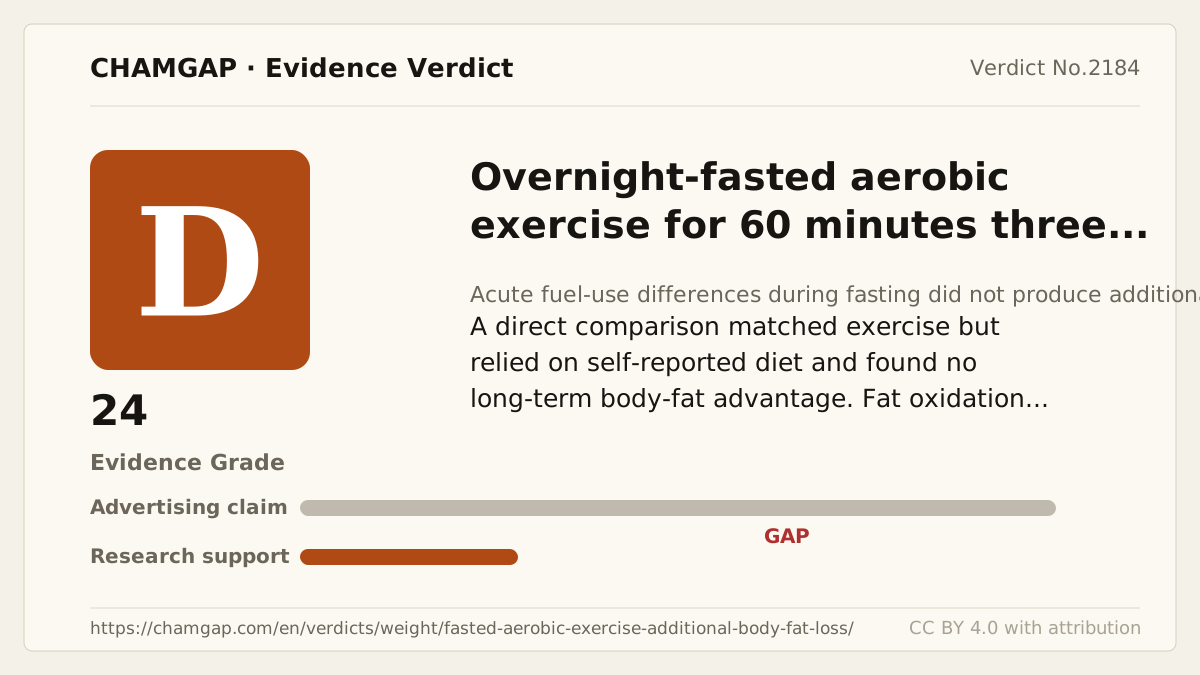
[Chamgap] Fasted aerobic exercise x additional body-fat loss — Evidence Grade D·28. 3 cited sources checked. Source: https://chamgap.com/en/verdicts/weight/fasted-aerobic-exercise-additional-body-fat-loss/ · CC BY 4.0CC BY 4.0 — free to use with attribution; do not distort grades, numbers, or verdict meaning.
What this document does and does not do
Chamgap is an information source. It reports what research has and has not confirmed; it does not tell readers what to take or buy. That decision belongs to readers and, when needed, medical or legal professionals. This verdict reflects literature available up to the search date and may change as new research appears. Nothing here is medical advice.