
Eight-hour time-restricted eating,
does it really help with Greater weight loss than a usual eating schedule without separate calorie restriction?
research showsThe claim that an eight-hour eating window produces greater weight loss than a usual schedule without separately reducing calories is rated D. In the peer-reviewed TREAT randomized trial, the weight-change primary endpoint failed in the actual 116-participant ITT population: the between-group difference was -0.26 kg (95% CI -1.30 to 0.78; P=0.63). A separate peer-reviewed 139-participant trial also failed its primary endpoint for added benefit when time restriction was layered onto equal calorie restriction. Trials of 90 and 61 participants without calorie counting were positive, but actual energy intake also fell and results are conflicting. Weight loss without a calorie reduction has not been established.
ads claimMarketing often says that people can eat freely within eight hours and lose more weight regardless of calories. In positive trials, restricting the window also acted as a behavioral tool that lowered total intake. Weight loss from fewer calories is different from a calorie-independent timing effect, and the latter is not established.
Useful facts when choosing a product
- A 16:8 schedule confines caloric intake to one continuous eight-hour period and avoids calories during the remaining 16 hours.
- Even without calorie counting, actual daily energy intake can fall spontaneously, so a no-counting study is not the same as an isocaloric study.
- Eating-window timing, baseline eating duration, counseling intensity, and diabetes status differ across trials, so all 16:8 programs are not equivalent.
- People using insulin or sulfonylureas face hypoglycemia risk during fasting, while pregnancy, breastfeeding, eating-disorder history, and frailty warrant clinical advice.
Chamgap Semantic Classification Code
Candidate index · review held
D.time-restricted-eating.oral.greater-weight-loss-than-a-usual-eating-schedule-without-separate-calorie-restriction.assess.UNKDietary patterns and eating practices > Time-restricted eating > Oral > Greater weight loss than a usual eating schedule without separate calorie restriction > Association or change assessment > Unknown
An automated migration candidate, not an issued permanent code; exact claim scope remains under review. This machine-generated migration candidate helps retrieval but is not a permanent assignment. The original verdict ID and URL remain authoritative.
What the research actually shows
TREAT was a peer-reviewed 12-week remote randomized original report with an actual ITT analysis of 116; its between-group weight primary endpoint failed. Its 50-person body-composition cohort showed a greater decline in appendicular lean-mass index. Liu 2022 randomized 139 participants, 118 of whom completed 12 months, and found no added weight-primary benefit from an eight-hour window under equal calorie restriction. Lin 2023 randomized 90 participants and Wilkinson 2026 randomized 61, with positive results but reduced energy intake or a small single-center design and a changed primary endpoint. Maruthur 2024 analyzed all 41 participants under isocaloric feeding and found no timing-only weight effect.
Why this is classified as D (34)
The weight primary endpoint failed in the actual 116-participant TREAT ITT analysis and the 139-participant long-term add-on trial. Positive no-counting studies were smaller, involved reduced intake, or conflicted with a null 41-person isocaloric trial. The calorie-independent timing claim therefore receives D with 34 points.
Counterpoint. For someone who finds calorie counting difficult, an eating window may be a simple way to reduce intake. Any success should be understood as a sustainable behavioral route to lower total intake rather than metabolic magic from the clock.
Rejudgment record. New verdict — Prioritized failure of the weight primary endpoints in the actual 116-participant TREAT ITT analysis and the 139-participant long-term trial while accounting for reduced intake, small size, and conflict in positive no-counting studies
Sub-claim grades by effect
This ingredient is marketed for several effects. A single overall grade blends strong and weak claims together, so each effect is graded separately here. The overall grade reflects the strongest disconfirming or core claim.
| Effect (sub-claim) | Grade | Basis |
|---|---|---|
| Additional weight loss versus usual eating without calorie restriction | D | TREAT primary failure and a null isocaloric trial conflict with smaller positive trials in which intake fell. |
| Additional weight loss from adding time restriction to equal calorie restriction | D | The weight primary endpoint failed in the 139-participant 12-month trial. |
| Practical weight loss using time-restricted eating | C | Some randomized trials are positive, but the effect is not separated from lower total intake and trials conflict. |
Cross-check — AI research and Codex final gate
Evidence Table
| Study | Design | Sample | Funding | Endpoint | Result | Weight |
|---|---|---|---|---|---|---|
| Lowe DA et al. TREAT. 2020 | Peer-reviewed randomized controlled original report | Actual ITT population of 116 | NIH, James Peter Read Foundation, and others | Primary endpoint of 12-week weight change | The between-group primary endpoint failed: -0.26 kg (95% CI -1.30 to 0.78), P=0.63. | Pivotal direct trial |
| Liu D et al. 2022 | Peer-reviewed 12-month randomized controlled original report | 139 randomized; 118 completed the 12-month visit | Chinese public research funding | Primary endpoint of added weight change from time restriction under equal calorie restriction | The primary endpoint failed; time restriction provided no added benefit. | Long-term comparative trial |
| Lin S et al. 2023 | Peer-reviewed 12-month three-arm randomized controlled original report | 90 randomized participants | NIH and other public funding | Primary endpoint of 12-month weight change | Time-restricted eating was positive versus control at -4.61 kg, but daily energy intake also fell by about 425 kcal. | Positive counterevidence without mechanistic separation |
Receipt — 5 References
All 5 cited sources were verified for existence at the original page (as of 2026-07-24).
Final verification and publication gate: Codex · Evidence date: 2026-07-24 · Corrections: none
Cite this verdict
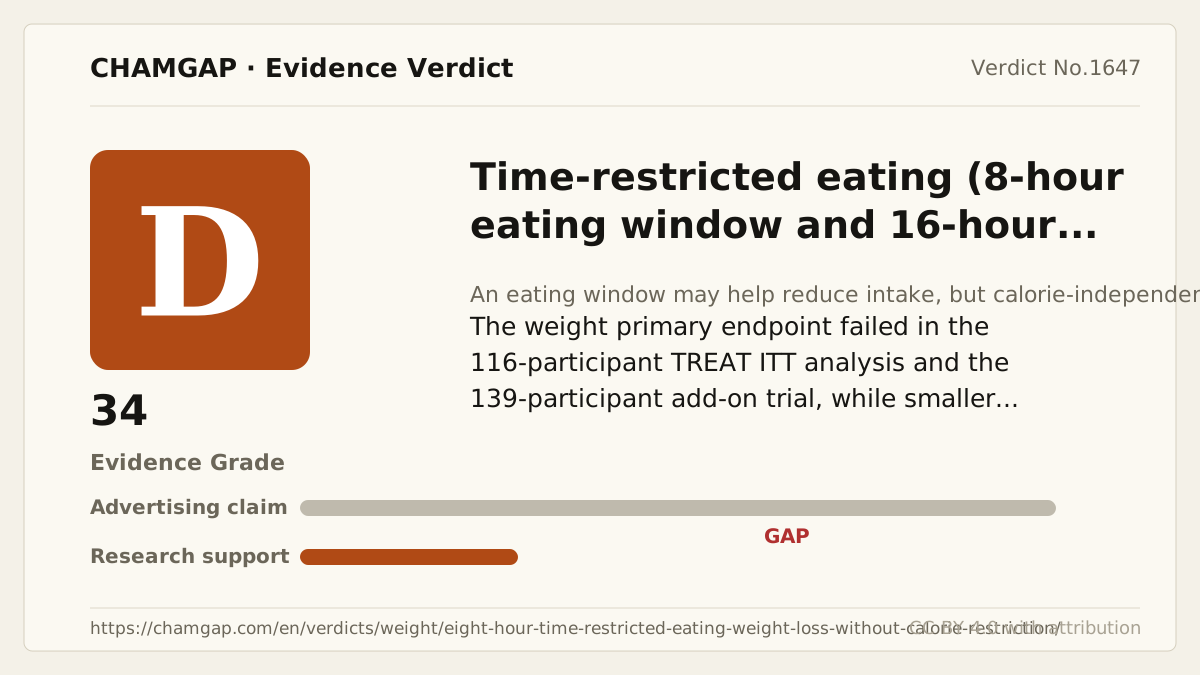
[Chamgap] Eight-hour time-restricted eating x extra weight loss without calorie restriction — Evidence Grade D·34. 5 cited sources checked. Source: https://chamgap.com/en/verdicts/weight/eight-hour-time-restricted-eating-weight-loss-without-calorie-restriction/ · CC BY 4.0CC BY 4.0 — free to use with attribution; do not distort grades, numbers, or verdict meaning.
What this document does and does not do
Chamgap is an information source. It reports what research has and has not confirmed; it does not tell readers what to take or buy. That decision belongs to readers and, when needed, medical or legal professionals. This verdict reflects literature available up to the search date and may change as new research appears. Nothing here is medical advice.