
Daily self-weighing behavioral bundle,
does it really help with Weight loss in adults with obesity?
research showsThe grade is D with 30 points. A three-month trial combined scales and daily weighing with a record card, a 0.5-kg-per-week goal, weekly text reminders, and two counseling sessions. Weight loss was only 0.5 kg greater than control, with a null 95% CI of -1.3 to 0.3 kg. This was not a weighing-only intervention.
ads claimWeight-app bundles vary. This verdict applies to a short, low-intensity package that included recording, a weight-loss goal, weekly texts, and two consultations in addition to daily weighing.
Useful facts when choosing a product
- The intervention combined daily weighing and a record card with a weekly loss goal and weekly text reminders.
- The control received two minimal weight consultations, not pure no-contact care.
- No serious related adverse event was reported, but between-group eating-disorder outcomes were not assessed, so that risk was not established.
Chamgap Semantic Classification Code
Candidate index · review held
X.self-weighing-bundled-with-a-record-card.behavioral.weight-loss-with-obesity.assess.UNKBehaviors, exposures and policies > self-weighing bundled with a record card > Behavioral delivery > Weight loss with obesity > Association or change assessment > Unknown
An automated migration candidate, not an issued permanent code; exact claim scope remains under review. This machine-generated migration candidate helps retrieval but is not a permanent assignment. The original verdict ID and URL remain authoritative.
What the research actually shows
SCALE DOWN randomized 183 adults with obesity, 92 to intervention and 91 to control, and analyzed three-month weight change. Overall missingness was 20/183, about 10.9%; follow-up was 92.4% in the intervention group and 85.7% in control. Among 163 followed participants, 15 without researcher-measured weights supplied self-reported values, and excluding them did not change the conclusion. Participants weighed on 73.1 of 90 days on average. A sample under 200 was counted as the one avoidable limitation; this level of missingness was not counted separately, so axis 6 is B1.
Why this is classified as D (30)
The direct weight endpoint was null and the interval left a small benefit possible. Overall missingness was about 10.9% and was not counted as a defect; only the 183-person sample remained, giving B1 and D with 30 points.
Counterpoint. Regular weighing can still be a monitoring tool in more intensive behavioral care. The null result applies to this particular low-intensity bundle of weighing, recording, goal setting, weekly texts, and brief counseling.
Rejudgment record. Cross-check applied — Three-month randomized trial of weighing, recording, a weight-loss goal, text reminders, and counseling; direct weight outcome and small sample
| Endpoint | P | Symptom or function itself is the target - including patient reports and performance tests |
| Replication | R1 | Single confirmatory trial |
| Independence | I2 | Decisive evidence is publicly or non-profit funded |
| Effect size | E0 | Null |
| Precision | C0 | The confidence interval leaves room for benefit |
Stored derived and displayed grades match; this is not a current recalculation or validity check (D).
Sub-claim grades by effect
This ingredient is marketed for several effects. A single overall grade blends strong and weak claims together, so each effect is graded separately here. The overall grade reflects the strongest disconfirming or core claim.
| Effect (sub-claim) | Grade | Basis |
|---|---|---|
| Greater three-month weight loss from the weighing, recording, goal, text, and counseling bundle | D | The -0.5 kg difference was not statistically significant. |
| Weight loss with feedback and coaching programs | C | Programs with different components and intensity are separate claims. |
Cross-check — AI research and Codex final gate
Evidence Table
| Study | Design | Sample | Funding | Endpoint | Result | Weight |
|---|---|---|---|---|---|---|
| Madigan et al. 2014 SCALE DOWN | Individually randomized controlled trial | 183 randomized (92 intervention/91 control); follow-up 92.4%/85.7%; 10.9% missing overall | University of Birmingham doctoral research funding | Weight change at three months | Between-group difference -0.5 kg (95% CI -1.3 to 0.3) | Pivotal evidence for a low-intensity self-weighing behavioral bundle |
Receipt — 2 References
All 2 cited sources were verified for existence at the original page (as of 2026-08-07).
Final verification and publication gate: Codex · Evidence date: 2026-08-07 · Corrections: none
Cite this verdict
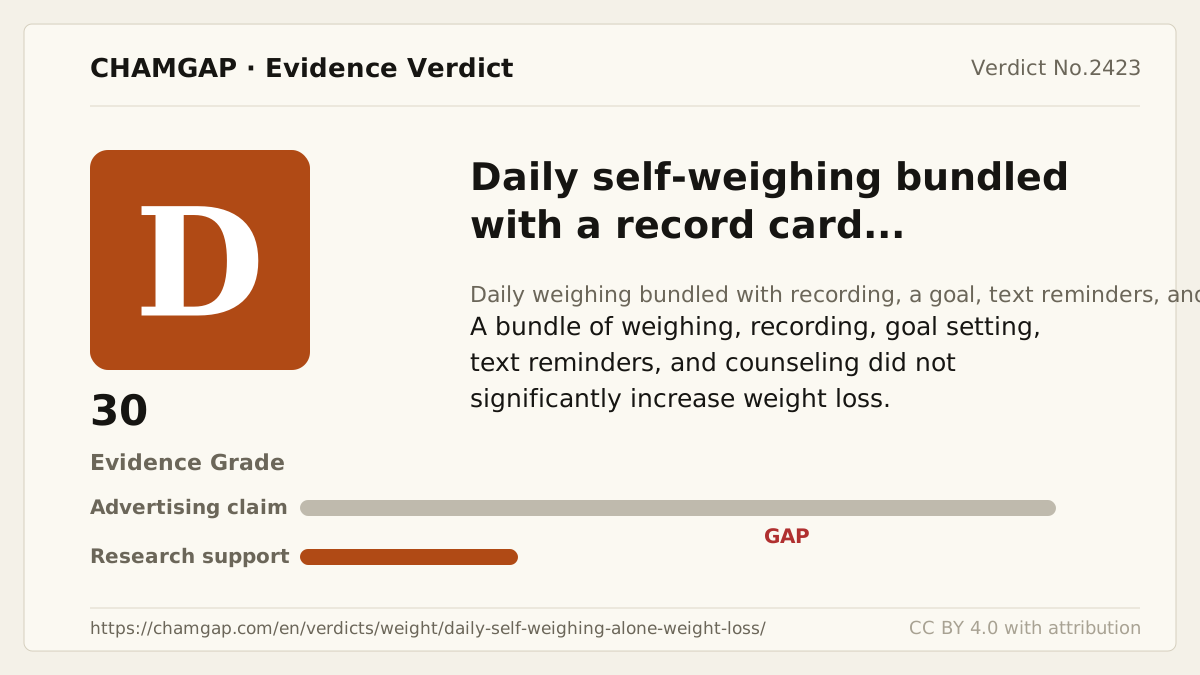
[Chamgap] Daily self-weighing behavioral bundle x weight loss — Evidence Grade D·30. 2 cited sources checked. Source: https://chamgap.com/en/verdicts/weight/daily-self-weighing-alone-weight-loss/ · CC BY 4.0CC BY 4.0 — free to use with attribution; do not distort grades, numbers, or verdict meaning.
What this document does and does not do
Chamgap is an information source. It reports what research has and has not confirmed; it does not tell readers what to take or buy. That decision belongs to readers and, when needed, medical or legal professionals. This verdict reflects literature available up to the search date and may change as new research appears. Nothing here is medical advice.