
D-allulose,
does it really help with Reduction of body weight and fat mass with daily intake in overweight adults?
research showsThe claim that daily D-allulose meaningfully reduces weight and fat in overweight adults is rated D. A 12-week preliminary double-blind trial in 121 Korean adults found small reductions in body-fat percentage and fat mass with 8 or 14 g/day, and the high dose improved BMI and some abdominal-fat measures. The overall between-group result for body weight was not significant at p=0.064, and the evidence was concentrated in one preliminary trial involving investigators from the ingredient manufacturer. A 2026 meta-analysis pooling the three 12-week longer-term allulose trials found no significant effect on BMI or body-fat percentage. The early signal is therefore acknowledged, but absent independent replication and clinically meaningful sustained weight loss support D with 30 points. Potential calorie reduction when allulose replaces sugar is distinct from an intrinsic weight-loss effect of the ingredient.
ads claimMarketing turns a low-calorie sugar label and animal fat-metabolism findings into a promise that consuming the sweetener makes body fat disappear. Replacing sugar may lower dietary calories, but adding allulose to an unchanged diet is not an evidence-based stand-alone weight-loss treatment.
Useful facts when choosing a product
- D-allulose is the C-3 epimer of fructose and is used as a low-calorie food sweetener because most absorbed allulose is excreted without substantial energy metabolism.
- The pivotal 12-week trial used divided daily totals of 8 g and 14 g; commercial products vary in allulose concentration and in added sugars or sugar alcohols, so the product label matters.
- Using allulose instead of sugar can reduce total sugar and calories, but adding it to the same diet does not guarantee weight loss.
- Typical food amounts are generally tolerated, but larger doses can cause bloating, abdominal pain, and osmotic diarrhea. In an adult tolerance study, diarrhea increased clearly at a single dose of 0.5 g/kg.
Chamgap Semantic Classification Code
Candidate index · review held
F.d-allulose.food.body-weight-and-fat-mass-with-daily-intake.reduce.placeboFoods and beverages > D-allulose > Food consumption > body weight and fat mass with daily intake > Reduction claim > Placebo
An automated migration candidate, not an issued permanent code; exact claim scope remains under review. This machine-generated migration candidate helps retrieval but is not a permanent assignment. The original verdict ID and URL remain authoritative.
What the research actually shows
Han and colleagues randomized 121 Korean adults aged 20 to 40 years with BMI at least 23 kg/m² to sucralose placebo, 4 g of allulose twice daily, or 7 g twice daily for 12 weeks under double masking. Weight changed by -0.36 kg with placebo, -0.98 kg at the low dose, and -1.28 kg at the high dose, but the overall between-group p value was 0.064. Adjusted fat-mass differences versus placebo were -0.74 kg and -0.78 kg for the low and high doses. The author group included CJ CheilJedang Food R&D employees and labeled the work preliminary. Osborn in 2026 systematically reviewed 12 allulose and eight tagatose trials with 1,033 total participants; the three 12-week longer-term allulose trials showed no significant improvement in BMI or body-fat percentage. This verdict concerns weight and adiposity, not the separate postprandial-glucose evidence axis.
Why this is classified as D (30)
The positive body-fat percentage and fat-mass signal in one 121-person preliminary trial distinguishes this claim from a complete absence of human efficacy literature. The between-group weight result was null, however, and the study was short, isolated, and manufacturer linked, while the 2026 meta-analysis of three 12-week longer-term studies found no effect on BMI or body-fat percentage. Lack of independent replication for clinically meaningful sustained weight loss supports D with 30 points. Gastrointestinal tolerance and food safety are kept separate from efficacy.
Counterpoint. Replacing sugary drinks or cooking sugar with allulose can help lower energy intake. A realistic strategy uses substitution rather than adding the sweetener and also addresses overall diet pattern, protein, fiber, activity, and sleep.
Rejudgment record. New verdict — Accepted the small body-fat signal in one 121-person 12-week preliminary trial, but assigned D because the between-group weight result was null, the trial was isolated and manufacturer linked, and a 2026 meta-analysis of longer-term allulose trials did not reproduce BMI or body-fat-percentage benefits
Sub-claim grades by effect
This ingredient is marketed for several effects. A single overall grade blends strong and weak claims together, so each effect is graded separately here. The overall grade reflects the strongest disconfirming or core claim.
| Effect (sub-claim) | Grade | Basis |
|---|---|---|
| Sustained body-weight reduction in adults with overweight | D | The 121-person trial had a null between-group weight result, and the latest longer-term synthesis did not establish a meaningful weight effect. |
| Reduction of body-fat percentage and fat mass in adults with overweight | D | One preliminary trial was positive, but the 2026 pooled body-fat-percentage result was nonsignificant and did not reproduce the signal. |
| Reduction of abdominal fat in adults with overweight | D | The high-dose CT subcutaneous-fat signal is confined to one short trial without independent long-term replication. |
Cross-check — AI research and Codex final gate
Evidence Table
| Study | Design | Sample | Funding | Endpoint | Result | Weight |
|---|---|---|---|---|---|---|
| Han Y et al. 2018 | Twelve-week randomized double-blind placebo-controlled preliminary trial | 121 Korean adults with overweight or obesity | Three CJ CheilJedang Food R&D employees were coauthors and the company supplied study material | Weight, BMI, body-fat percentage, fat mass, and abdominal CT fat areas | The between-group weight result was null at p=0.064; body-fat percentage and fat mass decreased modestly versus placebo, and the high dose improved BMI and subcutaneous-fat area. | Single preliminary positive trial with manufacturer links |
| Osborn L et al. 2026 | Systematic review and meta-analysis of controlled human intervention trials | Twenty rare-sugar trials with 1,033 participants; 12 allulose trials including three longer-term trials | Academic institutional research led by Brigham Young University under the article's disclosed conflicts | BMI, body-fat percentage, glycemia, insulin, and lipids | Across three 12-week allulose trials, BMI MD was -0.24 (95% CI -0.86 to 0.39) and body-fat-percentage MD was -0.62 (-1.63 to 0.38), both nonsignificant. | Latest null synthesis for weight and body composition |
| Han Y et al. 2018 gastrointestinal tolerance study | Open nonrandomized dose-escalation tolerance study | 29 young healthy adults in the single-dose study and 19 in the repeated-dose study | Korean public grants; CJ CheilJedang supplied material and employees were coauthors | Gastrointestinal tolerance including diarrhea, bloating, and abdominal pain | Diarrhea, bloating, and abdominal pain increased at a single dose of 0.5 g/kg, leading the authors to propose 0.4 g/kg as the maximum single tolerated dose. | Safety context, separate from efficacy |
Receipt — 3 References
All 3 cited sources were verified for existence at the original page (as of 2026-07-22).
Final verification and publication gate: Codex · Evidence date: 2026-07-22 · Corrections: none
Cite this verdict
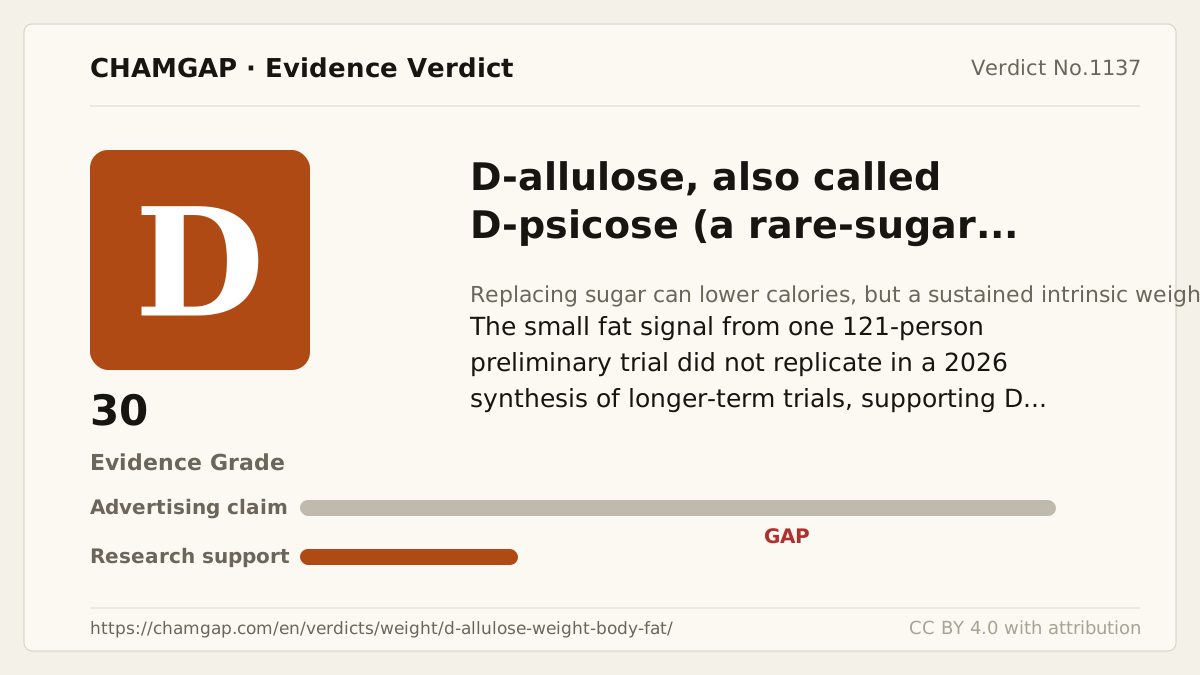
[Chamgap] D-allulose x reduction of body weight and fat mass in overweight adults — Evidence Grade D·30. 3 cited sources checked. Source: https://chamgap.com/en/verdicts/weight/d-allulose-weight-body-fat/ · CC BY 4.0CC BY 4.0 — free to use with attribution; do not distort grades, numbers, or verdict meaning.
What this document does and does not do
Chamgap is an information source. It reports what research has and has not confirmed; it does not tell readers what to take or buy. That decision belongs to readers and, when needed, medical or legal professionals. This verdict reflects literature available up to the search date and may change as new research appears. Nothing here is medical advice.