
Cryolipolysis,
does it really help with Reduced localized subcutaneous-fat thickness and circumference on the abdomen, flanks, and similar areas?
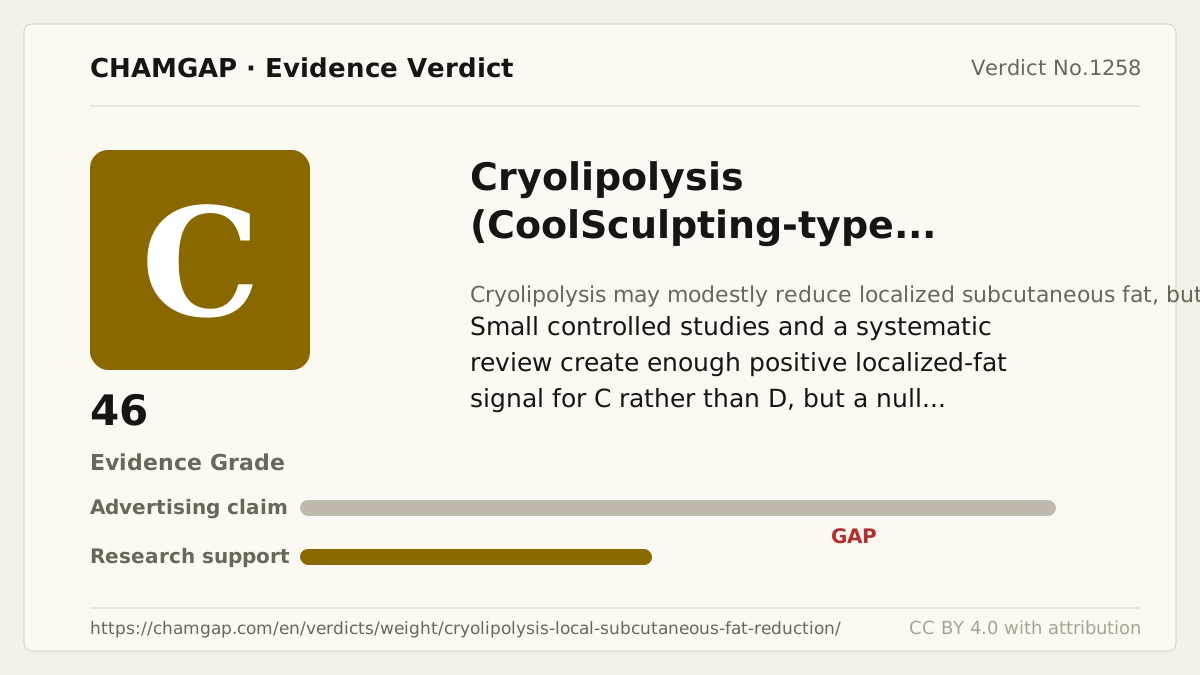
research showsCryolipolysis is rated C because positive human signals suggest a small reduction in localized subcutaneous fat on the abdomen or flanks. In an 11-person study with the opposite flank as control, the treated side lost about 39.6 mL more volume and caliper thickness fell by 14.9%. A systematic review of limited randomized and self-controlled trials also found mostly positive results. A more rigorous 34-person randomized trial with blinded assessment, however, found no significant difference in ultrasound thickness, skinfold, or abdominal circumference through 90 days. Small samples, device and protocol heterogeneity, manufacturer ties, and conflicting findings place the verdict at the bottom of C; this is not evidence of weight loss or obesity treatment.
ads claimMarketing expands the mechanism of freezing fat cells into claims of weight loss, visceral-fat removal, obesity treatment, or a substitute for diet and exercise. Direct evidence best fits modest contouring of pinchable localized subcutaneous fat in selected people, not a meaningful change on the scale.
Useful facts when choosing a product
- Cryolipolysis uses a vacuum or contact applicator to expose subcutaneous fat in a selected area to controlled cooling, aiming for a gradual local contour change over several weeks to months.
- Cleared treatment regions and applicators differ by device model, so patients should verify the authentic device, an authorized applicator for the intended area, and appropriate operator training.
- Redness, bruising, swelling, pain, tenderness, tingling, and temporary numbness are common and usually improve, although altered sensation or pain can persist.
- Rare paradoxical adipose hyperplasia causes a firm enlargement of fat in the treated shape months later. It may not resolve spontaneously and can require surgical correction such as liposuction.
Chamgap Semantic Classification Code
Candidate index · review held
P.cryolipolysis.subcutaneous.localized-subcutaneous-fat-thickness-and-circumference-on-the-abdomen-flanks-and-similar-areas.reduce.noneProcedures, devices and tests > Cryolipolysis > Subcutaneous > localized subcutaneous-fat thickness and circumference on the abdomen, flanks, and similar areas > Reduction claim > No intervention
An automated migration candidate, not an issued permanent code; exact claim scope remains under review. This machine-generated migration candidate helps retrieval but is not a permanent assignment. The original verdict ID and URL remain authoritative.
What the research actually shows
Garibyan and colleagues in 2014 treated one flank in 11 participants and used the other as an internal control with three-dimensional photographic volume analysis. At two months, the mean treated-control difference was 39.6 mL and caliper thickness fell 14.9%; some investigators served on the manufacturer's advisory board or had institutional royalty interests in relevant intellectual property. The allocation-concealed, assessor-blinded trial by Falster and colleagues in 2020 compared one session with no treatment in 34 women and found no significant difference in ultrasound thickness, skinfold, or two abdominal-circumference sites through 90 days. Resende and colleagues in 2022 systematically reviewed randomized and self-controlled human studies, finding mostly positive localized-fat results among five studies that passed methodological screening while emphasizing the shortage of good randomized trials. A 2023 review of United States data reported ultrasound reductions of 2.0 to 5.1 mm but also described the studies as few, underpowered, or low quality.
Why this is classified as C (46)
Objective treated-site controlled studies and a limited systematic review provide enough positive localized-fat evidence to avoid D. Samples are small, measurements and devices are heterogeneous, manufacturer interests are present, and an allocation-concealed assessor-blinded 34-person trial found no effect on thickness or circumference. Balancing the positive signal against these conflicts gives C with 46 points.
Counterpoint. Before treatment, patients should separate a weight-loss goal from a small contouring goal. The clinician should discuss suitable anatomy, expected changes in millimeters or milliliters, repeat-procedure cost, and a management plan for paradoxical adipose hyperplasia; obesity treatment requires separate assessment of behavioral, pharmacologic, and surgical options.
Rejudgment record. Cross-check applied — Applied the C-versus-D boundary rule because small site-controlled objective studies and a limited systematic review provide a positive signal, while heavily discounting for a null assessor-blinded 34-person randomized trial, measurement and device heterogeneity, and manufacturer ties
Sub-claim grades by effect
This ingredient is marketed for several effects. A single overall grade blends strong and weak claims together, so each effect is graded separately here. The overall grade reflects the strongest disconfirming or core claim.
| Effect (sub-claim) | Grade | Basis |
|---|---|---|
| Reduced localized subcutaneous-fat thickness at the treated site | C | Small site-controlled studies and a systematic review are positive, but a rigorous 34-person randomized trial was null. |
| Reduced circumference at treated regions such as the abdomen or flanks | C | Some before-after studies report small reductions, but circumference was null in the controlled trial and measurement variability is substantial. |
| Whole-body weight loss or obesity treatment | D | Localized contouring evidence cannot be extrapolated to weight loss, and controlled studies have not established meaningful reductions in body weight or BMI. |
Cross-check — AI research and Codex final gate
Evidence Table
| Study | Design | Sample | Funding | Endpoint | Result | Weight |
|---|---|---|---|---|---|---|
| Garibyan L et al. 2014 | Prospective site-randomized trial with one treated flank and the opposite flank as control | 11 participants | Departmental discretionary funds; some authors had Zeltiq advisory or intellectual-property royalty interests | Three-dimensional photographic volume, caliper thickness, and blinded photograph assessment at two months | The treated-control volume difference was 39.6 mL (p<0.0001), and treated-side caliper thickness decreased by 14.9%. | Positive but very small objective controlled evidence with conflicts |
| Falster M et al. 2020 | Allocation-concealed randomized no-treatment-controlled trial with blinded assessor | 34 healthy women; 17 treatment and 17 control | Funding source not stated in the PubMed/PMC record | Ultrasound thickness, skinfold, and two abdominal-circumference measures at 30, 60, and 90 days | No significant treatment-control difference was found for any thickness or circumference outcome at any time point. | Key conflicting null randomized trial |
| Resende L et al. 2022 | Systematic review of randomized and self-controlled human studies | 381 records identified, 7 eligible, and 5 retained after methodological assessment | Funding source not stated in the PubMed abstract | Localized-fat reduction, adverse effects, and satisfaction | Most included studies reported significant localized-fat reduction, but the number of good randomized trials was limited. | Limited positive synthesis |
Receipt — 4 References
All 4 cited sources were verified for existence at the original page (as of 2026-07-24).
Final verification and publication gate: Codex · Evidence date: 2026-07-24 · Corrections: none
Cite this verdict
[Chamgap] Cryolipolysis x reduced localized subcutaneous-fat thickness and circumference — Evidence Grade C·46. 4 cited sources checked. Source: https://chamgap.com/en/verdicts/weight/cryolipolysis-local-subcutaneous-fat-reduction/ · CC BY 4.0CC BY 4.0 — free to use with attribution; do not distort grades, numbers, or verdict meaning.
What this document does and does not do
Chamgap is an information source. It reports what research has and has not confirmed; it does not tell readers what to take or buy. That decision belongs to readers and, when needed, medical or legal professionals. This verdict reflects literature available up to the search date and may change as new research appears. Nothing here is medical advice.