
Breakfast skipping,
does it really help with Weight gain or impaired weight loss over 16 weeks?
research showsThe grade is D with 34 points. In 309 randomized adults with overweight or obesity, the 16-week intention-to-treat analysis using multiple imputation found no effect of advice to eat or skip breakfast on weight change. The 283-completer analysis also found no assignment effect (P=0.77). Calories were not matched, so this tests practical advice including compensatory intake, but it does not support the claim that skipping breakfast causes weight gain.
ads claimAn observational association between breakfast skipping and obesity does not prove causation. Direct assignment did not produce weight gain over 16 weeks.
Useful facts when choosing a product
- Breakfast participants ate before 10 am; skipping participants consumed no calories before 11 am, with later intake uncontrolled.
- The primary analysis included all 309 randomized participants; 283 completed.
- Verdict 1647 is D with 34 points for extra weight loss from an unrestricted-calorie eight-hour window; this verdict tests breakfast advice and 16-week weight change.
Chamgap Semantic Classification Code
Candidate index · review held
D.advice-to-skip-breakfast-and-consume-no-calories-before-11-am.dietary.weight-gain-or-impaired-weight-loss-over.assess.UNKDietary patterns and eating practices > Advice to skip breakfast and consume no calories before 11 am > Dietary regimen > Weight gain or impaired weight loss over > Association or change assessment > Unknown
An automated migration candidate, not an issued permanent code; exact claim scope remains under review. This machine-generated migration candidate helps retrieval but is not a permanent assignment. The original verdict ID and URL remain authoritative.
What the research actually shows
Dhurandhar et al. randomized 309 adults across five sites: 105 control, 101 advised to eat breakfast before 10 am, and 103 advised to consume no calories before 11 am. Allocation used sequentially numbered opaque sealed envelopes. The primary weight outcome was measured on an electronic scale, while self-report diaries were used only for secondary outcomes. A total of 283 completed; 8.4% missing weight-change data were multiply imputed for the 309-person primary analysis. Adjusted completer changes were roughly -0.53 to -0.76 kg across strata, with assignment P=0.77 and similar imputed results. Treating the unavoidable absence of participant blinding alone as a defect would automatically penalize every dietary-behavior trial. NIH-related grants and the Nordea Foundation supported this study. Separately, authors and institutions disclosed gifts, grants, or consulting relationships with Kraft, Kellogg, Quaker/Pepsi, the Dairy Research Institute, the Egg Board, McDonald's, General Mills, Nutrisystem, Dunkin' Donuts, Post Cereals, and others; these were not funding for this study.
Why this is classified as D (34)
A relatively large publicly supported randomized trial found a null registered primary weight outcome, but no precise treatment CI was verified, giving D with 34 points.
Counterpoint. This verdict does not address breakfast quality or separate glycemic outcomes.
Rejudgment record. Cross-check applied — Null registered primary weight endpoint in a 309-participant intention-to-treat randomized trial, without a verified treatment confidence interval
| Endpoint | P | Symptom or function itself is the target - including patient reports and performance tests |
| Replication | R1 | Single confirmatory trial |
| Independence | I2 | Decisive evidence is publicly or non-profit funded |
| Effect size | E0 | Null |
| Precision | CX | No pooled confidence interval could be confirmed |
Stored derived and displayed grades match; this is not a current recalculation or validity check (D).
Sub-claim grades by effect
This ingredient is marketed for several effects. A single overall grade blends strong and weak claims together, so each effect is graded separately here. The overall grade reflects the strongest disconfirming or core claim.
| Effect (sub-claim) | Grade | Basis |
|---|---|---|
| Sixteen-week weight gain from breakfast skipping | D | No assignment effect was found in all 309 randomized participants. |
Cross-check — AI research and Codex final gate
Evidence Table
| Study | Design | Sample | Funding | Endpoint | Result | Weight |
|---|---|---|---|---|---|---|
| Dhurandhar et al. 2014 | Multisite three-arm randomized effectiveness trial | 309 randomized and analyzed by intention to treat; 283 completed | This study was supported by NIH-related grants and the Nordea Foundation; separate food-industry gifts, grants, and consulting relationships were disclosed | Registered primary endpoint of 16-week weight change | No assignment effect; completer P=0.77 with similar multiple-imputation ITT results | Relatively large direct null trial |
Receipt — 2 References
All 2 cited sources were verified for existence at the original page (as of 2026-08-03).
Final verification and publication gate: Codex · Evidence date: 2026-08-03 · Corrections: none
Cite this verdict
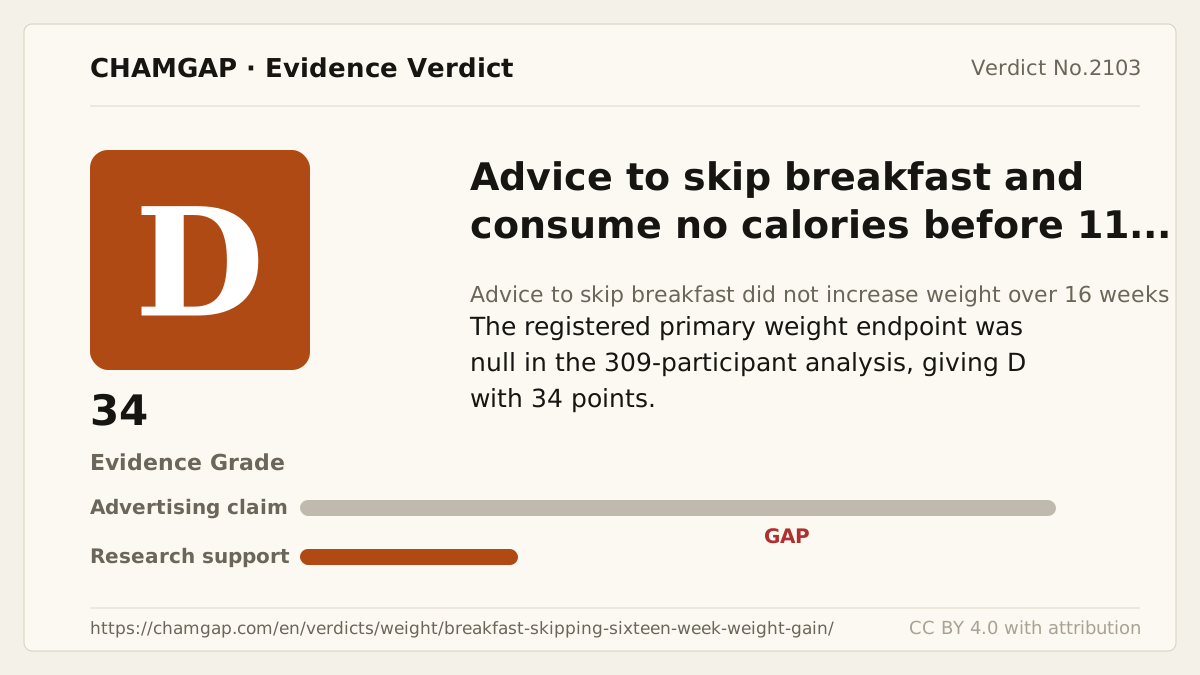
[Chamgap] Breakfast skipping x 16-week weight gain — Evidence Grade D·34. 2 cited sources checked. Source: https://chamgap.com/en/verdicts/weight/breakfast-skipping-sixteen-week-weight-gain/ · CC BY 4.0CC BY 4.0 — free to use with attribution; do not distort grades, numbers, or verdict meaning.
What this document does and does not do
Chamgap is an information source. It reports what research has and has not confirmed; it does not tell readers what to take or buy. That decision belongs to readers and, when needed, medical or legal professionals. This verdict reflects literature available up to the search date and may change as new research appears. Nothing here is medical advice.