
Berberine,
does it really help with Obesity treatment and weight loss?
research showsBerberine may produce a small reduction in weight, but the evidence does not support calling it 'natural Ozempic' or a pharmaceutical-grade obesity treatment. A 2026 meta-analysis of 23 randomized-trial reports found an average difference of only 0.88 kg, with small changes in BMI and waist circumference. Blinding, randomization, formulation, purity, dose, and study populations were poorly or inconsistently reported, and earlier meta-analyses found no weight effect. The grade is C.
ads claimAdvertising and social media describe berberine as 'nature's Ozempic,' 'GLP-1-like,' an appetite suppressant, or a fat burner. Mechanistic similarity does not establish the same receptor action, dose response, or large clinical weight loss. An average loss of 0.88 kg cannot be presented as equivalent to GLP-1 obesity medicines.
Useful facts when choosing a product
- Korean online stores carry 500 mg berberine hydrochloride capsules and liposomal or multi-ingredient products through both domestic manufacturing and overseas purchasing.
- Weight signals were seen mainly in subgroups using more than 1 g/day for longer than eight weeks, but this is not an established obesity-treatment dose.
- Salt form, purity, absorption-enhancing formulation, and additional ingredients vary, so marketed products cannot be assumed to match trial products.
- Abdominal pain, nausea, diarrhea, and constipation are common, and drug interactions are possible. Berberine should not be used during pregnancy or lactation or in infants; people taking medicines such as cyclosporine should consult a clinician.
Chamgap Semantic Classification Code
Candidate index · review held
S.berberine.UNK.obesity-treatment-and-weight-loss.treat.UNKSupplements and nutraceuticals > Berberine > Unknown > Obesity treatment and weight loss > Treatment or remission claim > Unknown
An automated migration candidate, not an issued permanent code; exact claim scope remains under review. This machine-generated migration candidate helps retrieval but is not a permanent assignment. The original verdict ID and URL remain authoritative.
What the research actually shows
The 2026 meta-analysis by Vahed and colleagues included 23 randomized-trial reports and found weight MD −0.88 kg (95% CI −1.36 to −0.39), BMI −0.48 kg/m², and waist circumference −1.32 cm, with no effect on waist-to-hip ratio. It called for better blinding, randomization, and reporting of product purity, potency, and gram amounts. The 2020 analysis by Xiong and colleagues found small BMI and waist changes across 10 trials but no weight effect at −0.11 kg. The 2020 analysis by Amini and colleagues, including 12 trials and 849 participants, also found no significant effects on weight, BMI, or waist circumference. A 2022 metabolic-risk meta-analysis found significant weight effects in high-risk-of-bias trials, limiting confidence.
Why this is classified as C (47)
Meta-analyses of randomized trials show signals for weight, BMI, and waist circumference, so D is not appropriate. However, the average weight difference is only about 0.88 kg, earlier meta-analyses were null, methods and product characterization were poorly reported, and clinical obesity outcomes are absent. The rating is C with 47 points.
Counterpoint. A small adjunctive weight change remains possible in some populations with metabolic disease. This verdict does not negate the separate blood-glucose and lipid axis, and it does not recognize berberine as a GLP-1 substitute or a pharmaceutical-grade obesity treatment.
Rejudgment record. New verdict — Accepted the latest randomized-trial meta-analysis signal of about 0.88 kg while limiting certainty for earlier null analyses, small magnitude, and weak blinding, randomization, and product reporting
Cross-check — AI research and Codex final gate
Evidence Table
| Study | Design | Sample | Funding | Endpoint | Result | Weight |
|---|---|---|---|---|---|---|
| Vahed IE et al. 2026 | Systematic review and meta-analysis of randomized trials | 23 | Authors reported no competing interests | Weight, BMI, waist circumference, and waist-to-hip ratio | Weight changed by −0.88 kg, BMI by −0.48 kg/m², and waist circumference by −1.32 cm, while waist-to-hip ratio was null; blinding, randomization, and product reporting were major limitations. | Key |
| Xiong P et al. 2020 | Dose-response systematic review and meta-analysis | 10 | Unknown | Weight, BMI, and waist circumference | BMI and waist circumference decreased modestly, but weight did not change significantly at −0.11 kg. | Key |
| Amini MR et al. 2020 | Systematic review and meta-analysis of randomized trials | 849 | Authors reported no conflicts of interest | Weight, BMI, waist circumference, and waist-to-hip ratio | In the combined berberine and barberry analysis, weight, BMI, and waist circumference did not change significantly; only waist-to-hip ratio decreased. | Supportive |
Receipt — 4 References
All 4 cited sources were verified for existence at the original page (as of 2026-07-18).
Final verification and publication gate: Codex · Evidence date: 2026-07-18 · Corrections: none
Cite this verdict
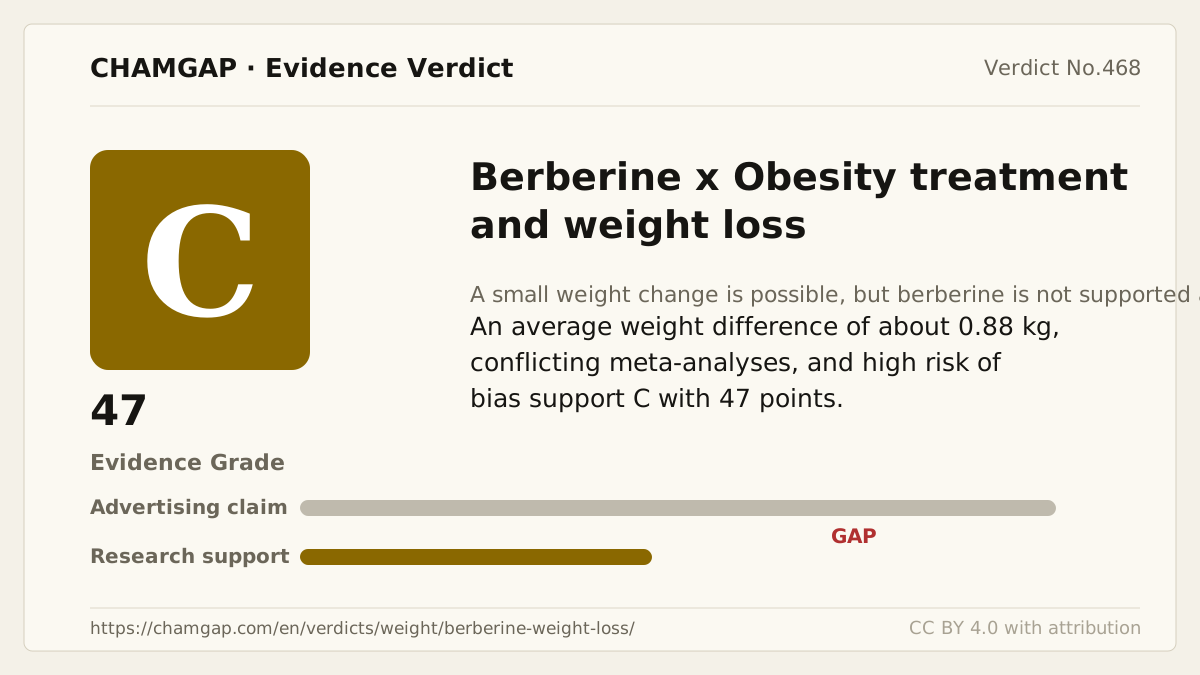
[Chamgap] Berberine x obesity treatment and weight loss — Evidence Grade C·47. 4 cited sources checked. Source: https://chamgap.com/en/verdicts/weight/berberine-weight-loss/ · CC BY 4.0CC BY 4.0 — free to use with attribution; do not distort grades, numbers, or verdict meaning.
What this document does and does not do
Chamgap is an information source. It reports what research has and has not confirmed; it does not tell readers what to take or buy. That decision belongs to readers and, when needed, medical or legal professionals. This verdict reflects literature available up to the search date and may change as new research appears. Nothing here is medical advice.