
Aspartame,
does it really help with Weight loss or prevention of weight gain independent of sugar replacement?
research showsThe grade is D. One hundred lean adults were randomized to 0, 350, or 1,050 mg/day; seven withdrew and 93 completed the 12-week analysis, which found no between-group effect on body weight or composition. Weight was secondary rather than the registered primary outcome, and one small manufacturer-funded trial is not repeated refutation, so the grade does not fall to F. Avoiding sugar calories through actual replacement is separate from an intrinsic weight-loss effect of aspartame.
ads claimAspartame provides energy per gram but is about 200 times sweeter than sugar, so the amount and calories used are very small. That composition advantage is not automatically weight loss, and any weight claim must name the displaced comparator.
Useful facts when choosing a product
- Aspartame provides about 4 kcal/g but is about 200 times sweeter than sugar according to FDA materials, so very little is needed for equal sweetness.
- Aspartame is digested to aspartic acid, phenylalanine, and methanol rather than directly supplying glucose or fructose.
- People with phenylketonuria must restrict phenylalanine and should check aspartame labeling.
- Verdict 1137 is D with 30 points for D-allulose and weight or body fat; this verdict concerns aspartame against a zero-dose control, so both ingredient and comparison differ.
Chamgap Semantic Classification Code
Candidate index · review held
S.aspartame.UNK.weight-loss-or-prevention-of-weight-gain-independent-of-sugar-replacement.prevent.UNKSupplements and nutraceuticals > Aspartame > Unknown > Weight loss or prevention of weight gain independent of sugar replacement > Occurrence-prevention claim > Unknown
An automated migration candidate, not an issued permanent code; exact claim scope remains under review. This machine-generated migration candidate helps retrieval but is not a permanent assignment. The original verdict ID and URL remain authoritative.
What the research actually shows
Higgins and colleagues randomized 100 lean adults in groups of 33, 33, and 34. Seven withdrew, leaving 31 per group and 93 completers for analysis. The registry's actual enrollment field of 93 must not be read as the randomized count. The 350-mg dose was delivered in a beverage, and 1,050 mg combined a 350-mg beverage with a 700-mg capsule. Compliance was about 95%, with no weight or composition effect. NCT02999321 was first submitted after the study started; glycemia was the primary objective and weight was secondary. Ajinomoto North America, Inc. provided support. Author disclosures stated no conflicts for K. A. Higgins; Almond Board of California research support for R. V. Considine and R. D. Mattes; and California Walnut Commission and study-specific Ajinomoto support plus ConAgra and Grain Foods Foundation scientific-board service for Mattes.
Why this is classified as D (28)
The registered secondary weight endpoint was null in a direct randomized trial, but the evidence is a single 93-person, 12-week, manufacturer-funded study without a verified adjusted between-group interval, giving D with 28 points.
Counterpoint. D does not deny calorie reduction when aspartame truly replaces sugar. It means an independent effect that burns weight or prevents gain has not been established.
Rejudgment record. Cross-check applied — Assessed weight as a registered secondary outcome, 93 participants actually analyzed, null repeated-measures results, manufacturer funding, and unavailable precision
| Endpoint | P | Symptom or function itself is the target - including patient reports and performance tests |
| Replication | R1 | Single confirmatory trial |
| Independence | I0 | Evidence comes only from manufacturer studies |
| Effect size | E0 | Null |
| Precision | CX | No pooled confidence interval could be confirmed |
Stored derived and displayed grades match; this is not a current recalculation or validity check (D).
Sub-claim grades by effect
This ingredient is marketed for several effects. A single overall grade blends strong and weak claims together, so each effect is graded separately here. The overall grade reflects the strongest disconfirming or core claim.
| Effect (sub-claim) | Grade | Basis |
|---|---|---|
| Aspartame itself reduces weight or prevents gain | D | The secondary weight endpoint was null in a 93-person 12-week trial. |
Cross-check — AI research and Codex final gate
Evidence Table
| Study | Design | Sample | Funding | Endpoint | Result | Weight |
|---|---|---|---|---|---|---|
| Higgins KA et al., 2018 | Twelve-week randomized parallel-group dose trial | 100 randomized in groups of 33, 33, and 34; seven withdrew; 93 completers analyzed, 31 per group | Supported by Ajinomoto North America, Inc.; Considine and Mattes disclosed Almond Board support, and Mattes disclosed California Walnut Commission and Ajinomoto support plus ConAgra and Grain Foods Foundation board service | Body weight and composition as secondary objectives | No between-group effect on body weight or composition across 0, 350, and 1,050 mg/day at 12 weeks | Direct randomized evidence, but small, manufacturer-funded, and secondary-outcome based |
Receipt — 3 References
All 3 cited sources were verified for existence at the original page (as of 2026-08-03).
Final verification and publication gate: Codex · Evidence date: 2026-08-03 · Corrections: none
Cite this verdict
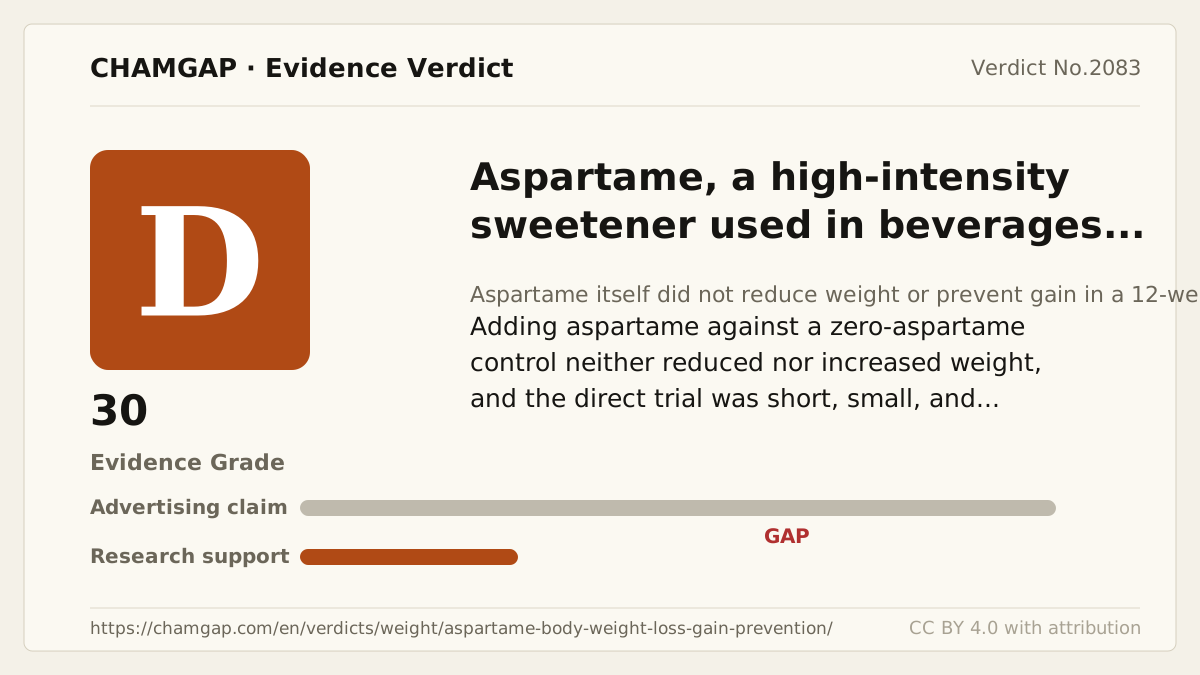
[Chamgap] Aspartame x weight loss or prevention of weight gain — Evidence Grade D·28. 3 cited sources checked. Source: https://chamgap.com/en/verdicts/weight/aspartame-body-weight-loss-gain-prevention/ · CC BY 4.0CC BY 4.0 — free to use with attribution; do not distort grades, numbers, or verdict meaning.
What this document does and does not do
Chamgap is an information source. It reports what research has and has not confirmed; it does not tell readers what to take or buy. That decision belongs to readers and, when needed, medical or legal professionals. This verdict reflects literature available up to the search date and may change as new research appears. Nothing here is medical advice.