
Artificial light during sleep,
does it really help with Increased risk of gaining at least 5 kg and developing overweight or obesity?
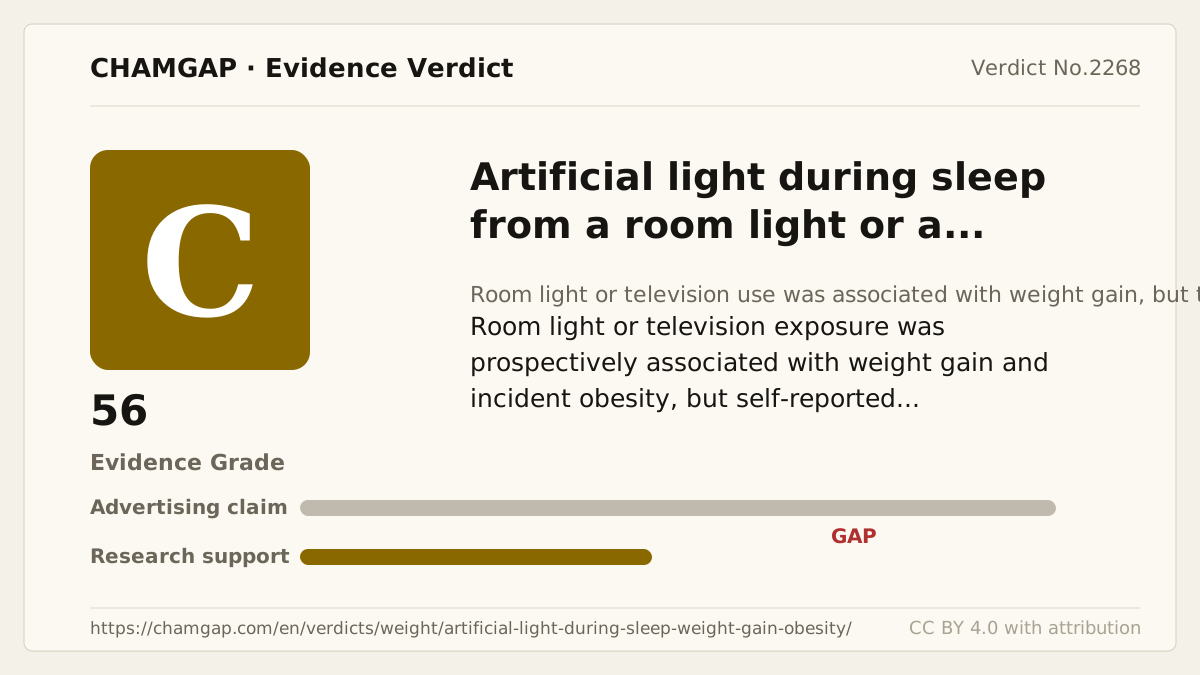
research showsThe grade is C with 56 points. In a large prospective cohort, women who slept with a room light or television on had 5.7-year cumulative incidences of 21.5% versus 15.6% for gaining at least 5 kg and 9.6% versus 5.8% for incident obesity, compared with women who used a sleep mask or reported no light at all. Adjusted relative risks were 1.17 and 1.33, respectively. However, light exposure and follow-up weight were largely self-reported, and nighttime eating, sleep, socioeconomic patterning, and reverse causation could not be eliminated. The cohort supports an association, not proof that leaving a light on causes weight gain.
ads claimThe circulating claim is that sleeping with a light or television on makes a person gain weight. The clearest association was for the combined room-light or television category. A small nightlight and light entering from outside were separate exposures. Marketing should describe an observational relative risk and must not present it as a trial showing how much weight is lost by turning lights off.
Useful facts when choosing a product
- The US reference group was not confirmed at zero lux by a sensor; it comprised women who used a sleep mask or reported no light at all.
- The US study combined a room light and television in its main category, although a sensitivity analysis reported similar associations when they were separated.
- The Japanese HEIJO-KYO cohort measured two nights with a light meter near the head of the bed and compared mean nighttime exposure at or above 3 lux with exposure below 3 lux.
- Women with baseline obesity were excluded from incident-obesity analyses, and results persisted after excluding frequent nighttime awakeners. No analysis excluded cases arising during an initial one- or two-year lag.
Chamgap Semantic Classification Code
Candidate index · review held
UNK.artificial-light-during-sleep-from-a-room-light-or-a-television-left-on.UNK.risk-of-gaining-at-least-and-developing-overweight-or-obesity.increase.reference-exposureUnknown > Artificial light during sleep from a room light or a television left on > Unknown > risk of gaining at least and developing overweight or obesity > Increase claim > Reference exposure
An automated migration candidate, not an issued permanent code; exact claim scope remains under review. This machine-generated migration candidate helps retrieval but is not a permanent assignment. The original verdict ID and URL remain authoritative.
What the research actually shows
Park and colleagues recoded self-reported baseline answers from 43,722 women aged 35 to 74 into four categories: no light; a small nightlight or clock-radio light; light from another room or outdoors; and one or more room lights or a television on for most or all of the night. The reference group used a sleep mask or reported no light. In contrast, Obayashi objectively measured illuminance near the head of the bed for two consecutive nights and compared mean nighttime light below 3 lux with at least 3 lux. Park exposure was self-reported, whereas Obayashi exposure was measured with a light meter; the two must not be interchanged. Park's main model adjusted for demographic, socioeconomic, smoking, alcohol, caffeine, menopause, depression, stress, and follow-up variables. Sleep, activity, diet, glycemic load, and nighttime eating entered secondary models only, and associations persisted.
Why this is classified as C (56)
Room light or television exposure was significantly associated with gaining at least 5 kg and incident obesity in a large, publicly funded prospective cohort. Nevertheless, self-reported exposure and follow-up weight, omission of nighttime eating, sleep, and activity from the main model, unknown reasons for leaving lights on, and no early-case lag analysis leave reverse causation and residual confounding. The grade is C with 56 points because temporal ordering is supported but a causal effect of turning lights off is not established.
Counterpoint. Obayashi 2016 had no authors in common with the US study and followed 766 of 1,110 Japanese older adults for a median 21 months. Mean bedroom light at or above 3 lux was associated with greater BMI and waist-to-height-ratio gain. However, it used two-night sensor exposure, continuous outcomes, and an older population, and it had mixed funding that included lighting and electric-power companies. It supports the direction but is not a directly comparable independent replication of the US categories and incident-obesity relative risk.
Rejudgment record. Cross-check applied — Cross-checked the four exposure categories, absolute event rates, adjusted relative risks, covariate models, and sensitivity analyses in the Sister Study report, then verified authorship, funding, exposure measurement, and outcome comparability in the Japanese sensor cohort
| Endpoint | H | Hard endpoint - actual events such as death |
| Replication | R1 | Single confirmatory trial |
| Independence | I2 | Decisive evidence is publicly or non-profit funded |
| Effect size | E+ | Meets the clinically important threshold |
Stored derived and displayed grades match; this is not a current recalculation or validity check (C).
Sub-claim grades by effect
This ingredient is marketed for several effects. A single overall grade blends strong and weak claims together, so each effect is graded separately here. The overall grade reflects the strongest disconfirming or core claim.
| Effect (sub-claim) | Grade | Basis |
|---|---|---|
| Room light or television and gaining at least 5 kg | C | Cumulative incidence was 21.5% versus 15.6%, adjusted RR 1.17 (95% CI 1.08 to 1.27). |
| Room light or television and incident obesity | C | Cumulative incidence was 9.6% versus 5.8%, adjusted RR 1.33 (95% CI 1.13 to 1.57). |
| Small nightlight or outside-room light and gaining at least 5 kg | D | Associations were null for a small nightlight, RR 1.01 (0.94 to 1.07), and outside-room light, RR 1.03 (0.96 to 1.10). |
Cross-check — AI research and Codex final gate
Evidence Table
| Study | Design | Sample | Funding | Endpoint | Result | Weight |
|---|---|---|---|---|---|---|
| Park et al. Sister Study 2019 | Large nationwide US prospective cohort using self-reported light exposure | 43,722 at baseline; 38,950 provided follow-up BMI; mean follow-up 5.7 years | US NIH and NIEHS Intramural Research Program grant Z01-ES044005; no conflicts reported | Gain of at least 5 kg, BMI increase of at least 10%, and incident overweight and obesity | Room light or television versus no light: gain of at least 5 kg, 21.5% versus 15.6%, RR 1.17 (95% CI 1.08 to 1.27); BMI increase of at least 10%, 14.3% versus 10.9%, RR 1.13 (1.02 to 1.26); incident overweight, 21.5% versus 14.8%, RR 1.22 (1.06 to 1.40); incident obesity, 9.6% versus 5.8%, RR 1.33 (1.13 to 1.57). | Most direct large prospective evidence, limited by self-report and residual confounding |
| Obayashi et al. HEIJO-KYO cohort 2016 | Prospective community cohort of Japanese older adults with sensor-measured light | 1,110 at baseline and 766 at follow-up; median 21 months | Mixed public, nonprofit, university, and corporate funding, including YKK AP, Ushio, Tokyo Electric Power, and Sekisui Chemical; two authors disclosed grants from related companies | Follow-up change in measured BMI and waist-to-height ratio | For mean nighttime light at or above versus below 3 lux, adjusted coefficients were 0.959 (95% CI 0.230 to 1.687) for waist-to-height-ratio change and 0.405 (0.011 to 0.799) for BMI change. The reported 10-year gains of 10.2% and 10.0% were projections, not changes observed over the 21-month median follow-up. | Sensor-based supportive evidence with no shared authors, but not a direct replication because exposure, outcome, population, and funding differed |
Receipt — 2 References
All 2 cited sources were verified for existence at the original page (as of 2026-08-05).
Final verification and publication gate: Codex · Evidence date: 2026-08-05 · Corrections: none
Cite this verdict
[Chamgap] Artificial light during sleep x weight gain and obesity — Evidence Grade C·56. 2 cited sources checked. Source: https://chamgap.com/en/verdicts/weight/artificial-light-during-sleep-weight-gain-obesity/ · CC BY 4.0CC BY 4.0 — free to use with attribution; do not distort grades, numbers, or verdict meaning.
What this document does and does not do
Chamgap is an information source. It reports what research has and has not confirmed; it does not tell readers what to take or buy. That decision belongs to readers and, when needed, medical or legal professionals. This verdict reflects literature available up to the search date and may change as new research appears. Nothing here is medical advice.