
AOD-9604,
does it really help with Produced clinically meaningful weight and body-fat loss in adults with obesity when added to diet and exercise?
research showsAOD-9604 is rated F because it repeatedly failed to establish clinically meaningful weight or body-fat loss in adults with obesity, and a regulatory review concluded that efficacy evidence was lacking. According to FDA's 2024 review, the largest phase 2b OPTIONS trial enrolled 536 people and randomized 502. Oral AOD-9604 or placebo was evaluated alongside diet and exercise, with no significant difference on the week-12 primary weight-loss outcome, and the company ended obesity development after the twenty-four-week program. FDA concluded that most identified trials failed to show weight-reduction benefit over placebo and that evidence did not support effectiveness for obesity by any route. Although AOD-9604 is marketed online and through Korean channels as an oral or subcutaneous peptide diet, no human efficacy data exist for the subcutaneous form, and approval, product quality, and long-term safety are not assured. Repeated failure plus a regulatory conclusion supports F with 8 points.
ads claimKorean online distribution, clinics, and vendor channels market AOD-9604 as a peptide diet that burns fat while preserving muscle, breaks down body fat without appetite suppression, or works through oral or subcutaneous programs. The large oral obesity trial failed and no human subcutaneous efficacy data exist; changing the formulation does not restore failed efficacy.
Useful facts when choosing a product
- AOD-9604 is a synthetic sixteen-amino-acid peptide corresponding to growth hormone residues 177 through 191 with an added N-terminal tyrosine.
- Human obesity development mainly used oral capsules or tablets, and no human trial was found testing weight-loss efficacy of the currently marketed subcutaneous products.
- No approved drug contains AOD-9604, and the labeled content, purity, sterility, and storage quality of online, compounded, or research products may not be assured.
- FDA found insufficient information on long-term safety, subcutaneous or transdermal pharmacokinetics, immunogenicity, impurities, and toxicity and concluded that compounded use may raise safety concerns.
Chamgap Semantic Classification Code
Candidate index · review held
M.aod-9604.MULTI.produced-clinically-meaningful-weight-and-body-fat-loss-with-obesity-when-added-to-diet-and-exercise.assess.MULTIMedicinal interventions > AOD-9604 > Multiple: primary unresolved > Produced clinically meaningful weight and body-fat loss with obesity when added to diet and exercise > Association or change assessment > Multiple: primary unresolved
An automated migration candidate, not an issued permanent code; exact claim scope remains under review. This machine-generated migration candidate helps retrieval but is not a permanent assignment. The original verdict ID and URL remain authoritative.
What the research actually shows
The AOD-9604 development program included six randomized double-blind studies conducted from 2001 through 2006, but public efficacy information depends largely on a developer-supported safety synthesis and company summaries. METAOD005 assigned 300 adults with obesity to 1, 5, 10, 20, or 30 mg or placebo for twelve weeks; only 1 mg produced a larger weight-loss signal, without a linear dose response. METAOD006, known as OPTIONS, enrolled 536 participants and randomized 502 to 0.25, 0.5, or 1 mg or placebo for twenty-four weeks alongside diet and exercise; it found no significant weight difference on the week-12 primary outcome. The FDA source states 536 enrolled and 502 randomized, not 502 analyzed. FDA concluded that most studies did not show weight-reduction benefit over placebo and that obesity development ended after failure. FDA also found no human exposure or efficacy literature for subcutaneous or transdermal AOD-9604.
Why this is classified as F (8)
The early twelve-week dose signal was nonlinear, and the larger twenty-four-week OPTIONS program missed its week-12 primary weight-loss outcome. FDA explicitly found that most trials showed no placebo benefit and that efficacy evidence was inadequate for every route, supporting F with 8 points under the repeated-refutation and regulatory-conclusion standard.
Counterpoint. When obesity treatment is indicated, approved options should be compared by eligibility, average benefit, adverse effects, and cost alongside nutrition, activity, and sleep. An unapproved injectable version of a failed development drug is not a validated alternative.
Rejudgment record. Cross-check applied — Under the D versus F boundary, a single large null trial receives D, while repeated failure or a regulatory conclusion of no efficacy receives F. The OPTIONS primary weight-loss failure, multiple placebo-null studies, termination of obesity development, and FDA's conclusion that efficacy evidence was inadequate for every route together support F
Sub-claim grades by effect
This ingredient is marketed for several effects. A single overall grade blends strong and weak claims together, so each effect is graded separately here. The overall grade reflects the strongest disconfirming or core claim.
| Effect (sub-claim) | Grade | Basis |
|---|---|---|
| Clinically meaningful weight loss in adults with obesity when added to diet and exercise | F | The week-12 primary weight-loss outcome in OPTIONS did not differ from placebo, and most development trials were also null. |
| Clinically meaningful body-fat reduction in adults with obesity | F | No controlled trial replicated clinically meaningful human body-fat benefit, and the obesity program ended for inadequate efficacy. |
| Weight or body-fat loss with subcutaneous AOD-9604 | ? | FDA found no human exposure or efficacy information for subcutaneous AOD-9604. |
Cross-check — AI research and Codex final gate
Evidence Table
| Study | Design | Sample | Funding | Endpoint | Result | Weight |
|---|---|---|---|---|---|---|
| U.S. FDA PCAC AOD-9604 briefing review. 2024 | Regulatory evidence review for a compounded bulk drug substance | 536 enrolled and 502 randomized in OPTIONS; about 893 participants across six human development studies | U.S. FDA regulatory review; original development trials were sponsored by Metabolic Pharmaceuticals | Week-12 primary weight loss alongside diet and exercise, the twenty-four-week development result, and route-specific efficacy and safety | OPTIONS found no significant weight loss versus placebo and obesity development ended. FDA concluded that most trials were null and efficacy evidence was inadequate for every route. | Key repeated-failure evidence and regulatory conclusion |
| Stier H, Vos E, Kenley D. 2013 | Developer-linked safety synthesis of six randomized double-blind human development trials | 893 participants across acute intravenous and oral studies and seven-day, twelve-week, and twenty-four-week oral studies | Two authors had ownership, consulting, or former medical-director ties to the developer, and the first author's company consulted for the developer | Safety, tolerability, IGF-1, glucose metabolism, antibodies, and summarized weight efficacy from development trials | Short-term safety was described as generally similar to placebo, but the twelve-week signal was nonlinear and the twenty-four-week OPTIONS program found no significant weight loss. | Context for efficacy failure with strong conflicts of interest |
Receipt — 2 References
All 2 cited sources were verified for existence at the original page (as of 2026-07-24).
Final verification and publication gate: Codex · Evidence date: 2026-07-24 · Corrections: none
Cite this verdict
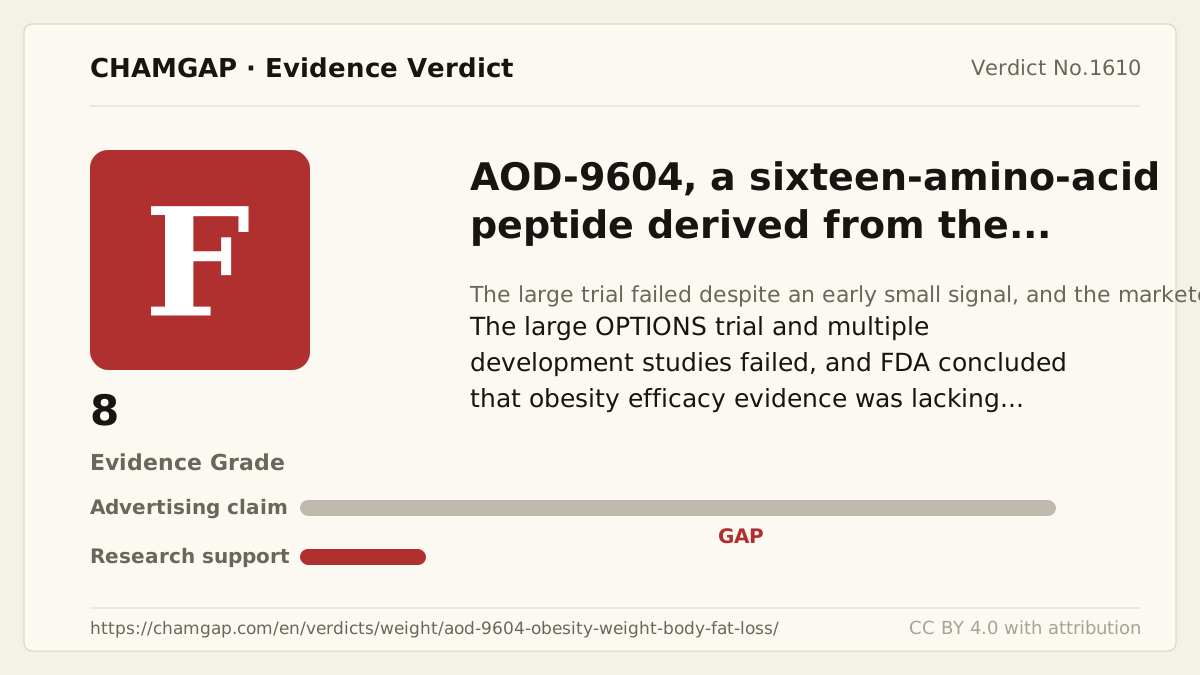
[Chamgap] AOD-9604 x clinically meaningful weight and body-fat loss with diet and exercise — Evidence Grade F·8. 2 cited sources checked. Source: https://chamgap.com/en/verdicts/weight/aod-9604-obesity-weight-body-fat-loss/ · CC BY 4.0CC BY 4.0 — free to use with attribution; do not distort grades, numbers, or verdict meaning.
What this document does and does not do
Chamgap is an information source. It reports what research has and has not confirmed; it does not tell readers what to take or buy. That decision belongs to readers and, when needed, medical or legal professionals. This verdict reflects literature available up to the search date and may change as new research appears. Nothing here is medical advice.