
An ad libitum low-fat vegan diet,
does it really help with Weight loss in adults with overweight?
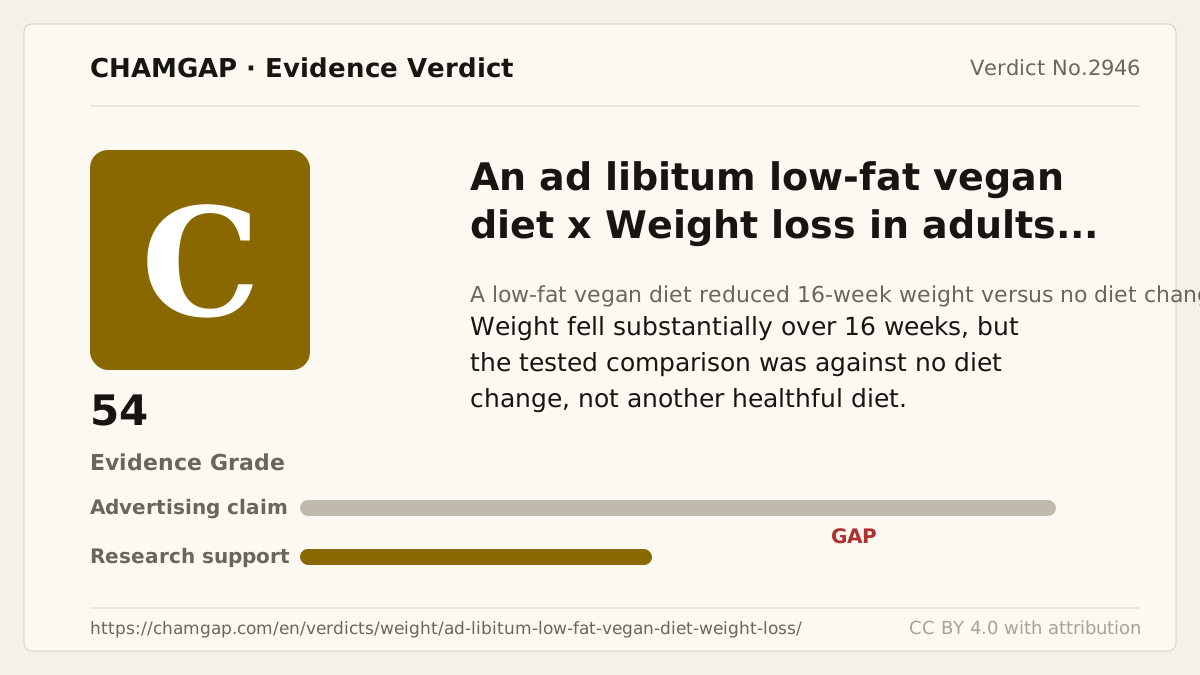
research showsGrade C. In a 244-participant randomized trial, 16-week weight change was -6.4 kg with the vegan diet versus -0.5 kg with no diet change, a treatment effect of -5.9 kg (95% CI -6.8 to -5.0; group-by-time P<.001). The comparator did not adopt another diet. Weight was a surrogate rather than a clinical event, and an organization that advocates the tested diet funded the trial and had senior officers among the authors.
ads claimAd libitum means calories were not explicitly restricted; it does not mean the groups received equal instruction and attention. The established comparison is against no diet change, not superiority over another weight-loss diet.
Useful facts when choosing a product
- The vegan arm avoided animal products and added fats and was instructed to keep fat intake low.
- No food or supplements were provided; weekly classes and support were provided to the vegan group.
- No prespecified primary safety endpoint or between-group adverse-event table was reported.
Chamgap Semantic Classification Code
Candidate index · review held
D.ad-libitum-low-fat-vegan-diet.dietary.weight-loss-with-overweight.assess.activeDietary patterns and eating practices > ad libitum low-fat vegan diet > Dietary regimen > Weight loss with overweight > Association or change assessment > Active comparator
An automated migration candidate, not an issued permanent code; exact claim scope remains under review. This machine-generated migration candidate helps retrieval but is not a permanent assignment. The original verdict ID and URL remain authoritative.
What the research actually shows
NCT02939638 randomized 244 participants, 122 per arm. A total of 222 (91.0%) completed week 16, and the primary repeated-measures model included missing observations. Food and supplements were not supplied, but the vegan group received weekly classes and support. Funding came from the Physicians Committee for Responsible Medicine, Yale Diabetes Center P30 DK-045735, R01 DK-113984, NIH P30 DK034989, and UL1 TR001863. Kahleova was PCRM's director of clinical research and Barnard its president; PCRM advocates the tested dietary pattern. Axis 6 B0 evidence ① Allocation concealment: "Participants were randomly assigned in a 1:1 ratio to the intervention or control group." ② Masking: Participant masking was infeasible for diet assignment, but weight was measured with "a calibrated scale accurate to 0.1 kg." ③ Analysis set and missing data: "The intention-to-treat analysis included all participants." Missing observations were included in the repeated-measures model. ④ Prespecified primary endpoint: "The primary outcomes were body weight, insulin resistance, postprandial metabolism, and intramyocellular and hepatocellular lipid levels." — consistent with NCT02939638
Why this is classified as C (54)
A single 16-week randomized trial found a large weight difference, but weight was a surrogate and the diet-advocacy funder had senior officers among the authors, giving C with 54 points.
Counterpoint. This verdict is limited to 16-week weight versus no diet change; long-term clinical events and superiority to another healthful diet are separate questions.
Rejudgment record. Cross-check applied — A 16-week randomized no-diet-change comparison with surrogate weight loss, one confirmatory trial, and mixed independence
| Endpoint | S | Surrogate marker - laboratory or imaging measures |
| Replication | R1 | Single confirmatory trial |
| Independence | I1 | Mixed funding sources |
| Effect size | E+ | Meets the clinically important threshold |
Stored derived and displayed grades match; this is not a current recalculation or validity check (C).
Sub-claim grades by effect
This ingredient is marketed for several effects. A single overall grade blends strong and weak claims together, so each effect is graded separately here. The overall grade reflects the strongest disconfirming or core claim.
| Effect (sub-claim) | Grade | Basis |
|---|---|---|
| Sixteen-week weight loss versus no diet change | C | The treatment effect was -5.9 kg. |
| Superior weight loss versus another healthful diet | D | The 74-week diabetes-diet trial had a between-group P=.25. |
Cross-check — AI research and Codex final gate
Evidence Table
| Study | Design | Sample | Funding | Endpoint | Result | Weight |
|---|---|---|---|---|---|---|
| Kahleova H et al. 2020 NCT02939638 | 16-week open-label parallel randomized trial | 244 randomized, 122 per arm; 222 completed; repeated-measures analysis included missing observations | PCRM plus NIH and Yale public grants; PCRM officers were authors | Change in calibrated-scale body weight at 16 weeks | -6.4 kg vs -0.5 kg; treatment effect -5.9 kg (95% CI -6.8 to -5.0), group-by-time P<.001 | Pivotal single randomized evidence |
| Barnard ND et al. 2009 74-week diabetes diet trial | Randomized trial of low-fat vegan versus conventional diabetes diet | 99 randomized | NIH R01 DK059362 and related support | Weight change at 74 weeks | -4.4 kg vs -3.0 kg, between-group P=.25 | Context from a different population and active diet comparator |
| NEW Soul | Randomized active-comparator trial of vegan versus low-fat omnivorous soul food diets | 159 randomized | Reported trial funding | 12-month weight change (primary endpoint) | -2.39 kg vs -2.03 kg, between-group P=.64 | Active-comparator evidence directly refuting superiority over another healthful diet |
Receipt — 3 References
All 3 cited sources were verified for existence at the original page (as of 2026-08-26).
Final verification and publication gate: Codex · Evidence date: 2026-08-26 · Corrections: none
Cite this verdict
[Chamgap] Benefit of an Ad Libitum Low-Fat Vegan Diet for Weight Loss — Evidence Grade C·54. 3 cited sources checked. Source: https://chamgap.com/en/verdicts/weight/ad-libitum-low-fat-vegan-diet-weight-loss/ · CC BY 4.0CC BY 4.0 — free to use with attribution; do not distort grades, numbers, or verdict meaning.
What this document does and does not do
Chamgap is an information source. It reports what research has and has not confirmed; it does not tell readers what to take or buy. That decision belongs to readers and, when needed, medical or legal professionals. This verdict reflects literature available up to the search date and may change as new research appears. Nothing here is medical advice.