
Ursolic acid,
does it really help with Increased muscle mass and strength during resistance training?
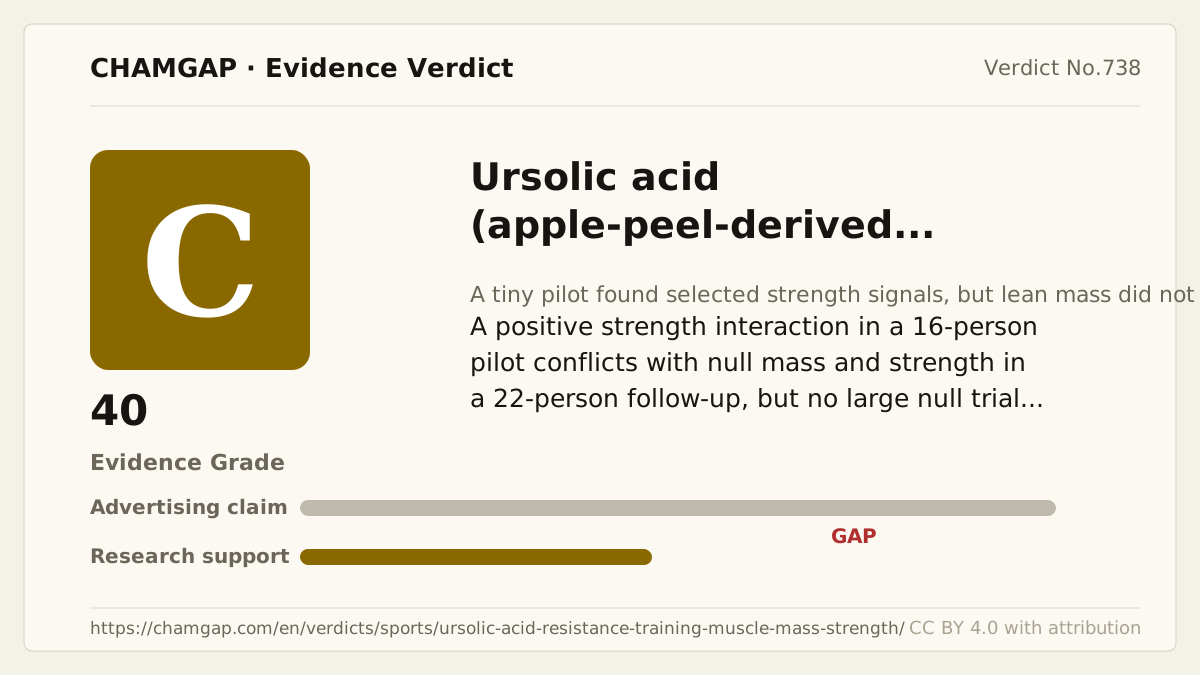
research showsC. A 16-person pilot found a significant group-by-time interaction for strength but no lean-mass gain. A 22-person double-blind follow-up found no added effect on either muscle mass or strength, creating a conflict. The null trial was also tiny, however, and was not an independent large human null trial, so the evidence does not meet D. Tiny conflicting and limited evidence fits C at its lower boundary, with 40 points.
ads claimMarketing translates IGF-1/Akt and anti-atrophy findings in mice into a proven human muscle builder and attributes training-driven strength gains to the supplement. Human evidence contains only a tiny strength signal, with no lean-mass gain even in that pilot and no added benefit in the follow-up trial.
Useful facts when choosing a product
- Ursolic acid is a pentacyclic triterpenoid found in apple peel, rosemary, loquat leaf, and other plants, and exposure can differ with botanical source, purity, and formulation.
- The pivotal exercise trials used 400 to 450 mg/day of purified ursolic acid for eight weeks, so apple-peel powder or low-content botanical extracts are not dose-equivalent.
- Oral bioavailability is low and product standardization varies, so animal-feed doses and intravenous liposome findings should not be converted into ordinary supplement dosing.
- Progressive resistance training, sufficient protein and energy, and recovery remain the evidence-based foundation for muscle and strength gains; evidence that ursolic acid adds to them is weak.
Chamgap Semantic Classification Code
Candidate index · review held
S.ursolic-acid.UNK.muscle-mass-and-strength-during-resistance-training.increase.placeboSupplements and nutraceuticals > Ursolic acid > Unknown > muscle mass and strength during resistance training > Increase claim > Placebo
An automated migration candidate, not an issued permanent code; exact claim scope remains under review. This machine-generated migration candidate helps retrieval but is not a permanent assignment. The original verdict ID and URL remain authoritative.
What the research actually shows
Bang and colleagues gave 450 mg/day ursolic acid with high-frequency resistance training for eight weeks and reported selected isokinetic strength gains in nine men, but the comparator had only seven and lean mass did not change. Lobo and colleagues compared 400 mg/day with placebo under double masking while both groups followed the same training and high-protein diet. Both placebo and ursolic-acid groups gained about 1.1 kg of muscle, with no between-group difference, and bench-press and knee-extension strength changes also did not differ. This illustrates how training and protein effects can be misattributed to the supplement.
Why this is classified as C (40)
C. The 16-person pilot had a significant group-by-time strength interaction but null lean mass, while the 22-person double-blind follow-up was null for both muscle mass and strength. Because there is no independent large human null trial, D is not met; tiny conflicting and limited evidence yields the lower C boundary with 40 points.
Counterpoint. If someone tests the supplement while continuing resistance training, exercise logs, protein intake, body weight, and strength should be tracked separately. Improvements produced by training should not automatically be credited to ursolic acid.
Rejudgment record. Reassessment (cross-check reflected) — Applied the lower C boundary because a 16-man pilot found a significant group-by-time strength interaction but null lean mass, a 22-man double-blind follow-up was null for mass and strength, the tiny results conflict, and no independent large human null trial exists to meet D
Sub-claim grades by effect
This ingredient is marketed for several effects. A single overall grade blends strong and weak claims together, so each effect is graded separately here. The overall grade reflects the strongest disconfirming or core claim.
| Effect (sub-claim) | Grade | Basis |
|---|---|---|
| Increased muscle mass | D | Lean mass in the 16-person pilot and the between-group muscle-mass effect in the 22-person follow-up were both null. |
| Increased strength | C | The 16-person pilot had a positive group-by-time interaction, but the 22-person follow-up was null, leaving conflicting tiny-sample results. |
| Generalization of animal anabolic mechanisms to humans | ? | No reproducible evidence shows that animal anabolic or anti-atrophy mechanisms produce clinically meaningful human muscle gain. |
Cross-check — AI research and Codex final gate
Evidence Table
| Study | Design | Sample | Funding | Endpoint | Result | Weight |
|---|---|---|---|---|---|---|
| Bang HS et al. 2014 | Eight-week randomized resistance-training controlled pilot | 16 healthy men; seven training and nine training plus ursolic acid | Academic study; no commercial sponsorship reported | Isokinetic strength, lean mass, body fat, IGF-1, and irisin | The group-by-time interaction for strength was significant, but lean mass did not increase significantly. | Very small positive pilot with null muscle mass |
| Lobo PCB et al. 2021 | Eight-week randomized double-blind placebo-controlled trial | 22 active men; 12 placebo and 10 ursolic acid | Brazilian university academic study | Muscle mass, bench-press one-repetition maximum, knee-extension ten-repetition maximum, and circumferences | Both groups improved with training, but ursolic acid added no muscle-mass or strength benefit. | Most direct null follow-up trial |
Receipt — 3 References
All 3 cited sources were verified for existence at the original page (as of 2026-07-20).
Final verification and publication gate: Codex · Evidence date: 2026-07-20 · Corrections: none
Cite this verdict
[Chamgap] Ursolic acid x increased muscle mass and strength during resistance training — Evidence Grade C·40. 3 cited sources checked. Source: https://chamgap.com/en/verdicts/sports/ursolic-acid-resistance-training-muscle-mass-strength/ · CC BY 4.0CC BY 4.0 — free to use with attribution; do not distort grades, numbers, or verdict meaning.
What this document does and does not do
Chamgap is an information source. It reports what research has and has not confirmed; it does not tell readers what to take or buy. That decision belongs to readers and, when needed, medical or legal professionals. This verdict reflects literature available up to the search date and may change as new research appears. Nothing here is medical advice.