
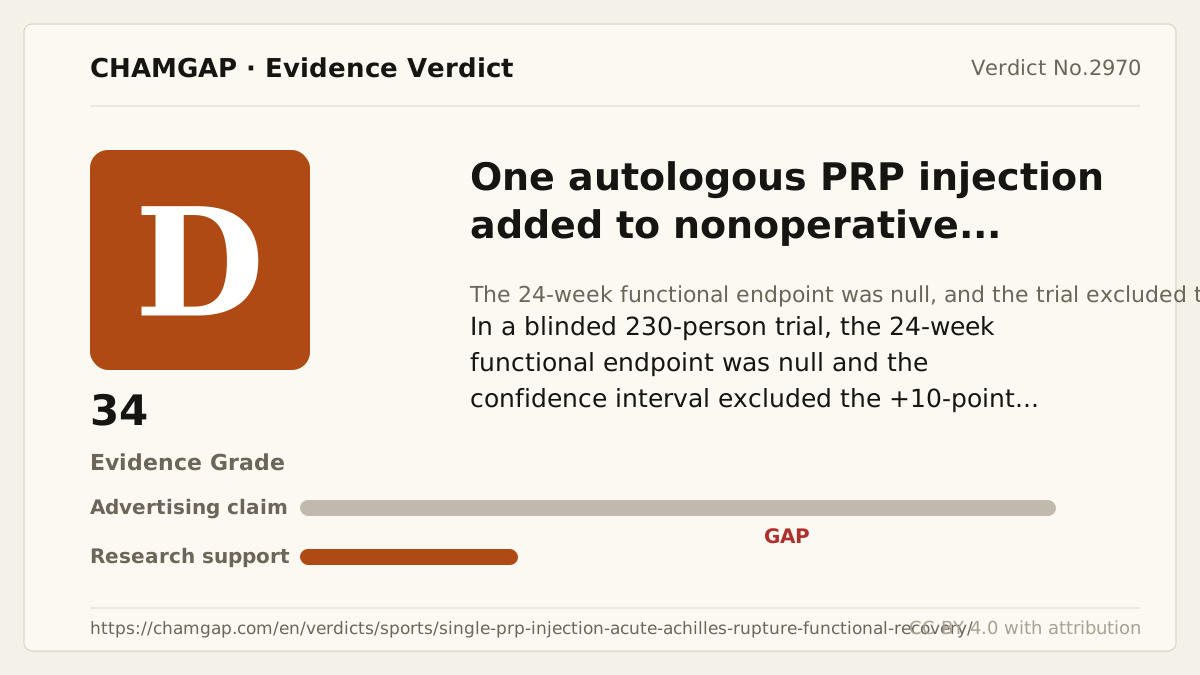
One autologous PRP injection added to nonoperative treatment of an acute complete midsubstance Achilles rupture,
does it really help with Improved heel-rise work limb-symmetry index at 24 weeks?
research showsGrade D. At 24 weeks, the work limb-symmetry index was 34.67% with PRP versus 38.54% with imitation dry needling, adjusted mean difference -3.87 points (95% CI -10.45 to 2.71), P=.23. The direction favored control. The observed confidence-interval upper bound of +2.71 excluded the +10-point effect size used for sample-size planning. However, that value was observed in a previous trial and used as a power assumption, not established as a validated minimum clinically important difference.
ads claimThis result concerns one injection added to nonoperative treatment of a complete acute midsubstance rupture within 12 days. It does not cover chronic tendinopathy, surgical augmentation, other PRP preparations, or repeated injections.
Useful facts when choosing a product
- The work limb-symmetry index is injured/uninjured×100; higher is better.
- Sample-size planning used a +10-point effect observed in a previous trial; it was not a validated minimum clinically important difference.
- The two-year paper followed the same PATH-2 participants and is not an independent trial.
Chamgap Semantic Classification Code
Candidate index · review held
P.one-autologous-prp-injection-added-to-nonoperative-treatment-of-an-acute-complete-midsubstance-achilles-rupture.procedural.heel-rise-work-limb-symmetry-index-at.improve.MULTIProcedures, devices and tests > One autologous PRP injection added to nonoperative treatment of an acute complete midsubstance Achilles rupture > Procedural > heel-rise work limb-symmetry index at > Improvement claim > Multiple: primary unresolved
An automated migration candidate, not an issued permanent code; exact claim scope remains under review. This machine-generated migration candidate helps retrieval but is not a permanent assignment. The original verdict ID and URL remain authoritative.
What the research actually shows
PATH-2 randomized 230 patients at 19 UK NHS hospitals within 12 days of an acute complete midsubstance rupture suitable for nonoperative treatment: 114 to PRP and 116 to imitation dry needling. Both groups received local anesthesia, blood draw, identical immobilization, and rehabilitation; control received needle insertion into the rupture gap. Funding came from the MRC-NIHR Efficacy and Mechanism Evaluation Programme, NIHR Oxford BRC, an NIHR Fellowship, and NIHR CLAHRC Oxford; the University of Oxford sponsored the trial. Investigators disclosed no PRP-device manufacturer product, analysis, writing, or publication support. SEL disclosed outside Pleuristem consulting and KW Zimmer Biomet royalties.
Axis 6 B0 evidence ① Allocation concealment: "Randomisation was performed using a secure central web based service with allocation revealed only to the treating surgeon after enrolment." ② Masking: "Participants and outcome assessors were blind to treatment allocation." Injectors could not be masked, but primary functional assessors were masked. ③ Analysis population and missing data: "The primary analysis was by intention to treat, with participants analysed in the groups to which they were randomised." Missing 24-week data were checked with prespecified multiple-imputation sensitivity analysis. ④ Prespecified primary endpoint: "The primary outcome was muscle tendon function at 24 weeks, measured objectively with the limb symmetry index in maximal work done during the heel rise endurance test." — matches NCT02302664 · ISRCTN54992179
Why this is classified as D (34)
A clean publicly funded functional-outcome trial was null and excluded the +10-point effect anticipated in sample-size planning, but there was no validated clinical threshold and one null trial gives D with 34 points.
Counterpoint. Verdict 1699 is F with 10 points (/en/verdicts/joint-bone/prp-chronic-midportion-achilles-tendinopathy/) for chronic midportion Achilles tendinopathy, a different population and question.
Rejudgment record. Cross-check applied — Null 24-week functional endpoint in PATH-2, exclusion of the +10-point effect used for sample-size planning, absence of a validated minimum clinically important difference, and a publicly funded blinded intention-to-treat design
| Endpoint | P | Symptom or function itself is the target - including patient reports and performance tests |
| Replication | R1 | Single confirmatory trial |
| Independence | I2 | Decisive evidence is publicly or non-profit funded |
| Effect size | E0 | Null |
| Precision | C0 | The confidence interval leaves room for benefit |
Stored derived and displayed grades match; this is not a current recalculation or validity check (D).
Sub-claim grades by effect
This ingredient is marketed for several effects. A single overall grade blends strong and weak claims together, so each effect is graded separately here. The overall grade reflects the strongest disconfirming or core claim.
| Effect (sub-claim) | Grade | Basis |
|---|---|---|
| Improved 24-week work limb-symmetry index | D | The CI upper bound excluded the +10-point effect used for sample-size planning, but this was not a validated clinical threshold. |
| Improved patient-reported function at two years | D | Follow-up of the same trial was null at P=.757. |
Cross-check — AI research and Codex final gate
Evidence Table
| Study | Design | Sample | Funding | Endpoint | Result | Weight |
|---|---|---|---|---|---|---|
| Keene DJ et al. 2019 PATH-2 | Multicenter participant- and assessor-blinded randomized placebo-controlled superiority trial | 230 randomized, 114/116 | Public MRC-NIHR EME Programme and NIHR funding | Injured/uninjured limb-symmetry index for maximal heel-rise work at 24 weeks | 34.67% vs 38.54%; adjusted difference -3.87 points (95% CI -10.45 to 2.71), P=.23 | Primary functional outcome excluding the +10-point benefit anticipated in sample-size planning |
Receipt — 2 References
All 2 cited sources were verified for existence at the original page (as of 2026-08-26).
Final verification and publication gate: Codex · Evidence date: 2026-08-26 · Corrections: none
Cite this verdict
[Chamgap] No Benefit of One Autologous PRP Injection for 24-Week Function After Acute Achilles Rupture — Evidence Grade D·34. 2 cited sources checked. Source: https://chamgap.com/en/verdicts/sports/single-prp-injection-acute-achilles-rupture-functional-recovery/ · CC BY 4.0CC BY 4.0 — free to use with attribution; do not distort grades, numbers, or verdict meaning.
What this document does and does not do
Chamgap is an information source. It reports what research has and has not confirmed; it does not tell readers what to take or buy. That decision belongs to readers and, when needed, medical or legal professionals. This verdict reflects literature available up to the search date and may change as new research appears. Nothing here is medical advice.