
Ordinary thiamine,
does it really help with Handgrip improvement in objectively weak adults?
research showsUnknown for this specific question. No directly eligible controlled strength result was verified within the recorded search through 16 September 2026. This is not proof of no effect or of no human thiamine research. Deficiency correction, fatigue improvement and derivative/injection findings are different questions.
ads claimLow TPP, fatigue, uncontrolled CMT follow-up, thiamine derivatives and injections are not substituted for ordinary oral thiamine effects on handgrip in objectively weak adults.
Four separate assessment dimensions
| Effect direction and size | Eligible handgrip effect direction and magnitude unverified |
|---|---|
| Evidence certainty | Stage-zero current value because no directly eligible comparison was verified |
| Applicability | Objectively weak adults, oral ordinary thiamine and handgrip only |
| Safety | Caution, separate from efficacy |
? / null, not zero points and not null efficacy
Useful facts when choosing a product
- The page concerns single-ingredient oral ordinary thiamine. Benfotiamine, fursultiamine/TTFD, sulbutiamine, allithiamine, injections and combinations remain separate.
- Because no directly eligible trial was selected, salt, product, dose, duration, handgrip protocol and principal time remain unverified.
- Deficiency correction is a separate clinical question, and study exposures are not personal dosing advice.
Chamgap Semantic Classification Code
Permanent code issued
S.thiamine.oral-single-ingredient-form-dose-duration-unverified.objectively-weak-adults-handgrip.improve.placebo-no-added-thiamine-matched-careSubstances > Ordinary thiamine (vitamin B1) > Oral single ingredient with form/dose/duration unverified > Handgrip in objectively weak adults > Improvement > Placebo, no added thiamine or matched care
The current value is ? with a null score. Elderly low-TPP, fatigue, uncontrolled CMT and derivative evidence are not treated as a direct handgrip effect. The code identifies the intervention and claim; it never contains the evidence grade, score, or safety result.
Exact Claim Classification
These independent facets prevent evidence from different forms, routes, populations, effects, and comparators from being mixed.
| Intervention class | S · Supplement or nutraceutical |
|---|---|
| Canonical ingredient or intervention | Ordinary thiamine (vitamin B1); exact salt unverified |
| Source or part used | Single-ingredient source/manufacturer unverified; not whole food |
| Formulation or processing | Single-ingredient oral product; base/HCl/mononitrate kept separate; no selected verified salt |
| Route | oral |
| Dose | Eligible-study dose unverified |
| Duration | Eligible-study treatment duration unverified |
| Population | Adults with objectively documented reduced strength; actual cutoff and thiamine status unverified |
| Effect or condition | Whether objective handgrip improves |
| Primary endpoint | One handgrip endpoint; hand/device/trial rule/units/principal time unverified |
| Comparator | Placebo/no added thiamine/otherwise matched usual care |
| Duplicate-detection key | S|thiamine|oral-single-ingredient-form-dose-duration-unverified|objectively-weak-adults|handgrip-improvement|placebo-no-added-thiamine-matched-care |
What the research actually shows
Wilkinson (1997) assigned 76 older adults to oral thiamine 10 mg/day or placebo for 3 months and measured dominant-hand grip with a Preston dynamometer. Entry depended on erythrocyte TPP <140 nmol/L, not an objective weakness cutoff. The report describes no significant grip change but gives no quantitative treatment contrast, CI or exact P; it cannot establish no effect. The CMT supplement lists 15 patients, mixing hydrochloride, derivatives, other therapy and a 16-year-old. The Figure 1 HCl grip follow-ups are patients 1 and 3; patient 2 received sulbutiamine. Healthy-marker comparisons were not treated as longitudinal untreated grip controls. The 40-person TARIF crossover used 600–1800 mg/day for 4-week periods separated by a 4-week washout, but fatigue was primary. An indexed nonsignificant grip excerpt does not verify an eligible baseline-weak group or quantitative grip effect. Existing fatigue verdict 3086 remains unchanged. A crossover in 15 students used allithiamine 1 g/day for 5 days and a Biodex System 2 dynamometer, reporting nonsignificant findings (P>0.05). This is derivative/different-population evidence, not proof of null efficacy or equivalence for ordinary thiamine.
Why this is classified as ?
No directly eligible controlled oral ordinary-thiamine strength result in objectively weak adults was verified. The current-value instruction requires stage-zero ?/null with downstream axes unscored. The unchanged calculator cannot encode this eligibility/access gap without falsely asserting no human study; its schema errors and raw invalid suggestion are retained, not adopted.
Counterpoint. Wilkinson (1997) assigned 76 older adults to oral thiamine 10 mg/day or placebo for 3 months and measured dominant-hand grip with a Preston dynamometer. Entry depended on erythrocyte TPP <140 nmol/L, not an objective weakness cutoff. The report describes no significant grip change but gives no quantitative treatment contrast, CI or exact P; it cannot establish no effect.
Rejudgment record. No directly eligible controlled handgrip result verified — No directly eligible controlled oral ordinary-thiamine strength result in objectively weak adults was verified. The current-value instruction requires stage-zero ?/null with downstream axes unscored. The unchanged calculator cannot encode this eligibility/access gap without falsely asserting no human study; its schema errors and raw invalid suggestion are retained, not adopted.
Review performed and remaining limitations
Salt, dose, duration, weakness cutoff, handgrip protocol, comparative effect and CI unverified
Evidence Table
| Study | Design | Sample | Funding | Endpoint | Result | Weight |
|---|---|---|---|---|---|---|
| Wilkinson et al. 1997. The response to treatment of subclinical thiamine deficiency in the elderly. | Randomized double-blind placebo-controlled parallel trial stratified by pretreatment TPP | 76; 38 thiamine and 38 placebo; all completed | Canterbury Medical Research Foundation and Sanitarium Health Food Company; product provision not reported | Dominant-hand grip with a Preston dynamometer; no baseline low-strength cutoff | Oral thiamine 10 mg/day for three months was compared with placebo, but no quantitative grip contrast, CI or exact P value was reported. Nonsignificance was not treated as equivalence or no effect. | Closest controlled trial but excluded from target-effect grading because objective baseline weakness was not an entry criterion |
| Bager et al. 2021. High-dose oral thiamine versus placebo for chronic fatigue in quiescent IBD. | Randomized double-blind placebo-controlled crossover trial in 40 participants | 40; grip-specific analyzed denominator unverified | Health Research Foundation of Central Denmark Region and Aase and Ejnar Danielsen Foundation; product provision unverified | Fatigue was primary; handgrip was secondary excerpt-level context | The 600–1,800 mg/day four-week periods did not enroll an objectively weak group, and no quantitative grip effect or CI was verified. | Excluded for fatigue-selected population and endpoint mismatch |
| Artiukhov et al. 2024. Pharmacological doses of thiamine in Charcot–Marie–Tooth neuropathy. | Uncontrolled before-after clinical descriptions and biomarker comparisons with mixed HCl, derivatives and other treatments | 15 in the supplement (14 adults); five adult HCl rows and two verified longitudinal HCl grip cases | Russian Foundation for Basic Research and State Task support; product provision unverified | CMT strength observations and biomarkers; no matched untreated longitudinal handgrip comparison | HCl, sulbutiamine, benfotiamine and other therapies were not pooled and the observations were not converted into a causal between-group handgrip effect. | Excluded for uncontrolled design and mixed formulations/ages |
| Doyle et al. 1997. Allithiamine ingestion does not enhance isokinetic parameters of muscle performance. | Placebo-controlled crossover trial in healthy college students using Biodex System 2 | 15 healthy college students | Funding and product supply unverified | Isokinetic muscle-performance parameters; not handgrip | Nonsignificant findings (P>0.05) after allithiamine 1 g/day for five days do not establish null efficacy or equivalence for ordinary thiamine, objectively weak adults or handgrip. | Excluded for derivative, healthy population and different strength endpoint |
Receipt — 23 References
Evidence access cutoff: 2026-09-16. Each citation states its actual access level (full-text transcription, abstract, index, or other) and remaining limitations. Bibliographic checking does not certify the study results or treatment efficacy.
Technical integration by: Codex · Evidence date: 2026-09-16 · Corrections: none
Cite this verdict
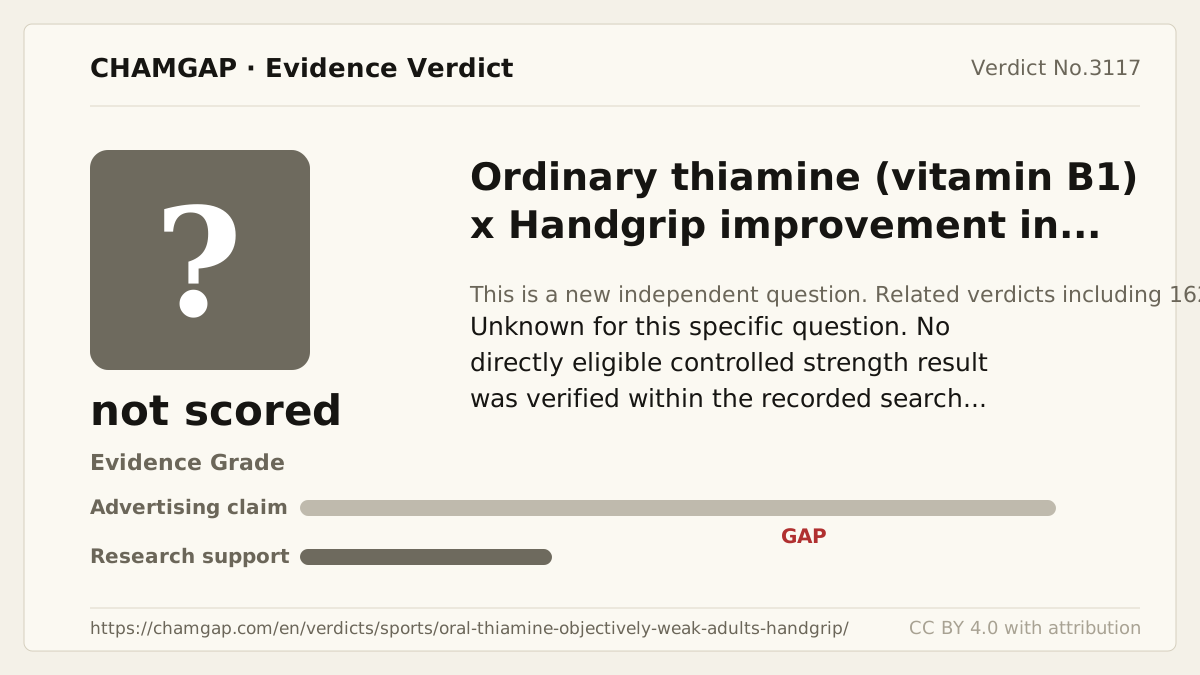
[Chamgap] In adults with objectively documented reduced muscle strength, does single-ingredient oral ordinary thiamine improve handgrip strength versus placebo, no added thiamine or otherwise matched usual care? — Evidence Grade ?. 23 cited sources checked. Source: https://chamgap.com/en/verdicts/sports/oral-thiamine-objectively-weak-adults-handgrip/ · CC BY 4.0CC BY 4.0 — free to use with attribution; do not distort grades, numbers, or verdict meaning.
What this document does and does not do
Chamgap is an information source. It reports what research has and has not confirmed; it does not tell readers what to take or buy. That decision belongs to readers and, when needed, medical or legal professionals. This verdict reflects literature available up to the search date and may change as new research appears. Nothing here is medical advice.