
Riboflavin,
does it really help with 161.3-km race finishing time in experienced adult ultramarathon runners?
research showsIn a small placebo-controlled study at a 161.3-km race in 2016, finish times did not differ significantly between riboflavin and placebo. The Table 1 study-completer means were 27.26 and 27.08 hours in 18 and 14 runners. Alternating allocation and selected-finisher analysis do not establish no effect, equivalence or exclusion of important benefit. [S01 Table 1 p4]
ads claimSpecific advertising was not systematically investigated. This assessment does not substantiate endurance enhancement in all athletes, equivalence of all B-vitamin forms, or prolonged high-dose use.
Four separate assessment dimensions
| Effect direction and size | The calculated descriptive mean contrast is riboflavin minus placebo +0.18 hours (+10.8 minutes), not causal evidence of harm. Original CI, exact P and adjusted estimate are null. Assumption-dependent selected-sample reconstructions are recorded separately. [S01; calculations.json] |
|---|---|
| Evidence certainty | Confidence is very limited even for the narrow race-time question. This is a narrative description of allocation, missingness and estimand limits, not a formal GRADE category. |
| Applicability | experienced adult ultramarathon runners, 2016 WSER; finish-time data restricted to study completers |
| Safety | Safety is Caution, separate from efficacy. The paper reports two riboflavin participants with emesis within an hour of the 90-km dose and urine-color observations (3 versus 1), but systematic arm-level adverse-event, serious-event and harm-withdrawal denominators were not verified. Causality of emesis is not established; unreported events are not zero. NIH’s lack of a tolerable upper intake level reflects limited harm data, not unlimited high-dose safety. Pregnancy, lactation, children, renal/hepatic disease, long-term high doses and laboratory interference were not adequately characterized by this study. Study doses are not personal dosing advice and do not replace assessment or treatment of symptoms during endurance exercise. [S01 Results p4; S03 excess-intake/interaction sections] |
Chamgap rule-based score, not success probability or official GRADE
Useful facts when choosing a product
- Capsules were reported as a single active nutrient, riboflavin; exact salt, batch and complete excipient certificate remain unverified. [S01]
- The population was not established as deficient or replete using baseline measurements. [S01]
- 5 mg of 10% beta-carotene powder corresponds to a nominal calculated 0.5 mg active amount. [S01; calculations.json]
Chamgap Semantic Classification Code
Permanent code issued
S.riboflavin.oral-capsule-100mg-prerace-100mg-90km-one-event.experienced-adult-ultramarathon-runners-161-3km-finish-time.shorten.matched-color-placebo-maltodextrin-beta-caroteneSubstances > Riboflavin (vitamin B2) > Oral capsule 100 mg pre-race plus 100 mg at 90 km in one event > 161.3-km finish time in experienced adult ultramarathon runners > Shorten > Matched-color maltodextrin/beta-carotene placebo
The descriptive study-completer contrast of +0.18 hours (+10.8 minutes) from 27.26 versus 27.08 hours is retained; alternating allocation and selection preclude relabeling it as no effect, equivalence or causal harm. The code identifies the intervention and claim; it never contains the evidence grade, score, or safety result.
Exact Claim Classification
These independent facets prevent evidence from different forms, routes, populations, effects, and comparators from being mixed.
| Intervention class | S · Supplement or nutraceutical |
|---|---|
| Canonical ingredient or intervention | Riboflavin (vitamin B2), ordinary form as reported |
| Source or part used | Isolated nutrient; manufacture/source organism or tissue not reported; botanical part not applicable |
| Formulation or processing | Investigator-prepared capsule containing reported single active nutrient riboflavin; full batch/excipient certificate unverified |
| Route | oral |
| Dose | 100 mg before start plus 100 mg at 90 km; planned total 200 mg in one event |
| Duration | one 161.3-km ultramarathon event; not a daily multiweek course |
| Population | experienced adult ultramarathon runners, 2016 WSER; finish-time data restricted to study completers |
| Effect or condition | faster endurance race completion |
| Primary endpoint | 161.3-km race finish time in hours at the race finish; Table 1 selected completers |
| Comparator | matched-color placebo with 95 mg maltodextrin and 5 mg 10% beta-carotene powder per capsule; race care/diet not standardized |
| Duplicate-detection key | S|riboflavin_as_reported|oral|100mg_pre+100mg_90km|WSER2016_161.3km|adult_experienced_finishers_complete_data|race_finish_hours|colored_placebo|supplementation |
What the research actually shows
This page concerns endurance finishing time in one race. A standardized laboratory time trial, 400-m recovery run, pain, CK and vitamin-status measures are separate; favorable recovery results are not converted into a race-time benefit. [S01 Methods/Results] Assignment alternated in order of arrival at study registration; it was not a random sequence. Of 44 starters (22/22), 37 finished (20/17), but the Table 1 times cover only 32 participants with complete study data (18/14). Baseline nutrient status, diet, adjusted effect and a prospective primary-outcome hierarchy remain unverified. [S01 pp2–6] The original reports oral riboflavin 100 mg 0.5–1 hour before the start and another 100 mg at 90 km. The planned total was 200 mg in one race, not a long-term daily 200- or 400-mg regimen. Each placebo capsule contained 95 mg maltodextrin plus 5 mg of 10% beta-carotene powder. [S01 Methods p2]
Why this is classified as D (30)
Axes B/P/R1/I2/E0/CX/B2 → unchanged native calculator D → fixed 30 anchor for one strength (I2). R1 follows case 31 for one comparable family, not a claim of confirmatory randomization. E0 is the nonsignificant-result pathway, not proof of exact zero. I2 classifies disclosed foundation/public support.
Counterpoint. No independently replicated same-boundary race endpoint was verified. Pain, recovery, swimming, combinations and status markers are not counted as replication. Unverified studies are not treated as nonexistent.
Rejudgment record. One same-boundary family; different endpoints not combined — Supplied rubric and unchanged calculator; primary-source checking and self-review
| Endpoint | P | Symptom or function itself is the target - including patient reports and performance tests Case application: Race finishing performance is the functional target itself: P, not restricted to patient self-report and not a biochemical surrogate |
| Replication | R1 | Single confirmatory trial Case application: One directly comparable family; case 31 prescribes R1 when adjacent studies are not comparable. The native single-confirmatory-trial label is qualified: this is an alternating-allocation preliminary study, not a randomized or confirmatory trial |
| Independence | I2 | Decisive evidence is publicly or non-profit funded Case application: I2 from directly read foundation/public support and conflict declarations. Full donor provenance, funder roles and product provision remain unreported; this is not independent replication or external review |
| Effect size | E0 | Null Case application: E0 rubric pathway for the reported nonsignificant Table 1 comparison; not literal zero, equivalence, or exclusion of important benefit |
| Precision | CX | No pooled confidence interval could be confirmed Case application: CX because original CI and adjusted causal estimand are unverified. Reconstructed selected-sample t intervals are assumption-dependent descriptive quantities, not a C1 justification |
Stored derived and displayed grades match; this is not a current recalculation or validity check (D).
Review performed and remaining limitations
Batch certificate, exact salt and full excipients Baseline riboflavin marker/deficiency threshold and total dietary intake Exact eligibility age bounds, renal/hepatic/pregnancy subgroup status Race clock/device and timing adjudication details Original CI/exact P, adjusted effect and baseline performance balance Registration/protocol/SAP and prospective finish-time hierarchy Outcomes of all 44 starters in a valid assigned-population estimand Diet and race-care balance, conflicting placebo medication numerator Funder roles/donor provenance and product provision Systematic arm-level adverse-event/serious-event/withdrawal denominators; long-term/special-population safety Inaccessible 1984 swimmer original methods/results Failed native database searches and no exhaustive unreported-trial assurance
Preliminary RoB 2-informed review — not a complete formal assessment
| Randomization | Allocation alternated by registration arrival, hence predictable and not a random sequence. |
|---|---|
| Deviations from assigned interventions | Second-dose omission/emesis and pain-medication use reported; full planned exposure not established in every participant. |
| Missing outcome data | Of 44 starters, Table 1 includes 32 (18/14). Seven nonfinishers and five finishers with incomplete study data are distinct. Selected-finisher comparison does not estimate the effect in all assigned participants. |
| Outcome measurement | Objective fixed-distance race time, but timing-device details and baseline equivalent-course performance adjustment unreported. |
| Selection of the reported result | Report focuses on pain/recovery; finish time is a characteristics-table row. Registration and planned hierarchy unverified, so it is not relabeled the primary efficacy endpoint. |
Reasons for the certainty judgment — not formal GRADE
| Risk of bias | substantial limitations |
|---|---|
| Inconsistency | not estimable from one comparable family; noncomparable evidence is not contradictory replication |
| Indirectness | field-race selected completers only; original task broader than verified endpoint |
| Imprecision | author interval unverified; reconstructed selected-sample intervals span faster and slower times |
| Publication bias | not assessable with one family and limited search; absence of unreported studies not established |
Search scope and limitations. 63 general-web queries; 3 native database search attempts failed; not exhaustive-search assurance
Evidence Table
| Study | Design | Sample | Funding | Endpoint | Result | Weight |
|---|---|---|---|---|---|---|
| Hoffman et al. 2017 placebo-controlled preliminary riboflavin study at the 2016 WSER ultramarathon | Prospective parallel placebo-controlled preliminary trial; alternating allocation by registration arrival, not a random sequence; participant and onsite-researcher blinding reported | 44 alternately assigned and started (22/22), 37 finished (20/17), and Table 1 finish times cover 32 complete-data study completers (18/14); no ITT finish-time estimate | Support reported from the WSER Foundation, Rossi Family Foundation and US Department of Veterans Affairs resources/facilities; no industry support reported and authors declared no competing interests; funder roles, product provision and all donor provenance unverified | 161.3-km 2016 race finishing time in hours among Table 1 study completers; not verified as prospectively primary and not a standardized laboratory time trial or 400-m recovery run | Riboflavin 27.26±2.36 hours (n=18) versus placebo 27.08±2.88 (n=14), mean±SD; no significant Table 1 group difference. Descriptive contrast +0.18 hours (+10.8 minutes); author exact P and CI unverified | Only directly comparable family at the locked finish-time boundary; nonsignificance is not extended to no effect, equivalence, causal harm or endurance in all athletes |
Receipt — 10 References
Evidence access cutoff: 2026-09-16. Each citation states its actual access level (full-text transcription, abstract, index, or other) and remaining limitations. Bibliographic checking does not certify the study results or treatment efficacy.
Technical integration by: Codex · Evidence date: 2026-09-16 · Corrections: 7
Correction log — 7
Corrections applied to this verdict, in chronological order. Changes are logged, not erased.
- · —
- · —
- · —
- · —
- · —
- · —
- · —
Cite this verdict
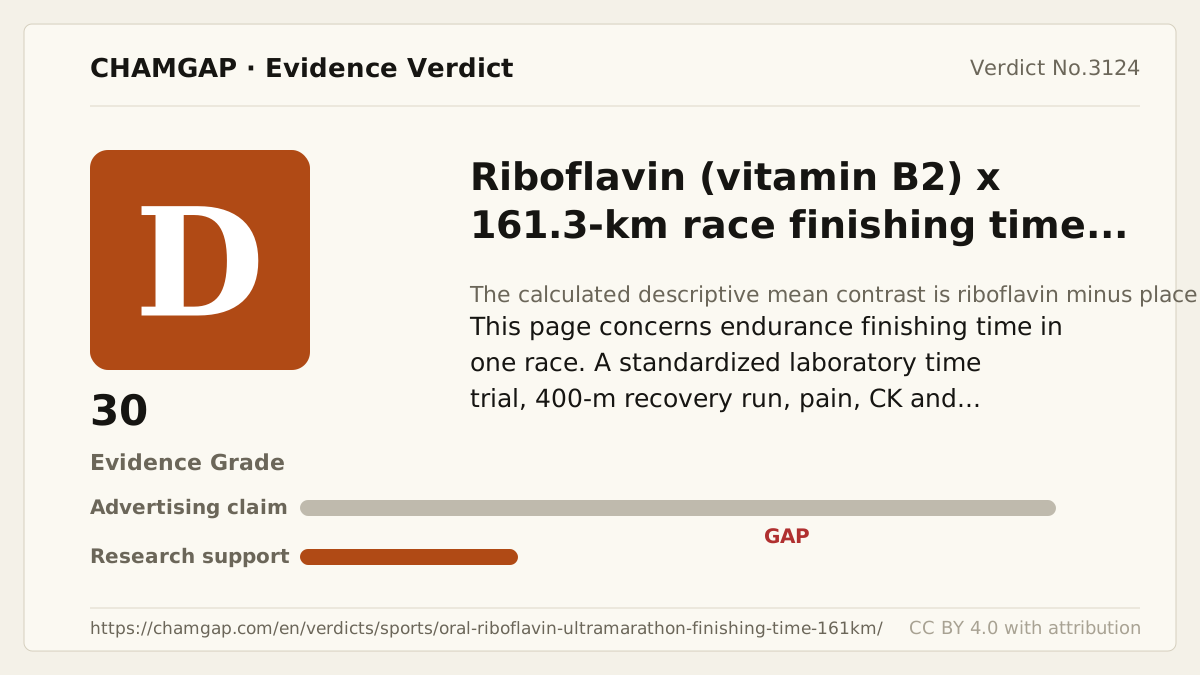
[Chamgap] Riboflavin and 161.3-km ultramarathon finishing time: current evidence D·30 — Evidence Grade D·30. 10 cited sources checked. Source: https://chamgap.com/en/verdicts/sports/oral-riboflavin-ultramarathon-finishing-time-161km/ · CC BY 4.0CC BY 4.0 — free to use with attribution; do not distort grades, numbers, or verdict meaning.
What this document does and does not do
Chamgap is an information source. It reports what research has and has not confirmed; it does not tell readers what to take or buy. That decision belongs to readers and, when needed, medical or legal professionals. This verdict reflects literature available up to the search date and may change as new research appears. Nothing here is medical advice.