
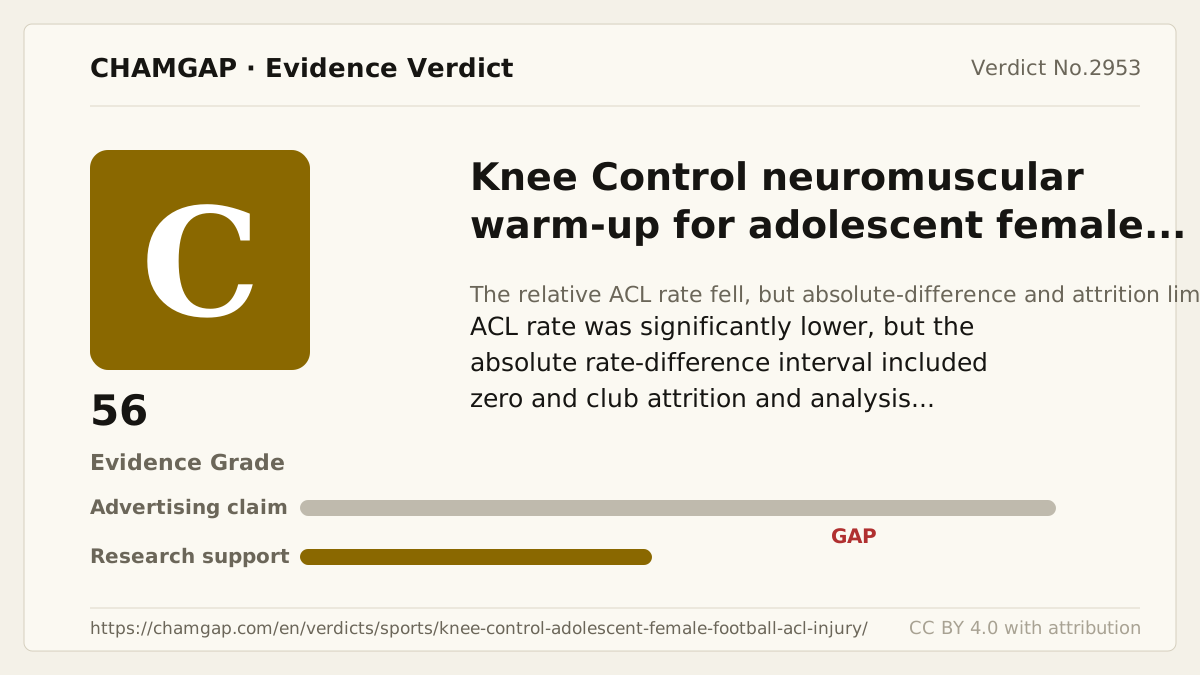
Knee Control neuromuscular warm-up for adolescent female football players,
does it really help with Reduced anterior cruciate ligament injury over one season?
research showsThe grade is C with 56 points. ACL injury occurred in 7/2,479 (0.28%) versus 14/2,085 (0.67%); exposure-adjusted RR 0.36 (95% CI 0.15 to 0.85), P=.02.
ads claimEvidence is specific to a twice-weekly 15-minute Knee Control program over one season in adolescent female football.
Useful facts when choosing a product
- The program was used twice weekly for about 15 minutes.
- RR was 0.36, but the absolute rate-difference interval included zero.
- No intervention-attributed adverse-event table was reported.
Chamgap Semantic Classification Code
Candidate index · review held
X.knee-control-neuromuscular-warmup.behavioral.anterior-cruciate-ligament-injury.prevent.UNKBehaviors, exposures and policies > Knee Control neuromuscular warm-up > Behavioral delivery > Anterior cruciate ligament injury > Occurrence-prevention claim > Unknown
An automated migration candidate, not an issued permanent code; exact claim scope remains under review. This machine-generated migration candidate helps retrieval but is not a permanent assignment. The original verdict ID and URL remain authoritative.
What the research actually shows
The stratified cluster trial covered eight Swedish regional associations, 230 clubs, 341 teams, and 4,564 players. Suspected injuries were assessed by a study physician with MRI offered, and the primary-outcome physician was masked. Clubs providing no data were excluded despite the ITT label, and 61/291 league-entry clubs, 21%, were lost. Funding came from the Swedish Football Association, Folksam, the Swedish National Centre for Research in Sports, and Hässleholm Hospital; two authors were paid medical staff for the association's men's U19 team.
Why this is classified as C (56)
A large hard-outcome cluster trial found fewer ACL injuries, but two attrition and analysis defects cap the verdict at C with 56 points.
Counterpoint. Other knee-injury outcomes were null.
Rejudgment record. Cross-check applied — Lower ACL injury rate in a large cluster RCT with club attrition and exclusions from analysis
| Endpoint | H | Hard endpoint - actual events such as death |
| Replication | R1 | Single confirmatory trial |
| Independence | I1 | Mixed funding sources |
| Effect size | E+ | Meets the clinically important threshold |
Stored derived and displayed grades match; this is not a current recalculation or validity check (C).
Sub-claim grades by effect
This ingredient is marketed for several effects. A single overall grade blends strong and weak claims together, so each effect is graded separately here. The overall grade reflects the strongest disconfirming or core claim.
| Effect (sub-claim) | Grade | Basis |
|---|---|---|
| Reduced ACL injury rate over one season | C | Positive RR; absolute rate-difference CI included zero |
Cross-check — AI research and Codex final gate
Evidence Table
| Study | Design | Sample | Funding | Endpoint | Result | Weight |
|---|---|---|---|---|---|---|
| Waldén M et al. 2012 | Stratified cluster-randomized trial | 230 clubs, 341 teams, 4,564 players | Football association, Folksam, sports research center, and hospital | ACL injury rate per football exposure | 7/2,479 vs 14/2,085; RR 0.36 (0.15 to 0.85), P=.02 | Pivotal hard-outcome trial |
Receipt — 1 References
All 1 cited sources were verified for existence at the original page (as of 2026-08-26).
Final verification and publication gate: Codex · Evidence date: 2026-08-26 · Corrections: none
Cite this verdict
[Chamgap] Benefit of Knee Control for Anterior Cruciate Ligament Injury — Evidence Grade C·56. 1 cited sources checked. Source: https://chamgap.com/en/verdicts/sports/knee-control-adolescent-female-football-acl-injury/ · CC BY 4.0CC BY 4.0 — free to use with attribution; do not distort grades, numbers, or verdict meaning.
What this document does and does not do
Chamgap is an information source. It reports what research has and has not confirmed; it does not tell readers what to take or buy. That decision belongs to readers and, when needed, medical or legal professionals. This verdict reflects literature available up to the search date and may change as new research appears. Nothing here is medical advice.