
Eight weeks of home neuromuscular training with a balance board, exercise sheets, DVD, and web materials after ankle sprain,
does it really help with Reduced recurrence in the same ankle over 12 months?
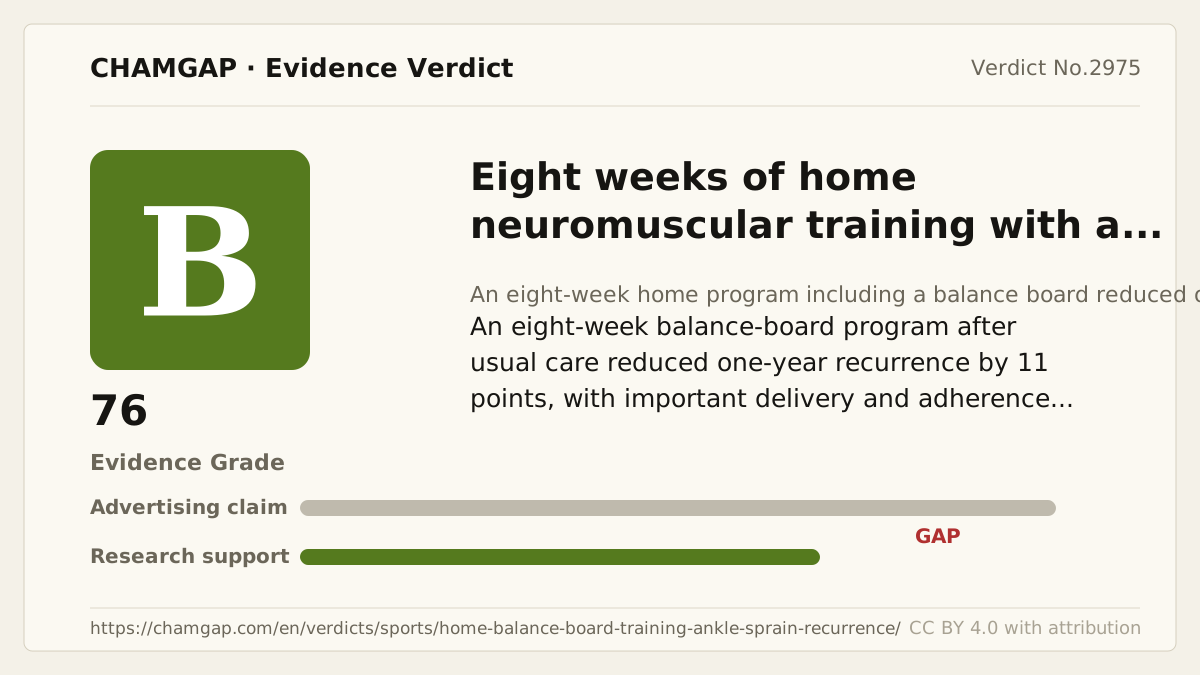
research showsGrade B. Recurrence was 56/256 (22%) versus 89/266 (33%), adjusted RR 0.63 (95% CI 0.45 to 0.88), NNT 9. Full adherence was only 23%, and initial reports were self-reported.
ads claimThis does not show that every ankle-exercise app prevents recurrence. It applies to an eight-week program supplying a balance board, sheets, DVD, and web materials after usual care.
Useful facts when choosing a product
- Training was three times weekly, up to 30 minutes, for eight weeks.
- Incidence density was 1.86 versus 2.90 per 1,000 exposure hours.
- The registry's first public date could not be established from the source, so prospective registration was not asserted.
Chamgap Semantic Classification Code
Candidate index · review held
X.of-home-neuromuscular-training-with-a-balance-board.behavioral.recurrence-in-the-same-ankle-over.reduce.usual-careBehaviors, exposures and policies > of home neuromuscular training with a balance board > Behavioral delivery > recurrence in the same ankle over > Reduction claim > Usual care
An automated migration candidate, not an issued permanent code; exact claim scope remains under review. This machine-generated migration candidate helps retrieval but is not a permanent assignment. The original verdict ID and URL remain authoritative.
What the research actually shows
2BFit randomized 522 athletes aged 12 to 70, 256/266, and followed them for 12 months. Monthly self-reports were independently adjudicated by a masked physical therapist and researcher. Full adherence was 58/256 (23%), control contamination 5/266 (2%), and attrition 14%. ZonMw grant 750-20-002 funded the study; authors declared no financial benefit or competing interests. Avanco AB boards were distributed, but manufacturer donation, research funding, analysis, writing, or publication support was not reported.
Axis 6 B0 evidence ① Allocation concealment: "An independent researcher prepared an allocation schedule by computer generated random numbers." ② Masking: Participants could not be masked, but "recurrences were independently assessed by a blinded physical therapist and researcher." ③ Analysis population and missing data: "All analyses were performed according to the intention to treat principle." ④ Prespecified primary endpoint: "The primary outcome was self reported recurrence of ankle sprain." — matches ISRCTN34177180
Why this is classified as B (76)
A clean single hard-outcome trial reduced recurrence by 11 points, giving B with 76 points.
Counterpoint. Exercise-related adverse events were not collected and reported in a separate table, so harmlessness cannot be concluded.
Rejudgment record. Cross-check applied — An 11-point reduction in one-year recurrence, adjusted RR 0.63, NNT 9, and one confirmatory trial
| Endpoint | H | Hard endpoint - actual events such as death |
| Replication | R1 | Single confirmatory trial |
| Independence | I2 | Decisive evidence is publicly or non-profit funded |
| Effect size | E+ | Meets the clinically important threshold |
Stored derived and displayed grades match; this is not a current recalculation or validity check (B).
Sub-claim grades by effect
This ingredient is marketed for several effects. A single overall grade blends strong and weak claims together, so each effect is graded separately here. The overall grade reflects the strongest disconfirming or core claim.
| Effect (sub-claim) | Grade | Basis |
|---|---|---|
| Reduced same-ankle recurrence over one year | B | 22% versus 33%, NNT 9. |
| Recurrence prevention by any app-based ankle exercise | D | A 2023 trial with a different delivery method was null. |
Cross-check — AI research and Codex final gate
Evidence Table
| Study | Design | Sample | Funding | Endpoint | Result | Weight |
|---|---|---|---|---|---|---|
| Hupperets MDW et al. 2009 2BFit | Multicenter randomized usual-care-controlled trial | 522 participants (256/266) | Public ZonMw grant 750-20-002 | Same-ankle recurrence reported monthly and independently adjudicated under masking | 56/256 (22%) vs 89/266 (33%); adjusted RR 0.63 (0.45 to 0.88), NNT 9 | Pivotal one-year recurrence trial |
Receipt — 1 References
All 1 cited sources were verified for existence at the original page (as of 2026-08-26).
Final verification and publication gate: Codex · Evidence date: 2026-08-26 · Corrections: none
Cite this verdict
[Chamgap] Benefit of Home Balance-Board Training for Recurrent Ankle Sprain — Evidence Grade B·76. 1 cited sources checked. Source: https://chamgap.com/en/verdicts/sports/home-balance-board-training-ankle-sprain-recurrence/ · CC BY 4.0CC BY 4.0 — free to use with attribution; do not distort grades, numbers, or verdict meaning.
What this document does and does not do
Chamgap is an information source. It reports what research has and has not confirmed; it does not tell readers what to take or buy. That decision belongs to readers and, when needed, medical or legal professionals. This verdict reflects literature available up to the search date and may change as new research appears. Nothing here is medical advice.