
High-dose vitamins C and E,
does it really help with Additional promotion of muscle-mass and strength gains in healthy, nutritionally sufficient resistance exercisers?
research showsHigh-dose vitamins C and E are rated D because they have not been shown to add muscle mass or strength in healthy, nutritionally sufficient people performing resistance training. A meta-analysis of nine resistance-training trials found no incremental effect on lean mass, with an SMD of -0.07, or strength, with an SMD of -0.15. In a double-blind trial of 23 trained men, upper-body fat-free soft tissue increased significantly only in the placebo group, while the vitamin group did not increase it. A 32-person trial found no extra muscle growth and suggested that selected strength gains and postexercise signaling could be blunted. A positive 2025 trial in women with sarcopenia involved a clinical deficiency-like population rather than healthy, nutritionally sufficient exercisers and is not directly transferable. Null efficacy and possible attenuation of adaptation yield D with 27 points; kidney-stone, gastrointestinal, and bleeding risks are separate safety issues.
ads claimMarketing converts removal of exercise-related oxidative stress into faster recovery and more muscle. Some exercise-generated reactive species participate in adaptation signaling, and improvements in antioxidant or inflammatory biomarkers do not establish additional muscle mass or strength.
Useful facts when choosing a product
- Key exercise trials commonly used vitamin C 1,000 mg/day plus vitamin E about 235 to 400 mg or 400 IU/day for ten to twelve weeks, far above usual food exposure.
- Correcting vitamin C or E deficiency is different from adding high doses in a nutritionally sufficient exerciser. This D verdict applies only to the latter.
- High-dose vitamin C can cause heartburn or diarrhea and increase urinary oxalate; people with kidney disease or a history of stones require particular caution.
- High-dose vitamin E can increase bleeding risk, so anticoagulant or antiplatelet therapy and the perioperative period warrant clinical review. Alpha-tocopherol forms and international-unit conversions also vary by product.
Chamgap Semantic Classification Code
Candidate index · review held
S.vitamins-c-and-e.UNK.additional-promotion-of-muscle-mass-and-strength-gains-in-healthy-nutritionally-sufficient-resistance-exercisers.assess.placeboSupplements and nutraceuticals > vitamins C and E > Unknown > Additional promotion of muscle-mass and strength gains in healthy, nutritionally sufficient resistance exercisers > Association or change assessment > Placebo
An automated migration candidate, not an issued permanent code; exact claim scope remains under review. This machine-generated migration candidate helps retrieval but is not a permanent assignment. The original verdict ID and URL remain authoritative.
What the research actually shows
Clifford and colleagues pooled randomized trials in which vitamin C and/or E accompanied at least four weeks of supervised exercise and found no incremental lean-mass or strength effect across nine resistance-training trials. Martínez-Ferrán and colleagues randomized 23 trained men to vitamins C and E or placebo during ten weeks of resistance training with an energy surplus and adequate protein. Bench-press and squat one-repetition maximum improved similarly, while total and regional fat-free tissue did not increase in the vitamin group. Paulsen and colleagues found equal ten-week hypertrophy in 32 healthy trained adults but lower selected strength gains and acute cellular signaling with vitamins. Trials by Dutra in young women likewise found total fat-free mass increased only with placebo or suggested attenuation of torque and total-work gains. The positive 2025 trial by Liu studied women aged 60 to 75 years with sarcopenia and does not directly match the present healthy population.
Why this is classified as D (27)
A meta-analysis of nine direct resistance-training trials in nutritionally sufficient adults was null for incremental lean mass and strength, and multiple individual double-blind trials were null or suggested attenuation of selected adaptations. A recent positive trial in a sarcopenic clinical population is indirect and does not overturn the healthy-population evidence. Repeated core null results produce D with 27 points, with safety assessed separately.
Counterpoint. When diet already supplies vitamins C and E, evidence does not support adding high-dose antioxidants for hypertrophy. Progressive overload, sufficient protein and energy, sleep, and recovery come first; suspected deficiency should be assessed and corrected separately.
Rejudgment record. New verdict — Applied D for repeated core null evidence because a meta-analysis of nine resistance-training trials in healthy, nutritionally sufficient adults found no added lean mass or strength and multiple individual trials were null or suggested attenuated adaptation; a positive trial in sarcopenia was separated for population indirectness
Sub-claim grades by effect
This ingredient is marketed for several effects. A single overall grade blends strong and weak claims together, so each effect is graded separately here. The overall grade reflects the strongest disconfirming or core claim.
| Effect (sub-claim) | Grade | Basis |
|---|---|---|
| Additional promotion of muscle-mass gains in healthy resistance exercisers | D | A nine-trial meta-analysis and multiple direct trials found no additional lean-mass or hypertrophy effect, with some showing an increase only in the placebo group. |
| Additional promotion of strength gains in healthy resistance exercisers | D | The pooled strength effect was null, and selected one-repetition-maximum or torque adaptations were similar or lower with vitamins. |
| Additional promotion of overall training adaptation in healthy resistance exercisers | D | There was no direct performance benefit, and adaptation signals including p70S6K and MAPK may instead be blunted. |
Cross-check — AI research and Codex final gate
Evidence Table
| Study | Design | Sample | Funding | Endpoint | Result | Weight |
|---|---|---|---|---|---|---|
| Clifford T et al. 2020 | Systematic review and meta-analysis of randomized exercise-training trials | Nine randomized trials in the resistance-training adaptation analysis | No external funding or conflicts of interest reported | Lean mass and strength after resistance training | Lean mass SMD -0.07 (95% CI -0.36 to 0.23; P = 0.67) and strength SMD -0.15 (P = 0.35) showed no incremental benefit. | Core synthesis of repeated null evidence |
| Martínez-Ferrán M et al. 2023 | Double-blind randomized placebo-controlled trial | Twenty-three resistance-trained men; 12 vitamins and 11 placebo | Funding source not stated in the public abstract | Ten-week DXA fat-free tissue, bench-press and squat one-repetition maximum, force, velocity, and power | One-repetition maximum improved similarly, upper-body fat-free tissue increased significantly only with placebo, and total or regional fat-free tissue did not increase with vitamins. | Direct null evidence in the target population |
| Paulsen G et al. 2014 | Randomized double-blind placebo-controlled resistance-training trial | Thirty-two healthy resistance-trained men and women | Academic and public research including the Norwegian School of Sport Sciences | Ten-week muscle cross-sectional area, lean mass, one-repetition maximum, isometric strength, and acute protein signaling | Muscle growth was equal, selected strength gains were lower with vitamins, and p70S6K, p38, and ERK1/2 signaling was blunted. | Null incremental benefit with possible attenuation of adaptation |
| Dutra MT et al. 2019 | Double-blind placebo- and nontraining-controlled trial | Thirty-three young women; 12 vitamins, 11 placebo, and 10 nontraining controls | University research; no commercial funding reported in the public article | Ten-week DXA fat-free mass and fat mass | Total fat-free mass increased significantly only in the placebo group and not in the vitamin group. | Direct counterevidence for body composition |
| Liu X et al. 2025 | Randomized double-blind placebo-controlled trial | Sixty women with sarcopenia | Chinese academic and clinical research; detailed funding not stated in the public abstract | Twelve-week muscle mass, strength, physical performance, and oxidative stress | Selected muscle-mass and strength gains were greater with vitamins, but participants had sarcopenia rather than being healthy, nutritionally sufficient exercisers. | Positive counterexample with major population indirectness |
Receipt — 5 References
All 5 cited sources were verified for existence at the original page (as of 2026-07-21).
Final verification and publication gate: Codex · Evidence date: 2026-07-21 · Corrections: none
Cite this verdict
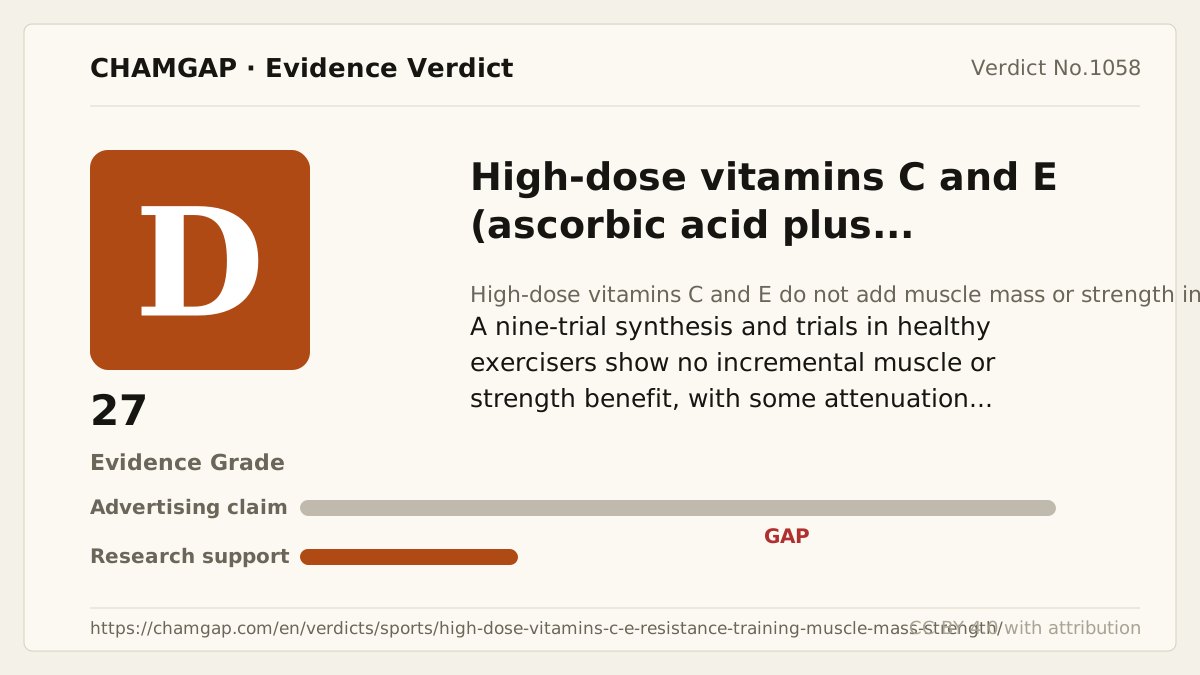
[Chamgap] High-dose vitamins C and E x additional muscle-mass and strength gains in healthy resistance exercisers — Evidence Grade D·27. 5 cited sources checked. Source: https://chamgap.com/en/verdicts/sports/high-dose-vitamins-c-e-resistance-training-muscle-mass-strength/ · CC BY 4.0CC BY 4.0 — free to use with attribution; do not distort grades, numbers, or verdict meaning.
What this document does and does not do
Chamgap is an information source. It reports what research has and has not confirmed; it does not tell readers what to take or buy. That decision belongs to readers and, when needed, medical or legal professionals. This verdict reflects literature available up to the search date and may change as new research appears. Nothing here is medical advice.