
Dileucine,
does it really help with Increased muscle protein synthesis, lower-body strength, and muscular endurance during resistance training?
research showsDileucine receives C because positive human signals exist. In a 10-man acute crossover trial, 2 g dileucine increased three-hour myofibrillar protein synthesis more than an equal dose of leucine. In a 34-man 10-week trial, leg-press one-repetition maximum improved more than placebo and leg-press repetitions to failure improved more than leucine. However, samples were very small, both pivotal studies had commercial ties, the training trial was retrospectively registered and analyzed 34 completers, and many outcomes including upper-body strength and body composition showed no between-group advantage. The proprietary-product and surrogate-endpoint limits give C with 43 points.
ads claimMarketing can turn three-hour MPS and selected leg-press findings into whole-body muscle gain, improvement in every performance domain, and proven superiority over leucine. Current evidence is confined to a specific 2-g ingredient and small samples of young men.
Useful facts when choosing a product
- Dileucine is the L-leucyl-L-leucine dipeptide formed from two leucine molecules, and published clinical trials mainly assessed 2 g daily of a specific proprietary ingredient or closely related formulation.
- Positive findings in the 10-week study concentrated on selected leg-press outcomes, while upper-body strength, body composition, jumping, and several other endpoints showed no additional benefit.
- No major safety issue emerged in short studies of healthy young men, but long-term data and evidence in women, older adults, and people with kidney or liver disease are inadequate.
- The supplement does not replace adequate protein and energy intake, progressive resistance training, or recovery, and real-world products may differ in content and quality.
Chamgap Semantic Classification Code
Candidate index · review held
S.dileucine.UNK.muscle-protein-synthesis-lower-body-strength-and-muscular-endurance-during-resistance-training.reduce.placeboSupplements and nutraceuticals > Dileucine > Unknown > muscle protein synthesis, lower-body strength, and muscular endurance during resistance training > Reduction claim > Placebo
An automated migration candidate, not an issued permanent code; exact claim scope remains under review. This machine-generated migration candidate helps retrieval but is not a permanent assignment. The original verdict ID and URL remain authoritative.
What the research actually shows
Paulussen 2021 crossed 10 healthy young men between 2 g dileucine and 2 g leucine and used muscle biopsies to measure resting MPS. Cumulative MPS increased with dileucine, but the study did not assess long-term postexercise adaptation. Hagele 2024 assigned 34 resistance-trained men to dileucine, leucine, or placebo for 10 weeks. Selected leg-press strength and endurance results favored dileucine, while bench press, body composition, jumping, and multiple other outcomes did not differ between groups. No large independent replication exists.
Why this is classified as C (43)
An acute MPS surrogate was positive in 10 men and a 34-man 10-week trial showed positive signals for selected direct lower-body strength and endurance outcomes. Very small samples, retrospective registration, attrition, numerous null endpoints, commercial and patent interests, and no independent replication invoke the proprietary-product ceiling and give C with 43 points.
Counterpoint. The positive lower-body performance findings justify further study. A sufficiently powered, preregistered independent trial replicating whole-body strength and muscle-mass effects could raise the grade.
Rejudgment record. New verdict — Accepted positive signals from a 10-man acute MPS crossover trial and selected lower-body outcomes in a 34-man resistance-training trial, but applied rules ① and ②-b because of an acute surrogate, small samples, retrospective registration, numerous null outcomes, sponsor and patent interests, and no independent replication
Sub-claim grades by effect
This ingredient is marketed for several effects. A single overall grade blends strong and weak claims together, so each effect is graded separately here. The overall grade reflects the strongest disconfirming or core claim.
| Effect (sub-claim) | Grade | Basis |
|---|---|---|
| Acute stimulation of muscle protein synthesis | C | A biopsy surrogate was positive in a 10-man resting crossover trial, but independent replication is absent. |
| Increased lower-body strength and muscular endurance with resistance training | C | Selected direct performance outcomes were positive in one 34-man sponsored trial, while many outcomes were null. |
| Broad superiority over leucine alone | ? | Independent evidence is absent for broad whole-body or long-term superiority beyond selected lower-body and acute MPS findings. |
Cross-check — AI research and Codex final gate
Evidence Table
| Study | Design | Sample | Funding | Endpoint | Result | Weight |
|---|---|---|---|---|---|---|
| Paulussen KJM et al. 2021 | Randomized double-blind acute crossover trial | 10 healthy young men | Collaborative study involving commercial ingredient and patent interests | Biopsy and isotope-derived myofibrillar protein synthesis over 0 to 180 minutes | Cumulative MPS increased with 2 g dileucine but not 2 g leucine, with a between-condition P value of 0.023. | Positive acute surrogate in a very small sample |
| Hagele AM et al. 2024 | Randomized double-blind placebo- and leucine-controlled 10-week resistance-training trial | 34 male completers from 57 starters | Funded by Ingenious Ingredients with sponsor principals and patent inventors as coauthors | Leg- and bench-press one-repetition maximum and repetitions to failure, body composition, jumping, and other outcomes | Selected leg-press strength and repetition comparisons were positive, while many other outcomes did not differ between groups. | Positive direct performance endpoints in one small high-bias-risk trial |
Receipt — 2 References
All 2 cited sources were verified for existence at the original page (as of 2026-07-20).
Final verification and publication gate: Codex · Evidence date: 2026-07-20 · Corrections: none
Cite this verdict
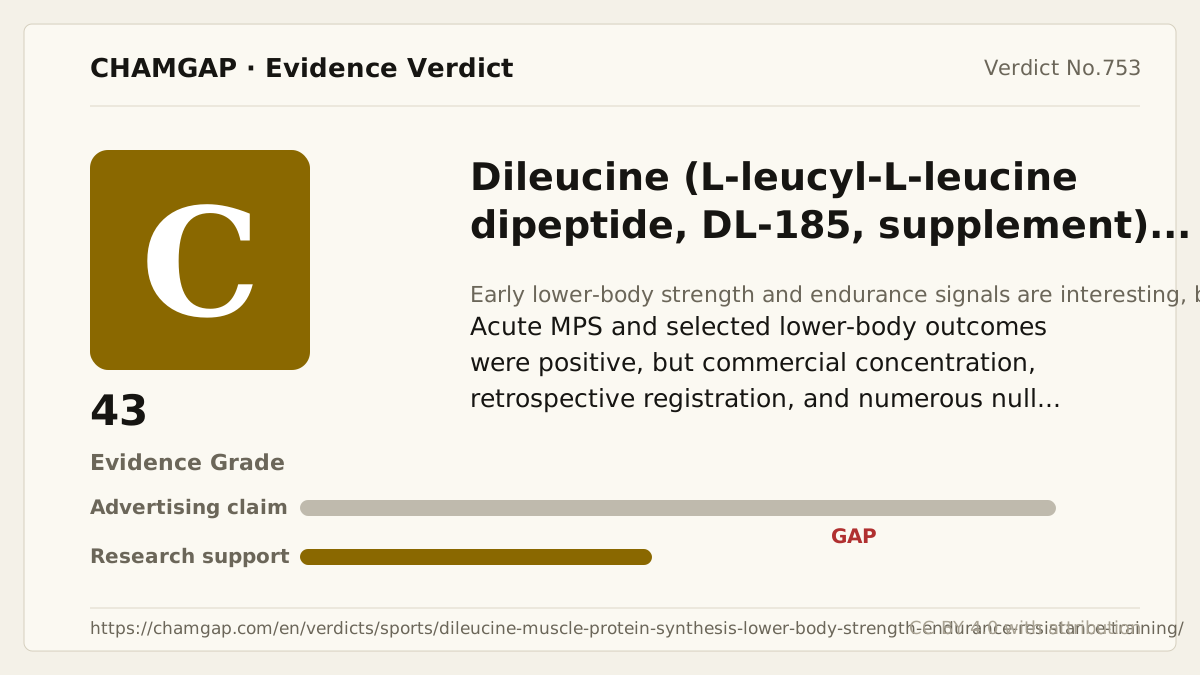
[Chamgap] Dileucine x increased muscle protein synthesis, lower-body strength, and muscular endurance during resistance training — Evidence Grade C·43. 2 cited sources checked. Source: https://chamgap.com/en/verdicts/sports/dileucine-muscle-protein-synthesis-lower-body-strength-endurance-resistance-training/ · CC BY 4.0CC BY 4.0 — free to use with attribution; do not distort grades, numbers, or verdict meaning.
What this document does and does not do
Chamgap is an information source. It reports what research has and has not confirmed; it does not tell readers what to take or buy. That decision belongs to readers and, when needed, medical or legal professionals. This verdict reflects literature available up to the search date and may change as new research appears. Nothing here is medical advice.