
Oral B12 and older-adult mobility: was 12-month TUG benefit demonstrated?
research showsAdjusted 12-month TUG difference −0.13s(95% CI −0.7 to 0.4) did not demonstrate benefit. Serum B12 changes or combination walking scores do not replace this result. The actual cohort is low-B12, nonanemic and aged ≥75, not selected for impaired physical function; TUG is not usual gait speed. The strict original-population estimate and m/s value remain null.
ads claimThis request is a research question; no specific advertising corpus was collected.
Seven original assessment explanations
| Effect direction and size | Adjusted 12-month TUG difference −0.13s(95% CI −0.7 to 0.4) did not demonstrate benefit. Serum B12 changes or combination walking scores do not replace this result. |
|---|---|
| Evidence certainty | This is a secondary functional endpoint from one randomized trial with missingness/reporting limitations. D 28 is a Chamgap rule value, not a success probability, official GRADE rating or verdict on all B12 effects. |
| Applicability | The actual cohort is low-B12, nonanemic and aged ≥75, not selected for impaired physical function; TUG is not usual gait speed. The strict original-population estimate and m/s value remain null. |
| Safety | Safety is Caution. Limited trial event reporting is separate from reused official cobalt-sensitivity and medication/B12-status information. Nonreporting is not a safety guarantee. |
| Verification scope | The 3166-record index,11 native candidates,341 selected prior files and latest 91 FULL evidence were compared. OPEN/B-PROOF mobility gaps were checked against primary text/protocol/PDF by the same model, not an independent external reviewer. |
| Limitations | Original registry history, the strictly impaired population, detailed TUG implementation/row denominators/MCID/exactP/missingness/safety denominators and some additional full texts remain uncertain. Irrelevant search results and source-download failures are logged. |
| Score interpretation | The B/P/R1/I1/E0/B2/C0 profile adopts the original calculator’s D and separately applies the table’s D/zero-strength anchor 28. Existing memory/ALS D 28 or depression C50 is not inherited. Manuscript quality A and safetyCaution are separate. |
Useful facts when choosing a product
- The actual primary intervention is a single-agent oral cyanocobalamin tablet.
- Research exposure is 1 mg/day for 12 months, not a personal recommendation.
- DSM material donation was reported; finished brand and excipients were not.
- Placebo reportedly matched appearance and sensory characteristics.
Chamgap Semantic Classification Code
Permanent code issued
S.cyanocobalamin-e0303.oral-e0303.low-b12-nonanemic-age-ge75.twelve-month-tug-seconds.matching-placebo-usual-careIngredients and nutrients > Crystalline oral cyanocobalamin tablet; brand/excipients unreported > Oral; not pooled with injections, transdermal or sublingual effects > Screened low B12, nonanemic, aged ≥75, MMSE ≥24; no required physical-function impairment > Page:12-month TUG seconds, lower better. Trial primary:posterior tibial CMAP. TUG is secondary in the published protocol > Matching placebo, detailed composition unreported, with usual background care
Original D28, low-B12/nonanemic/aged75+, single oral cyanocobalamin1mg/day12months, secondary TUGseconds, matching placebo,29information states and whole original KOEN/recorded executions preserved without regrading. The code identifies the intervention and claim; it never contains the evidence grade, score, or safety result.
Exact Claim Classification
These independent facets prevent evidence from different forms, routes, populations, effects, and comparators from being mixed.
| Intervention class | S · Supplement or nutraceutical |
|---|---|
| Canonical ingredient or intervention | Vitamin B12; the primary comparison uses single-agent cyanocobalamin |
| Source or part used | Purified B12 material; manufacturing organism/source part unreported |
| Formulation or processing | Crystalline oral cyanocobalamin tablet; brand/excipients unreported |
| Route | Oral; not pooled with injections, transdermal or sublingual effects |
| Dose | Research exposure 1 mg(1000 μg) once daily; not a personal prescription |
| Duration | Planned 12 months, reported mean 389 days; primary page time 12 months |
| Population | Screened low B12, nonanemic, aged ≥75, MMSE ≥24; no required physical-function impairment |
| Effect or condition | Improvement in walking-inclusive mobility in older adults; direct effect in the originally requested impaired subgroup unestablished |
| Primary endpoint | Page:12-month TUG seconds, lower better. Trial primary:posterior tibial CMAP. TUG is secondary in the published protocol |
| Comparator | Matching placebo, detailed composition unreported, with usual background care |
| Duplicate-detection key | cyanocobalamin-single|oral|low-B12-nonanemic-age-ge 75|TUG-seconds|12 months|matching-placebo |
What the research actually shows
# Does vitamin B12 improve walking function in older adults?
## Thirty-second answer
The closest randomized single-agent B12 evidence did not demonstrate a 12-month mobility benefit. In OPEN, low-B12, nonanemic adults aged ≥75 received oral cyanocobalamin 1 mg/day or placebo. The adjusted between-group TUG difference was **−0.13 seconds(95% CI −0.7 to 0.4)**. Negative values mean shorter performance time, but the interval includes benefit and worsening. This is not proof of exact zero or equivalence. [S01]
**Essential boundary:** the original question concerns older adults with impaired physical function. OPEN did not select participants for such impairment. TUG includes rising, walking, turning and sitting; it is not usual straight-line gait speed in m/s. A separate effect in the strictly requested impaired population and a usual-speed estimate were not established. The D/28 below is a current supplied-rule value for this actual low-B12/oral-single-agent/12-month-TUG comparison, not for all older-adult walking or all B12 effects. [S01,S02]
## Separating the question from the verified comparison
The original question asks about effects, differences or risks relating B12 to walking function in older adults with impaired physical function. Proposed oral monotherapy, placebo and usual gait speed were research assumptions, not observed facts. The page selects **one endpoint, TUG time**, and **one time point,12 months**. Selection prioritized an isolatable randomized B12-only contrast, older adults, a published mobility endpoint and the scheduled final assessment. This is an editorial selection, not a prospectively registered analysis, and was not a search for statistical significance. [S01,S02]
The trial-wide primary endpoint was posterior tibial CMAP amplitude. TUG was a secondary functional endpoint in the published protocol. ISRCTN54195799 agrees across the reports, but original registry fields/amendments were inaccessible. CMAP is not substituted for walking, and TUG is not labeled the independently verified sole registered primary. This is the same trial family as memory verdict 3164 but a different endpoint; previous memory, depression and ALS strength grades are not inherited. [S01,S02,S05]
## Actual participants, exposure and comparator
OPEN enrolled community-dwelling adults aged ≥75 in England using screening B12 of 107≤concentration<210 pmol/L, no anemia and MMSE ≥24, with exclusions including dementia, diabetes, selected neurological disorders and pernicious anemia. Completed-paper hemoglobin thresholds were 110 g/L for women and 120 g/L for men. Impaired physical function, sarcopenia or a gait disorder was not a required entry criterion. The median screening-to-baseline interval was 63 days, and the baseline microbiological assay was reported to give approximately 25% higher B12 estimates than the screening assay. Baseline medians 222.9/228.0 pmol/L therefore do not invalidate the low-screening-B12 eligibility description. These common trial facts were reused from existing OPEN extraction. [S01,S02]
The added active ingredient was crystalline cyanocobalamin 1 mg(1000 μg) as an oral tablet once daily for 12 months. Placebo reportedly matched size, shape, color, smell and taste. Mean exposure duration was 389 days; research exposure is not a personal dosing instruction. No randomized folate/B6/D, exercise or protein co-intervention was identified; this is neither proof that every background exposure was absent nor a claim of standardized co-treatment. Equivalence with other molecular forms or sublingual, transdermal, IM or IV administration is not assessed. [S01,S02]
## Measurement and evidence table
The protocol describes timing a participant rising from an armchair, walking 3m, turning, returning and sitting. Units are seconds and lower values are better. The implemented pace instruction, device/chair height, practice/repetition and best-versus-mean selection, aids/footwear, turning direction, timeout and noncompletion handling were not established. Knowing the route does not justify converting total task time to pure walking speed. [S02]
| Evidence and role | Actual exposure/population | Endpoint/time | Reported result and interpretation | |---|---|---|---| | OPEN, principal [S01,S02] | Low-B12, nonanemic,≥75; oral cyanocobalamin 1 mg/day versus placebo | TUG seconds at 12 months | Adjusted B12−placebo −0.13;95% CI −0.7 to 0.4. Benefit not demonstrated; not usual m/s. | | OPEN baseline [S01 Table 2] | Neurological table-header n 99/100 | TUG | Mean 10.4(SD 3.0) versus 10.7(SD 3.5)seconds. | | OPEN follow-up [S01 Table 5] | Table-header n 91/91; TUG model-specific n unreported | TUG 12 months | Mean 10.4±2.6 versus 10.7±3.2 seconds; retain footnote 6’s SE label, not silently relabeled SD. | | OPEN limited adjustment [S01 Table 5] | Same trial, not independent evidence | TUG 12 months | −0.12;95% CI −0.6 to 0.4. Column says Unadjusted, but footnote 2 specifies baseline neurological adjustment. | | B-PROOF, different-regimen positive finding [S03] | ≥65,Hcy 12–50;B12 500 μg+folic acid 400 μg/day;D 600 IU in both arms | Fast 3-m out-and-back ordinal score at 2 years | Placebo odds of a lower category: cumulative OR1.3,95% CI 1.1–1.5. Combination signal, not isolated B12 or a speed ratio. | | B-PROOF overall performance [S03] | Same 2919-person family | Walking/chair/balance sum 0–12 | Difference 0.1,95% CI −0.1 to 0.3. Overall benefit not established; not interchangeable with standard SPPB or usual speed. | | OPEN 2017 [S04] | Existing OPEN intervention-arm 91-person reanalysis | Eleven electrophysiological outcomes | Neither an independent trial nor a new between-group TUG contrast. |
## Denominators, statistics and reporting limitations
The Results section records 209 allocated participants,8excluded allocation errors and 201 valid baseline participants(99/102). Some follow-up outcomes were available for 191; Table 5 headers show 91/91. These are different denominators. Baseline TUG table headers show 99/100, and a separately confirmed paired TUG-model denominator is unavailable. Withdrawals were 2/4; one participant died, and three in the B12 group continued tablets without 12-month measurements. The death’s arm was not inferred. [S01]
The selected published estimate adjusts for baseline neurological function, age and sex; continuous outcomes were bootstrapped because of nonnormality. Exact P, model SE, paired-change SD/SE and covariance were not reported. Equal or different rounded baseline/end means are not individual changes. Table 5 dispersion is not ‘corrected’ to SD to generate a t-test or SMD. Original estimates and this task’s simple arithmetic are preserved separately. IPD-based ANCOVA/bootstrap reanalysis and meta-analysis were not performed, with null outputs/error counts/exit codes and explicit reasons. [S01]
A validated between-group MCID or equivalence margin for this population/test was not established. Within-person thresholds or thresholds from SPPB/other diseases were not imported. Multiplicity rules across secondary outcomes and full SAP/missingness sensitivity analyses were also not established. Nonsignificance is not exact zero, and uncertainty is not absence of human research or F/0. [S01,S02]
## Preserving different and contrary findings
B-PROOF was already available as a trial family in 1340 and 91. This task adds the fast 3-m out-and-back walking component and ordinal analysis. Walking scores 0–4 were based on timed sample quartiles; the lowest two categories were combined for the ordinal model. In the authors’ direction, cumulative OR1.3 means higher odds of being in a lower walking category on placebo. It does not mean 30% faster walking, a mean one-point improvement, a risk ratio or usual m/s. The nonsignificant overall-performance finding and positive component analysis are both preserved. The combination contrast cannot isolate which effect belongs to B12 rather than folic acid; shared vitaminD is not hidden. [S03]
Overall-performance observed counts were 1441/1434 at baseline,1266/1280 at 2 years and 1454/1452 with at least one visit. These do not establish the ordinal-walking model’s unique denominator. Exact walking-model P, its independently specified covariate list and full category thresholds remain limited; the parent trial primary was osteoporotic fractures. Approximately 4% were B12-deficient and entry did not require impaired function, so this was not treatment of confirmed deficiency-related gait disorder. A compliant over 80 subgroup was not invented as a new claim to evade duplication. [S03]
The BLSA gait-speed cohort and Lewerin movement-test study were identified, but required primary text could not be accessed and numerical effects were not filled from them. The Sato stroke-fracture/combination reference was not used for this efficacy judgement. Additional searches repeatedly returned irrelevant results, CAPTCHA or blank pages; an exhaustive systematic review or complete absence of newer studies is not asserted. These limitations do not prevent completion of the bounded current conclusion. [S06–S08; search record]
## Funding, safety and applicability
OPEN combined FSA/Department of Health and public service support with DSM’s donated B12 material. Authors reported no funder role in implementation, data, analysis, interpretation or manuscript preparation. This is mixed support I1, not invented independence. B-PROOF also combined public/academic support with Dutch Dairy Association and Orthica support. [S01,S03]
The separate safety label is **Caution**. OPEN’s one death and statement that no other serious adverse events were reported do not constitute detailed arm-specific safety rates. B-PROOF’s flowchart records 16/26 deaths and 14/13 withdrawals attributed to perceived side effects; discussion flags a cancer-diagnosis imbalance in the parent trial. These are not a comprehensive AE table or proof that isolated B12 causes cancer. Reused official safety records from 89 describe cobalt-sensitivity reactions with cyanocobalamin/hydroxocobalamin and the relationship of acid-suppressing drugs/metformin to B12 status. No medication stopping or switching is instructed. [S01,S03,R89-S05,R89-S06]
This result is not a reason to withhold treatment for severe symptomatic B12 deficiency. Different causes of functional impairment, neuropathy, anemia, malabsorption, molecular forms/routes, combinations and healthy replete states are not treated as interchangeable. Long-term, rare and special-population safety is not established, and unreported events are not observed zero events. This is a bounded research comparison, not personal prescribing advice.
## Seven assessment explanations
### Effect
Adjusted 12-month TUG difference −0.13s(95% CI −0.7 to 0.4) did not demonstrate benefit. Serum B12 changes or combination walking scores do not replace this result.
### Certainty
This is a secondary functional endpoint from one randomized trial with missingness/reporting limitations. D 28 is a Chamgap rule value, not a success probability, official GRADE rating or verdict on all B12 effects.
### Applicability
The actual cohort is low-B12, nonanemic and aged ≥75, not selected for impaired physical function; TUG is not usual gait speed. The strict original-population estimate and m/s value remain null.
### Safety
Safety is Caution. Limited trial event reporting is separate from reused official cobalt-sensitivity and medication/B12-status information. Nonreporting is not a safety guarantee.
### Verification
The 3166-record index,11 native candidates,341 selected prior files and latest 91 FULL evidence were compared. OPEN/B-PROOF mobility gaps were checked against primary text/protocol/PDF by the same model, not an independent external reviewer.
### Limitations
Original registry history, the strictly impaired population, detailed TUG implementation/row denominators/MCID/exactP/missingness/safety denominators and some additional full texts remain uncertain. Irrelevant search results and source-download failures are logged.
### Score interpretation
The B/P/R1/I1/E0/B2/C0 profile adopts the original calculator’s D and separately applies the table’s D/zero-strength anchor 28. Existing memory/ALS D 28 or depression C50 is not inherited. Manuscript quality A and safetyCaution are separate.
## Seven axes and the score
**claim_type** — B: This is a human mobility-efficacy claim, not a biochemical concentration or molecular fact.
**endpoint** — P: Directly measured TUG mobility is a patient-centered functional target under the supplied policy. It need not be self-reported and is not nerve conduction or a hard event.
**replication** — R1: This B12-only/placebo/older-adult/TUG 12-month contrast is represented by one OPEN trial family. Its memory and 2017 reports, B-PROOF combinations and different diseases/routes are not matching independent replications or repeated refutations.
**independence** — I1: Public support coexists with DSM’s in-kind material donation. Unverified cash funding or employee authorship is not invented, and funding is not double-counted as bias.
**effect** — E0: The adjusted −0.13-second contrast has a 95% CI of −0.7 to 0.4, including zero; selected TUG benefit was not demonstrated. The code does not mean exact zero, equivalence or exclusion of meaningful benefit. The positive different-regimen B-PROOF result is retained, not pooled.
**bias** — B2: Under supplied case 44/axis 6, two distinct reporting limitations apply: post-allocation exclusions/available cases without established missing-data handling, and unreported evidence of maintained participant masking. Existing OPEN method extraction is reused; TUG denominators are newly checked. Absence of masking is not asserted; registry inaccessibility is not a third defect, and a 201-person trial is not relabeled sub 200 because a table shows 182.
**precision** — C0: The CI includes negative improvement and positive worsening. With no applicable between-group MCID, meaningful benefit cannot be declared excluded (C1). The CI is known, so this is not CX.
Policy application: E0 routes to D. Neither RX nor C1 applies, so F is not assigned. None of H/R2/I2/E+/C1/B0/big-hard-RCT applies: zero strengths gives the supplied D-row anchor 28. No fabricated dispersion-based E+, arbitrary numeric adjustment or override is used. Actual original-calculator execution and the separate numeric anchor are documented in four receipts.
## Twelve facets
| Facet | Actual value | |---|---| | kind | S | | canonical_entity | Vitamin B12; the primary comparison uses single-agent cyanocobalamin | | source_part | Purified B12 material; manufacturing organism/source part unreported | | formulation | Crystalline oral cyanocobalamin tablet; brand/excipients unreported | | route | Oral; not pooled with injections, transdermal or sublingual effects | | dose | Research exposure 1 mg(1000 μg) once daily; not a personal prescription | | duration | Planned 12 months, reported mean 389 days; primary page time 12 months | | population | Screened low B12, nonanemic, aged ≥75, MMSE ≥24; no required physical-function impairment | | claim | Improvement in walking-inclusive mobility in older adults; direct effect in the originally requested impaired subgroup unestablished | | primary_endpoint | Page:12-month TUG seconds, lower better. Trial primary:posterior tibial CMAP. TUG is secondary in the published protocol | | comparator | Matching placebo, detailed composition unreported, with usual background care | | duplicate_key | cyanocobalamin-single / oral / low-B12-nonanemic-age-ge 75 / TUG-seconds / 12 months / matching-placebo |
## All unresolved information states
### strict_question_population_effect · not_reported
No isolated B12 walking estimate was established for older adults selected for impaired physical function. OPEN did not require such impairment; its cohort estimate is not relabeled as an impaired-subgroup estimate. [S01,S02]
### usual_gait_speed_mps · not_reported
The selected trial reports TUG seconds. Rising, turning and sitting are included, so this is neither usual straight-line gait speed in m/s nor 6 divided by TUG time. [S01,S02]
### TUG_pace_instruction · not_reported
The implemented OPEN instruction for usual, comfortable or maximal pace was not established. Standard practice for the test is not substituted for trial-specific reporting. [S01,S02]
### TUG_equipment_repeats_aids · not_reported
An armchair and a 3-m out-and-back route were verified; chair height, timing-device model, separate acceleration zone, footwear, aids, practice/repeats, best-versus-mean selection and turning direction were not reported. [S02]
### TUG_validity_limits · not_reported
Trial-specific timeout, noncompletion handling, valid measurement range and TUG test–retest reliability were not reported. The nerve-conduction correlation of 0.82 is not TUG reliability. [S01,S02]
### original_registry_history · inaccessible
The identifier agrees across paper and published protocol, but original registry fields and amendments were inaccessible. Published secondary-outcome status is distinct from direct original-registry verification. [S01,S02,S05]
### row_specific_model_denominator · not_reported
Table 5 headers show 91 per arm. A separate TUG-row complete-case count and covariate-missing denominator are not given; 182 is not the original randomized denominator or an independently confirmed model-complete-case count. [S01]
### exact_P_model_SE · not_reported
Exact P and model SE for the selected adjusted TUG contrast were not reported. No normal-approximation P was fabricated from a bootstrap CI. [S01]
### paired_change · not_reported
Paired TUG changes, change SD/SE and baseline–follow-up covariance were not reported. Differences of rounded means with different denominators are not paired changes. [S01]
### dispersion_independent_confirmation · not_reported
The 12-month TUG ±2.6/±3.2 values are preserved under Table 5 footnote 6, which labels such values SE. There is no separate row-specific confirmation; they are not silently changed to SD or used to invent a standardized effect. [S01]
### MCID_equivalence_margin · not_reported
No validated TUG between-group MCID/equivalence margin applicable to this low-B12 older cohort was established. Within-person, SPPB or other-disease thresholds are not transferred. [S01,S02]
### IPD_SAP_missingness · inaccessible
IPD, a complete SAP and imputation/sensitivity analyses were not obtained. The authors’ ITT label is presented alongside the available table denominators. [S01,S02]
### multiplicity · not_reported
Multiplicity-adjustment rules across the several neurological/cognitive secondary outcomes were not established. Nonreporting is not proof that no adjustment was performed. [S01,S02]
### masking_maintenance · not_reported
Matching tablets and masked staff were reported, but participant allocation-guess or masking-maintenance results were not. This does not assert that blinding was absent. [S01]
### product_source_excipients · not_reported
DSM material donation and cyanocobalamin were verified. Finished brand, batch, excipients, detailed placebo composition and manufacturing organism/source were not reported. [S01]
### diet_and_all_background_treatment · not_reported
Usual diet and prescription information were collected, but quantitative total dietary B12 and all co-medication, exercise and protein exposures were not established. No controlled exercise/protein/vitamin-D co-intervention is invented. [S01,S02]
### diagnosed_sarcopenia_or_neuropathy_subgroup · not_reported
There is no separate estimate for diagnosed sarcopenia or gait-limiting neuropathy. Low serum B12 is not equivalent to either diagnosis. [S01]
### malabsorption_etiology · not_reported
Some disorders including pernicious anemia were excluded, but malabsorption etiology/testing in every participant was not reported. Oral results do not establish equivalence to injection. [S01,S02]
### AE_detailed_denominators · not_reported
One death and a statement that no other serious adverse events were reported are available; death allocation/causality and arm-specific denominators for nonserious events were not established. Nonreporting is not demonstrated safety. [S01]
### long_term_special_population_safety · not_searched
Direct efficacy/safety beyond 12 months and in pregnancy, children or severe hepatic/renal disease were not separately researched for this walking question. Safety is not asserted for those populations. [S01]
### assay_interference · not_reported
Assay-interference outcomes were not reported. Differences between screening and baseline B12 assays do not demonstrate absence of interference. [S01]
### BPROOF_molecular_form · not_reported
B12 molecular form was not established in the walking report or reused extraction. It is not assumed to be single-agent cyanocobalamin. [S03]
### BPROOF_ordinal_details · not_reported
A unique ordinal-walking model denominator, exact P, all category cutpoints/distributions and a separately specified full adjustment list were not established. Overall performance denominators are not substituted for walking-model denominators. [S03]
### BPROOF_pure_B12_and_usual_speed · not_applicable
The B-PROOF combination ordinal OR is not isolated B12 efficacy, a speed ratio, 30% faster walking, a mean one-point gain or usual m/s. [S03]
### additional_leads_access · inaccessible
BLSA full text, the primary Lewerin report and some bibliographic/search routes failed. No between-group efficacy numbers were filled from these leads and an exhaustive systematic review is not claimed. [S06,S07]
### notice_completeness · inaccessible
No new correction/retraction notice was identified on accessible principal reports, but PubMed and some searches returned blank or irrelevant results. Complete Crossmark/registry/retraction clearance is not claimed. The Sato reference is not used as efficacy evidence. [S01,S03,S08]
### what_ads · not_searched
This request is a research question; no specific advertising corpus was collected.
### protocol_hemoglobin_units · conflicting
The 2011 protocol prints hemoglobin cutoffs of 11/12 g/L, whereas the completed 2015 paper reports 110/120 g/L. Neither source is edited; actual eligibility uses the completed paper, and the existing R01-089 discrepancy record is reused. [S01,S02]
### new_permanent_identity · not_applicable
This is an original handoff. New ID, site_id, slug, URL, semantic code and first publication are unassigned nulls; the task number is not a site identifier.
## Completion, display and revision status
This new independent mobility claim is completed_with_uncertainty, with manuscript quality A, editorial ready_with_uncertainty and publication needs_id_assignment. Review is by the same model, not independent external review or journal certification. Initial corrections=[] is distinct from the pre-submission audit. clinical_todo=[]; no clinical re-search, regrading or statistics/calculator rerun is delegated. The existing Vitamin B12 hub is reused, not a page per tag. ID/slug/URL/semantic code/first publication remain unassigned nulls. All 341 selected prior originals and 370 input members are preserved bytewise; no previous whole ZIP is presumed supplied.
English display body paths are en.what_research and en.body_markdown, exactly equal to the complete publication.en.md. All seven explanations, seven axes, twelve facets and unresolved reasons appear inside the body even when auxiliary fields are not rendered. Korean paths analogously match publication.ko.md. Clinical work is complete here; no next task is started.
## Source guide
- [S01] Dangour AD et al. Effects of vitamin B-12 supplementation on neurologic and cognitive function in older people: a randomized controlled trial. Am J Clin Nutr. 2015;102:639–647. https://pmc.ncbi.nlm.nih.gov/articles/PMC4548176/ — primary_fulltext_HTML_tables. - [S02] Dangour AD et al. OPEN study protocol. Nutrition Journal. 2011;10:22. https://link.springer.com/article/10.1186/1475-2891-10-22 — primary_published_protocol_fulltext_HTML. - [S03] Swart KMA et al. A Randomized Controlled Trial to Examine the Effect of 2-Year Vitamin B12 and Folic Acid Supplementation on Physical Performance, Strength, and Falling: Additional Findings from the B-PROOF Study. Calcif Tissue Int. 2016;98:18–27; online 2015. https://link.springer.com/article/10.1007/s00223-015-0059-5 — primary_fulltext_HTML_and_PDF_visual_pages. - [S04] Miles LM et al. Impact of baseline vitamin B12 status on the effect of vitamin B12 supplementation on neurologic function in older people: secondary analysis of data from the OPEN randomised controlled trial. Eur J Clin Nutr. 2017;71:1166–1172. https://link.springer.com/article/10.1038/ejcn.2017.7 — primary_abstract_and_funding_only_subscription_fulltext_unavailable. - [S05] OPEN trial registration ISRCTN54195799 https://www.isrctn.com/ISRCTN54195799 — inaccessible_holding_page. - [S06] Vidoni et al. Vitamin B12 and Homocysteine Associations with Gait Speed in Older Adults: The Baltimore Longitudinal Study of Aging. https://pmc.ncbi.nlm.nih.gov/articles/PMC5726303/ — bibliographic_discovery_only_fulltext_inaccessible. - [S07] Lewerin C et al. Significant correlations of plasma homocysteine and serum methylmalonic acid with movement and cognitive performance in elderly subjects but no improvement from short-term vitamin therapy: a placebo-controlled randomized study. Am J Clin Nutr. 2005;81:1155–1162. https://link.springer.com/article/10.1007/s00223-015-0059-5 — S03_reference_19_and_discussion_only_primary_not_obtained. - [S08] Sato Y et al. Effect of folate and mecobalamin on hip fractures in patients with stroke. JAMA. 2005;293:1082–1088. https://link.springer.com/article/10.1007/s00223-015-0059-5 — S03_reference_20_only_not_used_as_evidence. - [R89-S05] MHRA. Vitamin B12 (hydroxocobalamin, cyanocobalamin): known cobalt allergy and sensitivity reactions. 18 December 2023. https://www.gov.uk/drug-safety-update/vitamin-b12-hydroxocobalamin-cyanocobalamin-advise-patients-with-known-cobalt-allergy-to-be-vigilant-for-sensitivity-reactions — official_safety_HTML. - [R89-S06] NIH ODS. Vitamin B12 Health Professional Fact Sheet. https://ods.od.nih.gov/factsheets/Vitamin B12-HealthProfessional/ — official_nutrition_safety_HTML.
Why this is classified as D (28)
The B/P/R1/I1/E0/B2/C0 profile adopts the original calculator’s D and separately applies the table’s D/zero-strength anchor 28. Existing memory/ALS D 28 or depression C50 is not inherited. Manuscript quality A and safetyCaution are separate.
Counterpoint. Original registry history, the strictly impaired population, detailed TUG implementation/row denominators/MCID/exactP/missingness/safety denominators and some additional full texts remain uncertain. Irrelevant search results and source-download failures are logged.
Rejudgment record. Rule/adoption agreement, not consensus of independent reviewers — The B/P/R1/I1/E0/B2/C0 profile adopts the original calculator’s D and separately applies the table’s D/zero-strength anchor 28. Existing memory/ALS D 28 or depression C50 is not inherited. Manuscript quality A and safetyCaution are separate.
| Claim type | B | B: This is a human mobility-efficacy claim, not a biochemical concentration or molecular fact. |
| Endpoint | P | P: Directly measured TUG mobility is a patient-centered functional target under the supplied policy. It need not be self-reported and is not nerve conduction or a hard event. |
| Replication | R1 | R1: This B12-only/placebo/older-adult/TUG 12-month contrast is represented by one OPEN trial family. Its memory and 2017 reports, B-PROOF combinations and different diseases/routes are not matching independent replications or repeated refutations. |
| Independence | I1 | I1: Public support coexists with DSM’s in-kind material donation. Unverified cash funding or employee authorship is not invented, and funding is not double-counted as bias. |
| Effect size | E0 | E0: The adjusted −0.13-second contrast has a 95% CI of −0.7 to 0.4, including zero; selected TUG benefit was not demonstrated. The code does not mean exact zero, equivalence or exclusion of meaningful benefit. The positive different-regimen B-PROOF result is retained, not pooled. |
| Precision | C0 | C0: The CI includes negative improvement and positive worsening. With no applicable between-group MCID, meaningful benefit cannot be declared excluded (C1). The CI is known, so this is not CX. |
| Risk of bias | B2 | B2: Under supplied case 44/axis 6, two distinct reporting limitations apply: post-allocation exclusions/available cases without established missing-data handling, and unreported evidence of maintained participant masking. Existing OPEN method extraction is reused; TUG denominators are newly checked. Absence of masking is not asserted; registry inaccessibility is not a third defect, and a 201-person trial is not relabeled sub 200 because a table shows 182. |
Stored derived and displayed grades match; this is not a current recalculation or validity check (D).
Different evidence scope · main grade not applied
| B-PROOF fast ordinal walking | Separate grade null · main grade not applied | Different combination/test/duration, not pooled into the single main judgement. |
Review performed and remaining limitations
Original registry history, the strictly impaired population, detailed TUG implementation/row denominators/MCID/exactP/missingness/safety denominators and some additional full texts remain uncertain. Irrelevant search results and source-download failures are logged.
Evidence Table
| Evidence and role | Actual exposure/population | Endpoint/time | Reported result and interpretation | |---|---|---|---| | OPEN, principal [S01,S02] | Low-B12, nonanemic,≥75; oral cyanocobalamin 1 mg/day versus placebo | TUG seconds at 12 months | Adjusted B12−placebo −0.13;95% CI −0.7 to 0.4. Benefit not demonstrated; not usual m/s. | | OPEN baseline [S01 Table 2] | Neurological table-header n 99/100 | TUG | Mean 10.4(SD 3.0) versus 10.7(SD 3.5)seconds. | | OPEN follow-up [S01 Table 5] | Table-header n 91/91; TUG model-specific n unreported | TUG 12 months | Mean 10.4±2.6 versus 10.7±3.2 seconds; retain footnote 6’s SE label, not silently relabeled SD. | | OPEN limited adjustment [S01 Table 5] | Same trial, not independent evidence | TUG 12 months | −0.12;95% CI −0.6 to 0.4. Column says Unadjusted, but footnote 2 specifies baseline neurological adjustment. | | B-PROOF, different-regimen positive finding [S03] | ≥65,Hcy 12–50;B12 500 μg+folic acid 400 μg/day;D 600 IU in both arms | Fast 3-m out-and-back ordinal score at 2 years | Placebo odds of a lower category: cumulative OR1.3,95% CI 1.1–1.5. Combination signal, not isolated B12 or a speed ratio. | | B-PROOF overall performance [S03] | Same 2919-person family | Walking/chair/balance sum 0–12 | Difference 0.1,95% CI −0.1 to 0.3. Overall benefit not established; not interchangeable with standard SPPB or usual speed. | | OPEN 2017 [S04] | Existing OPEN intervention-arm 91-person reanalysis | Eleven electrophysiological outcomes | Neither an independent trial nor a new between-group TUG contrast. |
Receipt — 10 References
Evidence access cutoff: 2026-09-18. Each citation states its actual access level (full-text transcription, abstract, index, or other) and remaining limitations. Bibliographic checking does not certify the study results or treatment efficacy.
Technical integration by: Codex · Evidence date: 2026-09-18 · Corrections: none
Cite this verdict
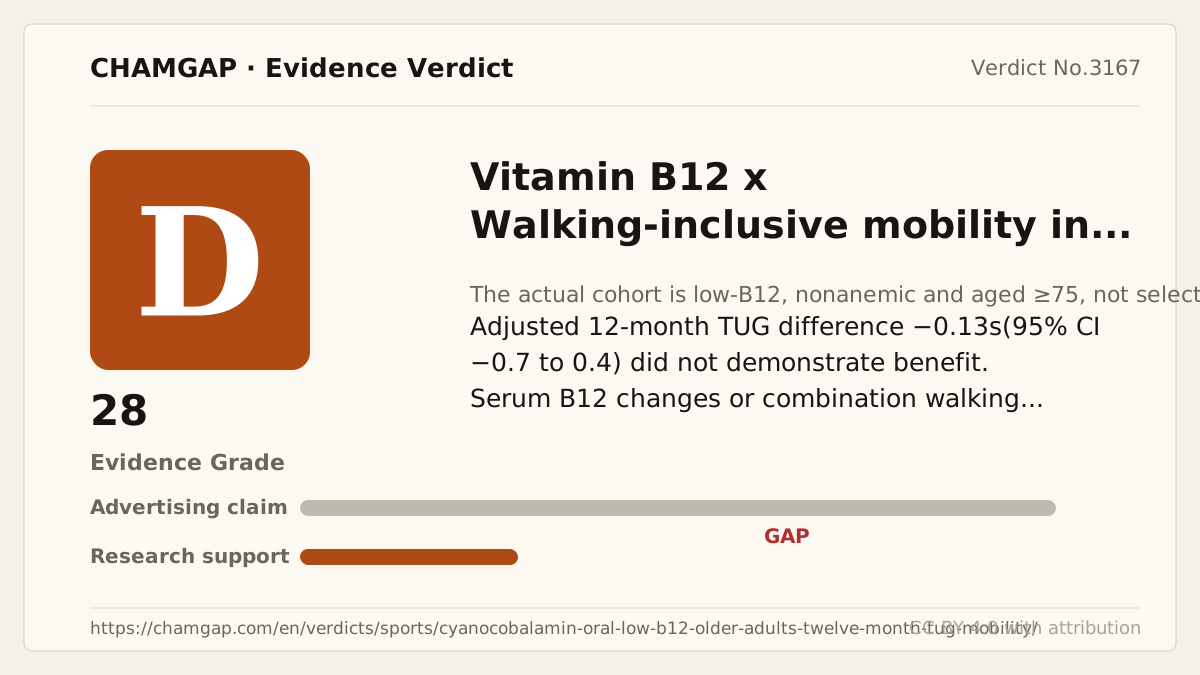
[Chamgap] Oral B12 and older-adult mobility: was 12-month TUG benefit demonstrated? — Evidence Grade D·28. 10 cited sources checked. Source: https://chamgap.com/en/verdicts/sports/cyanocobalamin-oral-low-b12-older-adults-twelve-month-tug-mobility/ · CC BY 4.0CC BY 4.0 — free to use with attribution; do not distort grades, numbers, or verdict meaning.
What this document does and does not do
Chamgap is an information source. It reports what research has and has not confirmed; it does not tell readers what to take or buy. That decision belongs to readers and, when needed, medical or legal professionals. This verdict reflects literature available up to the search date and may change as new research appears. Nothing here is medical advice.